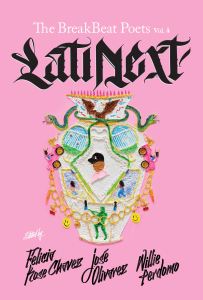
Just a quick post to share the release of the latest BreakBeat Poets anthology, The BreakBeat Poets Vol. 4: LatiNext edited by Felicia Chavez, José Olivarez, and Willie Perdomo and published by Haymarket Books. Super-excited to share news of this release – in part because my own poem “La Llorona Watches the Movie Troy” is featured in its pages alongside the work of a phenomenal community of poets including Sara Borjas, Javier Zamora, Denice Frohman, Peggy Robles Alvarado, John Murillo, Janel Pineda, Juan J. Morales, Benjamin Garcia, Jasminne Mendez, Elizabeth Acevedo, and Yesenia Montilla among so many stellar writers.
I’m also excited and grateful to the editors for creating a space representative and celebratory of Latinx poetry in its multitudes. In these pages are the stories and aesthetics of “an array of nationalities, genders, sexualities, races, and writing styles, staking a claim to our cultural and civic space.” I am proud to be a part of this event and look forward to the anthology’s success and impact.
In the spirit of celebration, I am sharing mine own contribution, “La Llorona Watches the Movie Troy” below. I spoke with a friend recently about what this specific poem being included means to me. This poem was one of the last ones revised in time to make it into my second full length collection, Small Fires (FutureCycle Press). So close it was to the then deadline that I never got a chance to send it out. One of four poems about La Llorona in that book, this poem had me exploring what it would be like to have her speak. The first draft was written the summer of 2004 when I lived in a house without electricity in Corpus Christi. Because it was summer in South Texas, I tried to stay out at the dollar movies for as long as I could. I ended up watching a lot movies on repeat, in particular Troy and Spiderman 2 (my book Everything We Think We Hear has the piece born from watching Spidey a bunch).
The first draft was very much heavy-handed and primarily focused as a statement against George W. Bush’s presidency and invasion of Iraq. That draft lived dated and lost for a good number of years. When it came time to work on Small Fires and its tetralogy of Llorona poems, this one came back to mind as being in conversation with that book’s statements of identity and conflicted nationalities. Letting La Llorona speak and harangue America via the actors of the movie still feels right. That the editors of this anthology saw fit to include this poem in an anthology full of similar conversations also feels right.
*
José Angel Araguz
La Llorona Watches the movie ‘Troy’
She watches Brad Pitt leap, then land a stab
like a hammer blow down, spends time taking in
the bronze skin of the actors, the way the say ‘grass’
like ‘toss,’ ¡Todo British! She snags popcorn
by the handful watching the gods
be shrugged off by warriors. During the scene
where the Greeks scurry from the Trojan horse,
their shadows fingers pulling at string
and unraveling the night, her breath is sand
and crackling flame. When they run towards fire
in the desert, towards collapsing roofs
and digitized screaming, the montage
of faces, of bodies pushing against each other
has her whispering to no one in particular:
¡Mira Baghdad, mira Juarez! And no one
in particular hears her over the Dolby
of swords being unsheathed. She begins to hum,
letting her voice hit the same notes
as the opera singer overlaid during the carnage.
Should anyone look over, they’d see
the silhouette of a woman in the third row
treating the forty-foot screen like an altar.
When, after seeing the toppling of statues
and the scavenging through offerings
to Apollo, sun god, the one who sees everything,
the aged and fallen king staggers in defeat
and cries out: Have you no honor!
Have you no honor!, she gasps and nods,
as if watching a telenovela unfold
according to how she would want it. Truth is,
she has seen this all before, has drowned
the brown bodies, has plucked gold coins
from river water before any boatman
could make his way to her. She knows
the blonde and blue-eyed have arrived
to play both hero and love interest again,
that though Helen here is a vagabond Marilyn,
she used to have un poquito de chile
in her blood, y un puñado de lodo
in her heart. That’s why it’s a woman
who says: If killing is your only talent,
then it is your curse, and says it
like one slapping their hand against the river,
a sting in their hands for a while. Truth is,
there will always be a Brad to leap, and hit hard,
the thud through the speakers like a heartbeat.
*
Copies of The BreakBeat Poets Vol. 4: LatiNext can be purchased from Haymarket Books.
 In my recent
  The Influence