* knocking around with kenyon & meyers

The Suitor – Jane Kenyon

We lie back to back. Curtains
lift and fall,
like the chest of someone sleeping.
Wind moves the leaves of the box elder;
they show all their light undersides,
turning all at once
like a school of fish.
Suddenly I understand that I am happy.
For months this feeling
has been coming closer, stopping
for short visits, like a timid suitor.

*
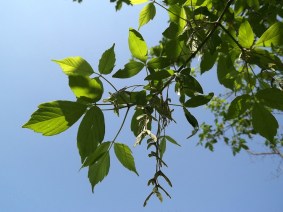
box elderIn the poem above, I’m moved by the way things knock into each other in the scene described, and how that knocking mirrors how the poem is working structurally. The lyric momentum here swings between the three “likes” in the poem. Each one is a simile of life: a person sleeping, a school of fish, a timid suitor.

The specificity of each, however, is what makes their presence move beyond image and metaphor. The whole poem moves through them: the suggested breath of “someone sleeping”knocks into the next line about the wind; the fish “turning all at once” turn in such a way that they knock like the mind of the speaker’s sudden understanding; and then the ending pushes things into a further understanding of silence and resilience.

This short lyric brought to mind this haiku by Bert Meyers:

I can only laugh
when my daughter spreads her arms
to catch the cold wind

Both poems, for me, reflect a bit of what this time of year feels like. May is like a hinge between spring and summer, and you can hear the seasons’ doors creaking on the leaves.

Happy creaking!

José

* layers via michael s. harper & basho


Village Blues – Michael S. Harper

The birds flit
in the blue palms,
the can workers wait,
the man hangs
twenty feet above;
he must come down;
they wait for the priest.
The flies ride on the carcass,
which sways like a cork in a circle.
The easter light pulls hims west.
The priest comes, a man
sunken with rum,
his face sandpapered
into a rough of split
and broken capillaries.
His duty is cutting
down the fruit
of this quiet village
and he staggers slowly, coming.

12th_century_Greek_Warrior_Fustanella

Sgraffito, I learned recently, is a technique used in both wall decor and ceramics in which contrasting colors are layered across a surface, only to be then scratched into so as to reveal parts of the underlying layer. The result is an image made of a specific depth and texture.

This week’s poem – “Village Blues” by Michael S. Harper – performs via language in a way similar to sgraffito. Harper writes of a hanged man’s body by choosing to write about the life going on around it. In describing the birds, workers, even the flies at the scene, Harper layers the daily lives of the village over the dead body, and thus makes the presence of the lost life all the more felt. The description of the priest, too, as he “staggers slowly, coming” to the body, becomes imbued with the unspoken. Through indirect association, everything in the village “sways” along to the village’s “blues.”

These thoughts also bring to mind the following haiku by Basho, where the layered images give way to something deeper:

On the white poppy,
a butterfly’s torn wing
is a keepsake

*

Happy winging!

José