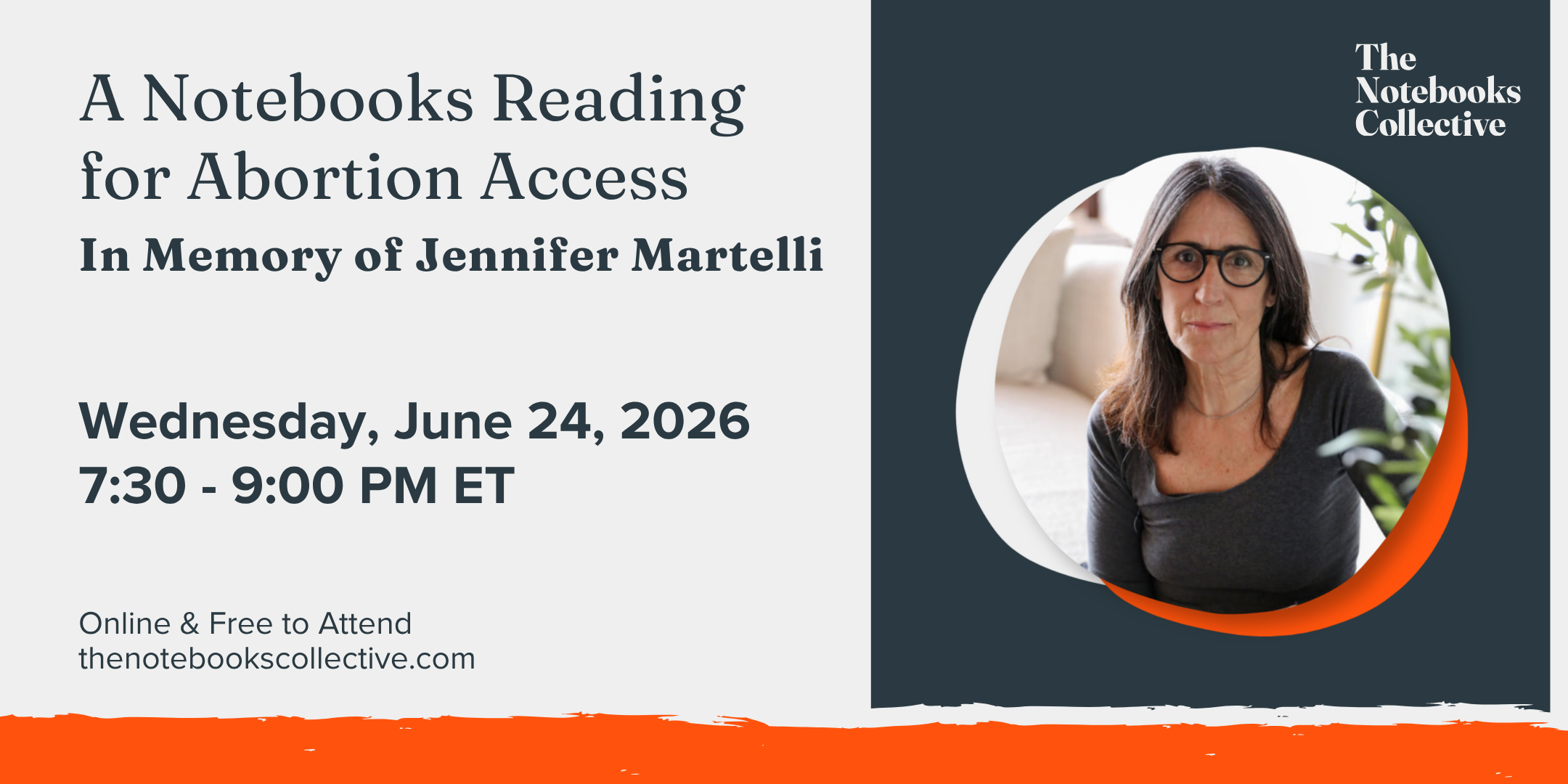
In preparation for tomorrow’s Notebooks Collective reading, I’ve been spending time with Jennifer Martelli’s work, specifically “Dear_________,”. Read on for some thoughts on this poem.
Content note: This post discusses a poem containing references to abortion, bodily distress, and patriarchal violence.
“Dear_________,” by Jennifer Martelli
*
Today, to ease my anxiety, I thought of the scariest scene in The Shining—
remember we saw it at the movies our last spring together, just after my abortion,
and the hostage crisis only six months old. It wasn’t the sister ghosts or
the ghost in the green bathtub. It was the opening scene. It was the vastness
of America and those mountains as the little Volkswagen crossed the divide
into a place so big, so deep, only a helicopter or bald bird of prey
could follow the road and understand what kind of country this was.
And then, at the movie’s very end, that old photograph hanging on the wall
of the haunted hotel: Jack Nicholson in the foreground, July 4, 1921. His eyes
the eyes of a raptor. He’d always been there, celebrating America’s birthday.
I see you in many men: angry men, bloated, omnipresent, powerful, afraid
of their own impossible hungers. I was so hungry after not eating for six weeks.
Do you remember the Fatted Calf down the street from the clinic? That rare burger
in the plastic basket filled with thick fries? Finally, I could keep something down.
originally published in Action, Spectacle
Jennifer Martelli’s “Dear_________,” begins with a paradox: “Today, to ease my anxiety, I thought of the scariest scene in The Shining—” The speaker then takes us into the opening sequence, in which a small Volkswagen travels through a mountain landscape while the camera follows from high above. What frightens the speaker is the scale of the view: “the vastness / of America,” the mountains, the road crossing into a place so immense that “only a helicopter or bald bird of prey” could follow it and comprehend “what kind of country this was.”
That gaze reappears at the end of The Shining, in the old photograph hanging in the haunted hotel. Jack Nicholson’s character stands in the foreground at a July Fourth celebration in 1921, though the film has taken place decades later. “He’d always been there,” Martelli writes, “celebrating America’s birthday.”
This move underscores the horror of realizing that the film’s violent man is part of the hotel’s past and, additionally troubling, how he may never have been separate from that past. Patriarchal violence is not an interruption of the national story. It is already inside the photograph, the celebration, and the country’s account of itself.
From there, the poem turns toward its unnamed recipient: “I see you in many men.” The blank in the title permits the addressee to remain particular while also becoming representative. One man proliferates into “angry men, bloated, omnipresent, powerful,” men frightened by “their own impossible hungers.”
That word, hungers, carries the poem into its final intimate turn, when the speaker remembers the Fatted Calf restaurant down the street. After six weeks of being unable to eat, she orders a rare burger and thick fries. “Finally,” the poem ends, “I could keep something down.”
The difference between the men’s hunger and the speaker’s hunger is crucial. Their “impossible hungers” appear boundless: appetites for power, control, possession, and permanence. The speaker’s hunger is physical and finite. Her body needs food. The ability to receive it, to eat and keep it down, is ordinary, but the poem makes that ordinariness profound.
The poem’s movement is almost cinematic in reverse. It begins with a camera hovering above an enormous country, then moves into a hotel, an old photograph, a man’s predatory eyes, a clinic, and finally a basket of food. Its field of vision continually narrows. Against the fantasy of the omnipresent man who has “always been there,” the poem offers the specificity of a body returning to itself.
This is part of what makes “Dear_________,” especially resonant for a reading supporting abortion access. The poem does not reduce abortion to an abstract argument, but neither does it pretend that bodily experience exists outside politics. The private memory and the national history cannot be cleanly separated. The country enters the body through anxiety, illness, appetite, danger, and relief.
Martelli leaves us with difficult questions about hunger. Whose appetites are treated as limitless? Whose body is made into contested territory? What does it mean for a country to be split between vulnerability and violence? And what might it mean, after all that vastness and predation, for the last word to belong to a person who can finally eat and move forward?
You can learn more about the reading here:
https://thenotebookscollective.com/event/a-notebooks-reading-for-abortion-access/


 The Influence