Last week, I visited my hometown of Corpus Christi, Texas. It was a short trip, long enough to get in good talk and hugs with family as well as plenty of good taqueria food and BBQ. It was also the first chance I’ve gotten to show Ani around the city I grew up in. Unsurprisingly, we kept finding ourselves down along Ocean Drive, watching the water move. Going back this time, I realized how, in some ways, fascination is almost a reflex. If I have a natural measure, it’s in sync to the waters of Corpus Christi Bay.
This week’s poem – “A Boy’s Room” by John Philip Drury – deals with a similar spirit of fascination. The poem details a son’s fascination with insects as experienced by the father. In an email, Drury shared the following story:
I’m pleased that you’ve singled out “A Boy’s Room,” one of several poems in the book about my son Eric. It began with his early fascination with insects and scorpions. Whenever we went to the zoo, he wanted to visit the Insect House, but he was too little to peer into the glass enclosures (such as the big box full of leaf-cutter ants), so I had to carry him, and he hadn’t yet learned to read, so I had to recite the labels identifying every single bug in the whole place. And that happened on every trip we made. Man, I miss those days!
Reading the poem, I’m moved most by the connection between father and son via language. That the father is aware of both the words that fascinate and the words the son “hates.” The tension moves from the careful “fashioning” of insects paralleled with the fashioning of the poem in the first stanza, then into the second stanza’s violent undertones. The people in the house are seen as restless as the insects the son is fascinated with.
What I love about the above story is the image of John carrying his son, much as the house at the end of the poem is “carried” off.
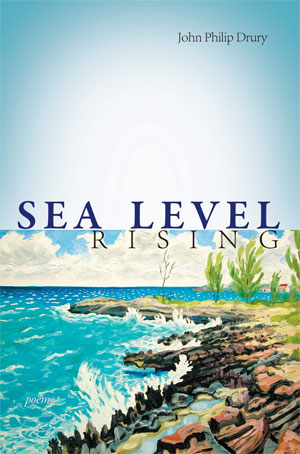
* john’s new book! *
A Boy’s Room – John Philip Drury
With tiny wads of Play-Doh, he has fashioned
scorpions, Io moths, red velvet mites,
water spiders emerging from thick air sacs,
Japanese beetles perched upon white petals.
He places them in his secret gallery –
a Danish Modern liquor cabinet –
to let them dry. He loves assassin bugs
and Congo chafers. He listens for the sound
of hissing cockroaches and tinfoil beetles
clicking against their luminous green shells.
He hates the words “explode” and “blow” and “burst.”
He knows we have a nest of paper wasps
in the kitchen’s ventilator. He knows
we find it odd that people find it odd.
He knows that when we quarrel, the house walls hum
like glassed-in hives of honey bees at the zoo.
He hopes and fears that when the wings beat loudest,
the house will lift above the tall catalpas
and he’ll look down at miniature explosions:
fireflies rising from a darkened crater.
***
Happy rising!
Jose

 The Influence