Once upon a time, I was a young poet reading through an anthology of Latin American poetry when I came across a poem by João Cabral de Melo Neto that just blew me away. I wrote the poem down in a notebook – it was in Spanish, translated from the original Portuguese – to translate into English later, which I did, happy to be in conversation with the poem.
The thing is when I discovered this poem years ago, I had it in my head that it was made up of only one part, and so for me, the poem was only one section long. And this one section is lovely. See for yourself:
Weaving the Morning – João Cabral de Melo Neto*
translated into English by José Angel Araguz
1
One rooster alone does not weave the morning:
he will always be working with other roosters.
One to pick up the cry that he
and throw it to another; another rooster
to pick up the cry of the previous rooster
and throw it to another; and other roosters
with many other roosters crossing
the sun-threads of their rooster cries,
so that the morning, made of a soft fabric,
goes on being woven among all roosters.

* gallo remembered *
Later, I rediscovered the poem and learned that the poet had written it with two sections, not just one. And what’s worse, that second, new (to me) section was kinda clunky (again, to me). Again, see for yourself:
2
And taking shape in this fabric, gathered,
stored and waiting where everyone will enter,
entertaining itself in the awning
(morning) sets down its frameless plans.
Morning, a canopy woven of such airy material
it rises by itself: a globe of light.
So there I was, mistaken and shaken. Was the poem I ran into in the anthology misprinted? Or had it been printed at the bottom of a page, and had younger me – floored and amazed by that first section – not turned the page when I copied it down? What else but poetry can have us slipping past ourselves like this?
There were also the questions of translation: Was the poem in its entirety a finer product in the original Portuguese? Should I consult other Spanish translations? What is a translation but a reaching into the material of memory, other’s and one’s own?
Now, my goal in sharing this story – well, not really story, more snapshots of poetic fumbling – is not to make a case against the second section, but to share the poem (it’s charm can withstand my fumbling). I also wanted to engage a bit with ideas of memory and enchantment (charm, enchantment: très magique) and how both work in specific ways in poetry. The way the roosters build off each other’s cries is much like the way one poem is answered by another, and how one memory is blurred and built upon by another. One reads and writes, in order to read and write some more.
In a recent postcard exchange with Edward Vidaurre, I held onto my earlier enchantment as I wrote the first section of the poem out. I figured, hey, the first section’s the best part and there’s only so much room on a postcard for a poem plus my own meandering explanation at how I failed to remember the second section initially.
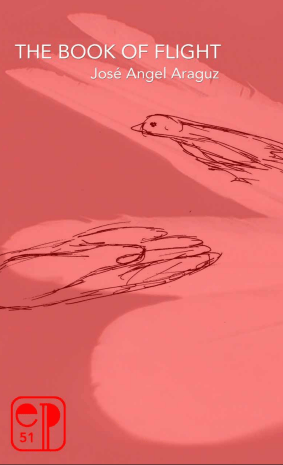
So, really, this is a tale of failure. Speaking of: As I prepared to write this blog post, I flipped through my sketchbook, remembering distinctly that I had sketched a rooster sometime in the past, had the image of it vividly in mind (see above).
Alas, when I found the image, it was no rooster:

* mis-galloed *
Happy roostering!
Jose
*p.s. Here is the poem in the original Portuguese as well as the Spanish translation I worked from:
Tecendo a Manhã – João Cabral de Melo Neto (original)
Um galo sozinho não tece uma manhã:
ele precisará sempre de outros galos.
De um que apanhe esse grito que ele
e o lance a outro; de um outro galo
que apanhe o grito de um galo antes
e o lance a outro; e de outros galos
que com muitos outros galos se cruzem
os fios de sol de seus gritos de galo,
para que a manhã, desde uma teia tênue,
se vá tecendo, entre todos os galos.
E se encorpando em tela, entre todos,
se erguendo tenda, onde entrem todos,
se entretendendo para todos, no toldo
(a manhã) que plana livre de armação.
A manhã, toldo de um tecido tão aéreo
que, tecido, se eleva por si: luz balão.
*
Tejiendo la mañana – João Cabral de Melo Neto
translated into Spanish by José Antonio Montano
1
Un gallo solo no teje una mañana:
precisará siempre de otros gallos.
De uno que recoja el grito que él
y lo lance a otro; de otro gallo
que recoja el grito del gallo anterior
y lo lance a otro; y de otros gallos
que con otros muchos gallos se crucen
los hilos de sol de sus gritos de gallo,
para que la mañana, con una tela tenue,
vaya siendo tejida, entre todos los gallos.
2
Y tomando cuerpo en tela, entre todos,
erigiéndose en tienda, donde entren todos,
entretendiéndose para todos, en el toldo
(la mañana) que planea libre de armazón.
La mañana, toldo de un tejido tan aéreo
que, tejido, se eleva de por sí: luz globo.
 The Influence