review by José Angel Araguz

[CW: talk of suicide]
One of the gifts of lyric poetry is the way that it can hold space for a full range of truths as well as ways to access understandings of truth. I often tell writers that what we are after is awkward human utterance. This can be interpreted both as craft as well as content. Figuring out what needs to be said as well as how it needs to be said–this is the gift and animation of engaging with poetry and its truths.
These thoughts are on my mind after spending time with the digital album Songs For Wo(Men) 2 (Hello America Stereo Cassette) by Mugabi Byenkya. This album’s narrative arc centers the experiences of a disabled body navigating an able-bodied world as well as the themes of intimacy and love and their role in survival. What charges through the listening experience is Byenkya’s lyric sensibility.
The opening to “Tina,” for example, sets a scene deftly then quickly makes clear what the stakes are:
Housekeeping keeps knocking on the door telling me to open up. I sit and listen. I’m the reason that the towel rack lies mangled askew on the chalky linoleum floor, wondering how much this is going to rack up in charges, wracking my mind for a convincing enough excuse, because I had a seizure while getting out of the shower is a little too much truth, a little too much awkward silence, a little too much shifty eyes, a little too much tiptoeing past the room but barging in when the fork clatters to the ground, a little too much.
The scene here depicts the liminal space of having to negotiate around vulnerability. The physical vulnerability of the moment runs parallel with the emotional vulnerability behind the speaker’s voice. Reading the words alone makes clear the mind at work; the wordplay of “open up” can be appreciated and lingered over in text, such a poignant note to hit before moving forward. Listening to Byenkya’s voice behind words, however, adds a further dimension, makes clear exactly the “opening up” to come.
The idea present in the phrasing “a little too much truth” lives at the core of this album. Byenkya’s awareness and ability to evoke for listeners moments of “a little too much truth” is a gift to watch in action. The track “Professor Poopy Pants” shows how this kind of truth can be accessed through humor:
No doctorate. But my pants are poopy. Did I just poop in my pants? Absolutely. There’s no fade to black like a scene in a movie cuz I just pooped my pants and that’s a major oopsies. You might be chuckling and wondering how I could get to the point where I poop in my pants while asleep; you won’t be chuckling when you discern that it’s due to me suffering from three strokes by the time I turn 23. At the time life was so stressful and depressing that pooping my pants was honestly a relief. For I went to bed most nights wishing for death, but that morning I woke up to some comic relief.
When listening to the track, Byenkya’s performance takes centerstage. He delivers the above lines with a swagger and play at first, only to ground that swagger in a tone of conviction as the lines move from play to the truth of the scene. This switch in tone occurs in text via word choice, as can be seen midway in this excerpt when the speaker moves from “poop” to “discern” midway, the physical language shifting to language of the mind.
More than analysis, this mixtape invites introspection, the speaker waxing through intimate raw recollections, sharing them with the listener in ways that spark insights. The blunt and direct statements throughout stand in stark contrast with the emotional tenor in which they are delivered:
My first thought upon waking up is suicide; my last thought before drifting off to sleep is suicide. I’m not often this frank about my suicidal ideation, but I am often this frank about my love for you.
This moment from “Laura” is a good example of the facility with which Byenkya creates moments of intimate juxtaposition that point to personal stakes. In doing this, Byenkya is able to tap into a lyric sensibility and draw out the poetic from vulnerability. Here, too, is another example of how “a little too much truth” is necessary to speak about what matters.
*
Songs For Wo(Men) 2 can be found at Hello America Stereo Cassette site.
Find out more about Mugabi Byenkya’s work, at his site.
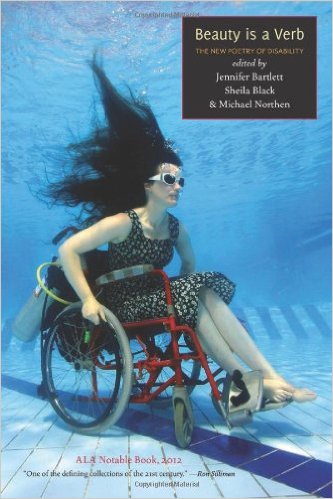 One of the highlights of teaching composition this summer has been engaging with excerpts from the anthology Beauty is a Verb: The New Poetry of Disability. There is a wealth of great poetry in this anthology, which includes the work of Ona Gritz, Hal Sirowitz, and the writer of this week’s poem, Jim Ferris.

 The Influence