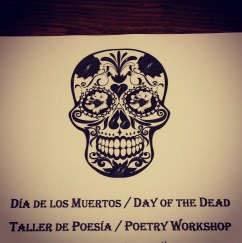
 This week found me conducting two separate poetry workshops, one in Spanish and one in English, focused on Día de los Muertos / Day of the Dead. At this workshop, we went over some of the history of the holiday, from its indigenous roots and variations to contemporary observances. While I had students write recuerdos / poems of remembrance, I also shared examples of calaveras (short, satirical poems that are also at times political) and descanso poems.
This week’s poem, “World to World” by Valerie Martinez, is an example of a descanso poem, a tradition that combines elegy and narrative. In his introduction to Camino Del Sol: Fifteen Years of Latina and Latino Writing, editor and poet Rigoberto González describes the descanso poem as “a word version of an altar to the dead,” and cites Martinez’s poem as an example.
 Reading through the poem, one can see the altar-like spirit of the poem in the way the narrative collects its details while at the same braiding the human and the natural world. When “the dead come” in the poem, for example, they come with “mouths silent as under-earth.” This metaphor pairing “mouths” with “under-earth” builds off the idea of the dead engaging with the living world and gives an exactness of feeling. The “silence” described here is tied to the absence of words. The speaker then shares that “We needn’t have any words, / the dead and I,” and continues in its details, leading us from the earth to the sky through graceful turns of enjambment and phrasing. The ending then takes a poem that is about exploring layers of outer existence and notes how these layers resemble the ones we live with inside ourselves.
Since my workshops were in two languages, I went ahead and translated Martinez’s poem. I’m sharing the translation below as well. Enjoy!
World to World – Valerie Martinez
for Tim Trujillo 1951-1991
I discover the Buddha in the backyard,
black paint on wood, head titled,
smile so tranquil. Then the dead come,
over the grass, the garden stones,
a bed of wildflowers, without sound,
mouths silent as under-earth.
We needn’t have any words,
the dead and I, just holy imagery,
the message, they come, the secret
passage under the wall, the creature
who climbs through, the sky
over the clouds over the air over the earth,
world to world, this afternoon
someone I am someone I knew,
the layers beneath the layers.
*
Mundo a Mundo – Valerie Martinez
traducido por José Angel Araguz, Ph.D.
for Tim Trujillo 1951-1991
Descubro al Buda en el patio trasero,
pintura negra sobre madera, cabeza inclinada,
una sonrisa tan tranquila. Luego vienen los muertos,
sobre la hierba, las piedras del jardín,
una cama de flores silvestres, sin sonido,
bocas calladas como la tierra.
No necesitamos ninguna palabra,
los muertos y yo, sólo imágenes santas,
el mensaje, ellos vienen, el paseo
secreto bajo la pared, la criatura
quien sube, el cielo
sobre las nubes sobre el aire sobre la tierra,
mundo a mundo, esta tarde
alguien que soy alguien que conocí,
los estratos debajo los estratos.
*
The original poem is from Valerie Martinez’s collection World to World (University of Arizona Press). To learn more about Martinez’s work, check out her site.

 The Influence