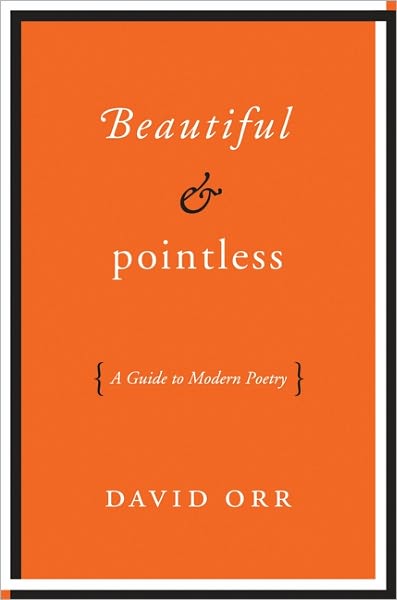
Just finished reading David Orr’s lovely book: Beautiful & Pointless, a marvelous and sly book.
now to think of another title for my autobiography
Marvelous because Orr is able to navigate through the realm of contemporary poetry – both the writing of it and the living of it – in a charming and knowledgeable manner.
Sly because his essays have forced me to take a long, hard look at myself and my aspirations as a poet while making me chuckle.
Damn.
David Orr is the poetry columnist for The New York Times Book Review. I have been enjoying his columns for years now.
The biggest risk taken in this book is Orr’s breaking down of the mystique surrounding the business and writing of poetry while at the same time showing how the public and private realms are inseparable and *gasp* often beneficial to each other.
(*gasp* because I am a bit of a poet hermit in terms of the outside poetry world. I mean, it’s scary. They should send chocolate with rejection letters.)
The charm of the book is how, by breaking down the mystique, Orr makes a fair argument for how poetry is like sports or travel or any other activity that gives pleasure and meaning on an individual level, first and foremost. By putting it in this context, poetry’s mystique – the revelations, the idiosyncratic fascinations, its intimate tones – is simply part of its appeal. It is an art not for everyone, but no less worthwhile and valuable to people.
Overall, it is a reaffirming book and worth checking out.
Here’s a sample of why:
…much of life is devoted to things that in the don’t matter very much, except to us. Time passes whether we like it or not, and its too-quick progress is measured out in private longings and solitary trivialities as much as in choices we might defend to a skeptical audience…I can’t tell you why you should bother to read poems, or to write them; I can only say that if you do choose to give your attention to poetry, as against all the other things you might turn to instead, that choice can be meaningful. There’s little grandeur in this, maybe, but out of such small, unnecessary devotions is the abundance of our lives sometimes made evident…
Check out more from David Orr at his website: http://davidorr.com/
Happy evidenting!
J

 The Influence