This week The Friday Influence introduces the “some words from” feature – on the last Friday of each month expect a quote or two from poets that have and are presently influencing my work or simply blowing my mind.
Our first feature: haiku poet Matsuo Basho!

Sabes sabi?
Here he is talking about the idea of sabi:
“Sabi is in the colour of a poem. It does not necessarily refer to the poem that describes a lonely scene. If a man goes to war wearing a stout armour or to a party dressed up in gay clothes, and if this man happens to be an old man, there is something lonely about him. Sabi is something like that. It is in the poem regardless of the scene it describes – whether it is lonely or gay. In the following poem, for example, I find a great deal of sabi.” *
Under the cherry
Flower guards have assembled
To chatter –
Their hoary heads together.
In citing this poem (by one of his disciples), Basho illustrates sabi as something to be experienced, a thing to be completed through the engagement of the reader.
This attention to not only what goes in a poem but what it does in each of us is part of the reason is why I return to Basho’s work often. He gets this poetry thing in a way that expands it, gets it in a way that shows the way for others.
He is one of the great travelers, both on the road and the word.
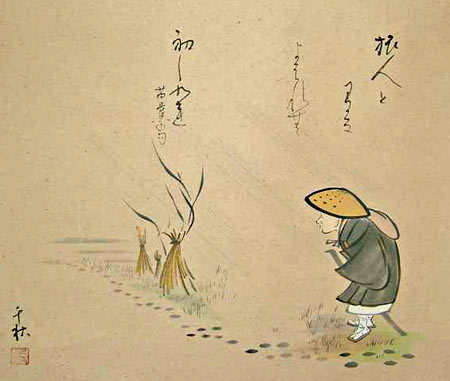
Here’s an excerpt from Basho’s travel journal, The Records of a Travel-worn Satchel:
“In this mortal frame of mine which is made of a hundred bones and nine orifices there is something, and this something is called a wind-swept spirit for lack of a better name, for it is much like a thin drapery that is torn and swept away at the slightest stir of the wind. This something in me took to writing poetry years ago, merely to amuse itself at first, but finally making it its lifelong business. It must be admitted, however, that there were times when it sank into such dejection that it was almost ready to drop its pursuit, or again times when i was so puffed up with pride that it exulted in vain victories over the others. Indeed, ever since it began to write poetry, it has never found peace with itself, always wavering between doubts of one kind and another. At one time it wanted to gain security by entering the service of a court, and at another it wished to measure the depth of its ignorance by trying to be a scholar, but it was prevented from either because of its unquenchable love of poetry. The fact is, it knows no other art than the art of writing poetry, and therefore, it hangs on to it more or less blindly.”
***
Happy hanging!
jose
* all quotes in this post come from Nobuyuki Yuasa’s translation of Basho’s The Narrow Road to the Deep North and other travel sketches.

 The Influence