* knocking around with kenyon & meyers

The Suitor – Jane Kenyon

We lie back to back. Curtains
lift and fall,
like the chest of someone sleeping.
Wind moves the leaves of the box elder;
they show all their light undersides,
turning all at once
like a school of fish.
Suddenly I understand that I am happy.
For months this feeling
has been coming closer, stopping
for short visits, like a timid suitor.

*
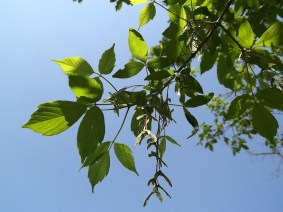
box elderIn the poem above, I’m moved by the way things knock into each other in the scene described, and how that knocking mirrors how the poem is working structurally. The lyric momentum here swings between the three “likes” in the poem. Each one is a simile of life: a person sleeping, a school of fish, a timid suitor.

The specificity of each, however, is what makes their presence move beyond image and metaphor. The whole poem moves through them: the suggested breath of “someone sleeping”knocks into the next line about the wind; the fish “turning all at once” turn in such a way that they knock like the mind of the speaker’s sudden understanding; and then the ending pushes things into a further understanding of silence and resilience.

This short lyric brought to mind this haiku by Bert Meyers:

I can only laugh
when my daughter spreads her arms
to catch the cold wind

Both poems, for me, reflect a bit of what this time of year feels like. May is like a hinge between spring and summer, and you can hear the seasons’ doors creaking on the leaves.

Happy creaking!

José

* surging with angela narciso torres

Reading through Angela Narciso Torres’s poetry collection Blood Orange, I was moved again and again by the way moments of attention and detail are hinged in such way to the line as to create a visceral reaction, a blur of image and meaning that shifts the act of reading poetry beyond merely running eyes over text.

In this week’s poem, “Ironing Woman,” the memory of being with someone as they work is delivered in rich, physical detail. What makes the details sing is how the poet handles the pacing throughout. There is a move repeated between stanza breaks, for example, that is later followed through the poem’s final image. The broken sentence at the end of the first stanza delivers its wisdom via white space and suspense; white space enters again between the second and third stanza to let the word “Slowly” linger in the reader’s mind so that the movement between the image before and the image after carry significant weight and presence. This movement of presence and resonance comes to a stunning flourish in the final image, which moves from the interior of the room to an image of ” a gull’s shadow / over the surging sea.”

This final image of shadow tied strictly to the sea mirrors the ironing woman’s stare and delivers the reality of how work ties itself to who we are, whether through physical or psychic memory.

seagull

Ironing Woman – Angela Narciso Torres

Afternoons I’d lie on her woven mat
of lemongrass and burnt leaves,
listening to tales of spurned love
on her bright-yellow transistor radio.
From her I learned what the old wives knew —

never to wash after ironing. Propelling
the gleaming prow across the ripples
of my father’s shirt, she’d tell how the iron
gnarled her wrists, once smooth as bamboo.
How the steaming metal twisted
her veins, brought on “the shakes.”
When I saw the serpentine rivers
on her arms, I knew this was true. Slowly

she’d raise both hands to show how
they trembled like maidenhair ferns
before a storm. Turning to her work,
her eyes reclaimed their stare
as though tracing a gull’s shadow
over the surging sea.

*

Happy surging!

José