arte-ing with vicente huidobro

This week I’m happy to share a translation of a poem by Chilean poet Vicente Huidobro. What moves me about this week’s poem is how closely the logic of the lines play out some of Huidobro’s ideas on poetry. For Huidobro, the poet was a “maker” and creator of “new worlds that never existed before, that only the poet can discover.”*

An example of what this thinking looks like in a poem can be seen in the first two lines: Let the verse be like a key / that opens a thousand doors. Here, the logic and imagery come together with a stunning immediacy. My first reaction in reading these lines was a professional envy; I mean, were they my lines, I might have just stopped at these two lines and called it a poem!

But Huidobro (with better sense than me, obvs) forged ahead, delivering an ars poetica that enacts in poetry what it would have poetry do. Often an ars poetica will be lost in abstraction and an attempt at a grand statement. Here, Huidobro doubles down in grand statements, the effect being a poem that keeps creating its ideas before the reader.
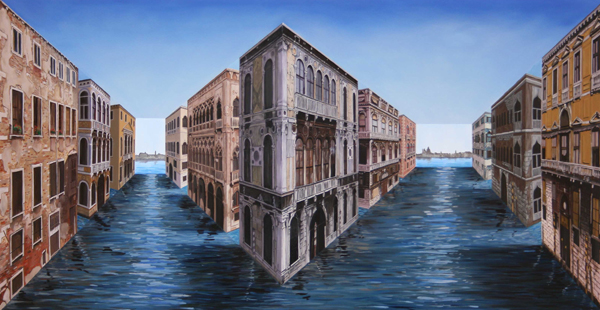
vanishing_venice_-_patrick_hughes

Arte Poetica – Vicente Huidobro

Que el verso sea como una llave
Que abra mil puertas.
Una hoja cae; algo pasa volando;
Cuanto miren los ojos creado sea,
Y el alma del oyente quede temblando.

Inventa mundos nuevos y cuida tu palabra;
El adjetivo, cuando no da vida, mata.

Estamos en el ciclo de los nervios.
El músculo cuelga,
Como recuerdo, en los museos;
Mas no por eso tenemos menos fuerza:
El vigor verdadero
Reside en la cabeza.

Por qué cantáis la rosa, ¡oh Poetas!
Hacedla florecer en el poema ;

Sólo para nosotros
Viven todas las cosas bajo el Sol.

El Poeta es un pequeño Dios.

*

Arte Poetica – Vicente Huidobro

translated by José Angel Araguz

Let the verse be like a key
that opens a thousand doors.
A leaf falls; something passes in flight;
whatever the eyes see, let it be created,
and the soul of the listener be shaken.

Invent new worlds and take care of your word;
the adjective, failing to give life, kills.

We are in the age of nerves.
The muscle hangs,
like a memory, in the museums;
but that is not why we have less strength:
true vigor
resides in the mind.

Why do you sing the rose, oh Poets!
make it flower in a poem;

just for us
all things live under the sun.

The poet is a little God.

*

Happy arte-ing!

José

*These quotes are from the introduction to The Selected Poetry of Vicente Huidobro (New Directions).
bolaño: a lyrical alignment

I recently reread Robert Bolaño’s novel “The Savage Detectives.”

I first read it in 2008. I had just moved to Oregon after completing my MFA, two years in NYC that were a combination of awe and awful. To be a young poet anywhere is to be confused and enchanted – and able to use words like “confused” and “enchanted” in regards to oneself without the slightest blush (blogging allows me to hide any possible blushing).

I was elated to find in Bolaño’s world a gang of poets that were as breathlessly falling apart as I felt. Six years later, and the book hasn’t lost its charm. Bolaño’s writing is overwhelming: he goes from inundating you with insider literary namedropping with the air of gossip and conspiracy to creating astounding metaphors that drive home the depths of human despair.

Or something like that.

The aligned below is a secondhand account about the reading habits of Ulises, one of the main characters of the novel whose adventures throughout the book prove him worthy of his namesake.

* some books may have been damaged during the making of this novel *

* some books may have been damaged during the making of this novel *

Making the Ink Run

aligned from Roberto Bolaño’s novel “The Savage Detectives”

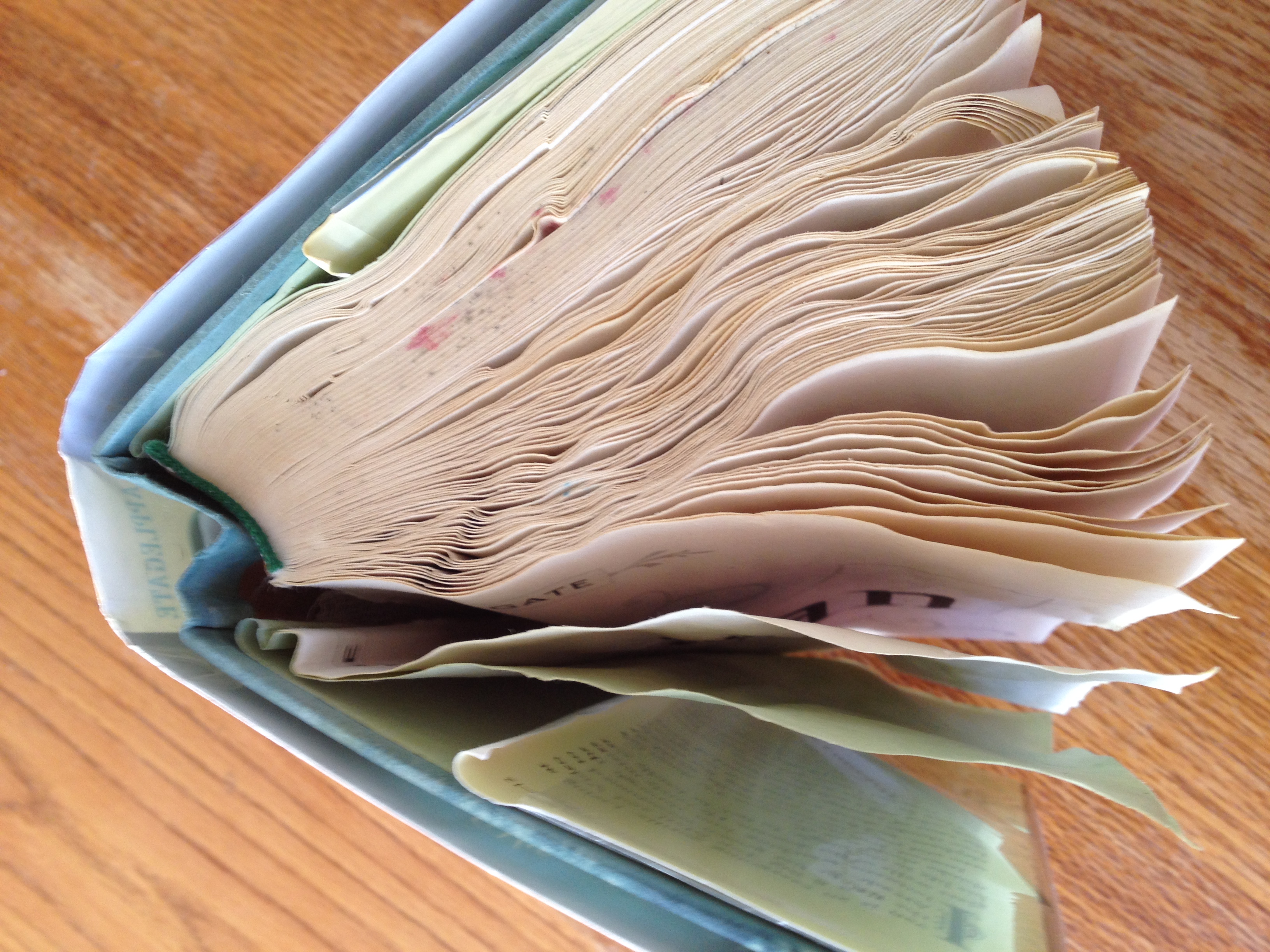
He was a strange person. He wrote in the margins
of books. I’m glad I never lent him any
of mine. Why? Because I don’t like people
to write in my books. You won’t believe this but he
used to shower with a book. I swear.
He read in the shower. How do I know? Easy.
Almost all his books were wet. At first I thought
it was the rain. Ulises was a big walker.
He hardly ever took the metro. He walked
back and forth across Paris and when it rained
he got soaked because he never stopped to wait
for it to clear up. So his books, at least
the ones he read most often, were always a little
warped, sort of stiff, and I thought it was
from the rain. But one day I noticed that he went
into the bathroom with a dry book and when
he came out the book was wet. That day my curiosity
got the better of me. I went up to him
and pulled the book away from him. Not only
was the cover wet, some of the pages were too,
and so were the notes in the margins, some maybe
even written under the spray, the water
making the ink run, and then I said,
for God’s sake, I can’t believe it, you read
in the shower! have you gone crazy? and he said he
couldn’t help it but at least he only read
poetry (and I didn’t understand
why he said he only read poetry,
not at the time, but now I do: he meant
that he only read two or three pages, not
a whole book), and then I started to laugh,
I threw myself on the sofa, writhing in laughter,
and he started to laugh too, both of us laughed
for I don’t know how long.

****

Happy laughing!

Jose