-review by José Angel Araguz
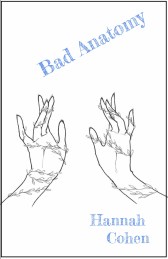
There’s a sense of recklessness that feels natural to poetry. By recklessness, I mean less Robin Williams standing on a desk shouting a Whitman poem in Dead Poets Society and more the honesty and nerve involved in trusting language to carry what you mean. It is this latter recklessness that runs through Hannah Cohen’s chapbook, Bad Anatomy (Glass Poetry Press). In poems that show the lyric self pulsing between various modes of suspension and isolation, Cohen engages language in a way that invites the reader to experience the plummet into language we call poetry.
The collection opens with “Aubade Inverse,” a poem that subverts the traditional aubade with its focus on lovers reluctantly departing and grounds it in feelings of threat and danger:
I left scuffmarks
on white doors. I wish
I could break. I left
my legs in bed.
I left you
before you, left wet
knives in the knife block.
The emphatic “I” statements here create both a presence and momentum that charge the poem with the panicked feeling of someone checking for their car keys in the dark. Yet, despite this feeling, or perhaps because of it, the aubade’s theme of love is still invoked in the poem’s ending line: “I leave / nothing.” These three words point outward in a few directions. They can be read as the speaker implying that they “leave / nothing” meaning no trace; but they can also be read as refuting the departure implied in the aubade form, the speaker adamantly making it clear that they “leave / nothing” behind, suspending what they can through the act of the poem.
Or perhaps both meanings are meant: The way ambiguity works here and throughout these poems shows a poetic sensibility awake to the subtleties of line break and evocation. This next set of three lines from the middle of the poem serve as another example of this sensibility:
I am drinking. I drive
so fast I kill
the moon.
Here, the clipped enjambment creates an opportunity to dwell on the meaning of each turn. Between “drinking” and “drive,” there is recklessness; when we get to “kill” there’s a heightened sense of danger, a sense that is pivoted into surreality by the time we get to “moon.” The juxtaposition of action, voice, and image in these lines evokes not a swagger or false bravado (see my earlier reference to Dead Poets Society) but a clear, suspended feeling. This moment works in a way that is instructive and illuminating; dwelling on these lines brings out what the speaker means as the reader understands it. In the middle of a poem that ends with “I leave / nothing,” these lines point to ways in which meaning can be followed as it leaves from word to word.
This ability to navigate across ambiguity and voice is present throughout the world of the poems in Bad Anatomy. In “Like Someone Driving Away From Her Problems” we find that:
even god doesn’t believe
in the rusty jesus-saves
signs can’t save her
from living
without landmark
or companion the road a black snake
beheaded
Here, isolation is depicted as a space that even god can passively inhabit, joining the speaker in disbelief. The apt break between the words “can’t save her” and “from living” do similar work as in the opening poem, creating a space where mortality itself is glimpsed for a moment as a threat before moving on with the narrative. This reckoning with mortality is found again in “Upon Starting My Period After The Election” as the speaker reflects:
Even my body knew it was wrong to begin
again. What’s different between this cycle
and a hundred ones before? Is this my god-
given right to be less every time?
Here, the interiority and isolation found in other poems is given a more outward, public turn. Yet, the poem engages with the outside world on its own terms, framing this meditation on the political climate within the workings of the speaker’s body. The purposeful break on “my god-” sets up the gravity of the following line; together they evoke a personal and public bleakness. When the speaker notes at the end of the poem that she “can’t stop the betrayal,” the speaker’s menstruating body parallels the more public feeling of betrayal felt by most since the last election.
By tempering lyric recklessness with vulnerability and honesty, the poems of Bad Anatomy deliver reading experiences that reward nuanced and repeated readings. These poems are filled with the insight and thrill of overhearing someone tell a story at a bar, or reading someone’s lost love letters. And like great stories and love letters, these poems are compelling because of their unabashed mix of light and dark. What I mean can be seen in the final lines of “Sad Girl’s Drinking Ghazal” (printed in full below):
Just fuck me up. I love how pure bourbon is. I’m not
Hannah tonight. She’s only the crow in my rib cage.
What keeps me reading and re-reading these poems are the flashes of lyric self like this one; they occur in moments braided from voice and imagery, but are executed with raw soul.
Sad Girl’s Drinking Ghazal – Hannah Cohen
This shitty cocktail is more insightful than I am.
Unfilled, I count all the secret valleys in my rib cage.
Even the universe lets me down. I’m drunk, awake.
Is this how to feel? Next morning’s sunk in my rib cage.
There’s something romantic about a building condemned.
All that space. All the never-smashed ribs in my rib cage.
Call it a tendency to forget. I like things false
and true. Can’t pray for what isn’t there in my rib cage.
I keep returning from the dead. What a masochist.
Don’t, don’t, don’t — that self-defeating heart in my rib cage.
Inhabiting a body is easy. But living
in one? Can I be more than the bones in my rib cage?
Just fuck me up. I love how pure bourbon is. I’m not
Hannah tonight. She’s only the crow in my rib cage.
*
Influence Question: How would you say this collection reflects your idea of what poetry is/can be?
Hannah Cohen: I have a few tangential thoughts for this question:
– At its best and even at its worst, poetry is a community. An ever-changing, populous community of thoughts that manifest into words. With this in mind, Bad Anatomy represents everything about being a person with depression, anxiety, and an unhealthy sense of self-deprecating humor. These traits interact with each other like passersby on a street, or rowdy drunks in a bar. However, there’s always that thread of hope that weaves itself throughout the chapbook’s pages, and I fully believe that for a poem or set of poems to fully succeed for the reader and its author, there must be that “break.”
– Poetry can be short and terse, with gaping spaces of images that sometimes don’t make sense the first time. The ending poem “[and the deer flash guernica]” serves as a soft echo to the chapbook’s opening poem, with a one-act scene of some deer at night juxtaposed to the multiple “I” scenes in “Aubade Inverse.”
– Accessibility is important. I want to believe people can emotionally and mentally relate to the poems in Bad Anatomy. Even if they can’t always see where the poems are coming from, they can understand the content at least.
Influence Question: What were the challenges in writing these poems and how did you work through them?
Hannah Cohen: These poems are like my own piercing arrows in that they’re tangible problems I’ve dealt with and continue to deal with in my life. While obviously not 100% autobiographical, several poems from Bad Anatomy sprouted from real situations and feelings. “2 a.m.,” for example, was made up of several moments where I was driving home in the dark. I suffer from pressure headaches and take Excedrin mainly for the placebo effect. I put all these things together and gave it that title to emphasize the aimlessness I was experiencing in my early twenties. Other poems have painful content (see “Sad Girl’s Drinking Ghazal”) that was eventually tamed by either its form or presentation.
Another challenge was the actual order of the poems. I did not want an obvious A to Z narrative, nor did I want poems to merely be mirrors to each other. I am thankful that one of my blurbers, Emilia Phillips, was able to offer some valuable advice about how to arrange Bad Anatomy for the most emotional impact. “Saturnism” was a frustrating poem to work into the chapbook, because it’s based on Vincent van Gogh and is the oldest poem. I almost removed it entirely. However, because it’s bookended by two short-ish poems about either separation or moving on, it seemed to finally work as its own entity, allowing me and the reader to inhabit a different mental space.
In the end, I’m happy with the final result. At some point, you just have to save the Word document and send it off to your publisher because if you keep nitpicking or changing up the order or a poem’s line, it won’t ever be done. Poems aren’t this finite object – you can always change it up at a reading or any future reprints.
*
Special thanks to Hannah Cohen for participating! To learn more about Cohen’s work, check out her site! Copies of Bad Anatomy can be purchased from Glass Poetry Press.
 *
*
Hannah Cohen received her MFA from Queens University of Charlotte and lives in Virginia. Hannah is the author of the chapbook Bad Anatomy (Glass Poetry Press, 2018). She is a contributing editor for Platypus Press and co-edits the online journal Cotton Xenomorph. Recent and forthcoming publications include Glass: A Journal of Poetry, Noble/Gas Qtrly, Cosmonauts Avenue, Tinderbox Poetry Journal, Verse Daily, and Gravel. She’s received Best of the Net and Pushcart Prize nominations.


 Jennifer Met lives in a small town in North Idaho with her husband and children. She is a Pushcart Prize nominee, a finalist for
  The Influence