* prose poem buzz & Max Jacob

Poem of the Moon

There are upon the night three mushrooms that are the moon. As brusquely as the cuckoo sings from a clock, they rearrange themselves at midnight each month. There are in the garden rare flowers that are small sleeping men, one-hundred of them. They are reflections from a mirror. There is in my dark room a luminous censer that swings, then two… phosphorescent aerostats. They are reflections from a mirror. There is in my head a bumblebee speaking.
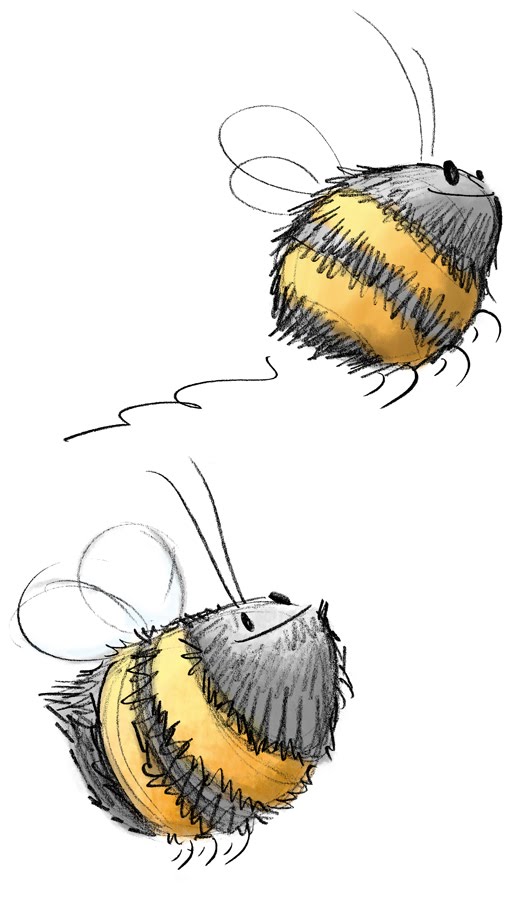
*buzzoverkill*

*whatcha thinkin’?*

And because I like working in threes, here is one more foray into the prose poem – this time with the renown French poet Max Jacob.

In talking about prose poetry, one must always acknowledge the fact that the tradition began in French literature.  Here’s the quote from Charles Baudelaire that, if you haven’t run into it yet, will possibly make you a believer:

Which one of us has not dreamed, on ambitious days, of the miracle of a poetic prose: musical, without rhythm or rhyme; adaptable enough and discordant enough to conform to the lyrical movements of the soul, the waves of revery, the jolts of consciousness?

Since these famous words were given to the world, many have laid open their dreams and given back their versions of poetic prose.

The poem below is one of the first prose poems I read that really had me nodding my head saying: yes, that’s it, that’s what you do in a poem.  I love the way it captures that moment of jolt when you look closer at your surroundings and see something you’ve neglected to notice.

***

The beggar woman of naples

When I lived in Naples there was always a beggar woman at the gate of my palace, to whom I would toss some coins before climbing into my carriage. One day, surprised at never being thanked, I looked at the beggar woman. Now, as I looked at her, I saw that what I had taken for a beggar woman was a wooden case painted green which contained some red earth and a few half-rotten bananas …

***

Happy bananas!

Jose

* pic found here.

* Akhmatova & some news on the friday influence

Willow – Anna Akhmatova

 “And a worn-out cluster of trees.”

                                  — Pushkin


In the cool nursery of the young century,

I was born to a patterned tranquility,

The voice of man was not sweet to me,

But the wind’s voice I could understand.

I loved burdocks and nettles,

But the silver willow best of all.

And, obligingly, all my life it lived

With me, and its weeping branches

Fanned my insomnia, with dreams.

But – strangely – I’ve outlived it.

There’s a stump, with strange voices,

Other willows are conversing,

Under these, under our skies.

I’m silent…as if a brother had died.

***

This week on The Friday Influence: the great Russian poet Anna Akhmatova.

Akhmatova lived under the reign of Stalin and consequently had her work censored and condemned by the government.  She is known best for her poems of witness during these times, notably the poem cycle “Requiem”.  I first discovered her work while reading Carolyn Forche’s book “The Country Between Us”.

The poem above was the first poem I came across when I laid her collected poems on a table at a bookstore.  I should point out that her collected is 948 pages long and so the book kinda flopped open to this poem.  There were a few weeks that summer where I repeated this exercise over and over again to sheer illumination.

In “Willow”, I am taken in by the power of the direct address.  There are some poets who send the “you” out in a poem and you can dodge it.  Here, the tone of the poem is such that you feel taken into the confidence of the speaker.  While the speaker does not speak to a “you”, it is felt no less distant.  I guess I could call it an indirect direct address.

Whatever it is, the poem pulses with it, and I read the last line for all its implications of loss.  The worlds traveled here, nature, human, dream – all ring in that last line.

This intimate address makes sense seeing as much of her early work is made up of love poems in this vein:

‘He loved three things, alive:’ *

He loved three things, alive:

White peacocks, songs at eve,

And antique maps of America.

Hated when children cried,

And raspberry jam with tea,

And feminine hysteria.

…And he had married me.

It takes not only nerve to say something like this but to write it, and write it well.

***

While thinking about Akhmatova’s intimate tone, I found myself thinking about the tanka poet Izumi Shikibu.  Something of Akhmatova’s connection with the willow and the heart can be found in this:

Sleeplessly

I watch over

the spring night—

but no amount of guarding

is enough to make it stay.

(Izumi Shikibu) **

***

In other news, my chapbook, The Wall, is officially out from Tiger’s Eye Press.  I am working on a page for this blog with excerpts and ordering information but for now please know info on how to order a copy can be found here:

http://www.tigerseyejournal.com/chapbooks.html

Ok, fine.  I’m excited.

***

Happy exciting!

J

* translated by A.S. Kline here:  http://www.poetryintranslation.com/PITBR/Russian/Akhmatova.htm

** translated by Jane Hirshfield, The Ink Dark Moon (read this!!!)