* William Meredith on the friday influence

This week’s poem is The Illiterate by William Meredith.

This one is a favorite.  I memorized it years ago and come back to it often.

The simplicity of both the subject matter and form is deceptive.  It is a sonnet but note how the rhymes work, how they envelope around the last syllables – man, hand, hand, man – playing out the story of the poem in the word choice itself.

The extended metaphor takes over after the first line and comes back in the turning over of words at the end of the poem.

I won’t say too much  more, seeing as this is a poem about what is left unsaid.

Enjoy.

letter-proud *

letter-proud *

The Illiterate – William Meredith

Touching your goodness, I am like a man

Who turns a letter over in his hand

And you might think this was because the hand

was unfamiliar but, truth is, the man

Has never had a letter from anyone;

And now he is both afraid of what it means

And ashamed because he has no other means

To find out what it says than to ask someone.


His uncle could have left the farm to him,

Or his parents died before he sent them word,

Or the dark girl changed and want him for beloved.

Afraid and letter-proud, he keeps it with him.

What would you call his feeling for the words

That keep him rich and orphaned and beloved?

***

Happy keeping!

jose

* image found here.
* Rilke, winter & the friday influence

I am almost done with The Complete French Poems of Rainer Maria Rilke.  Fascinating stuff.  Rilke wrote something like 400 poems in French towards the end of his life.  Basically a whole Collected Works in another language.  He approached his poems in French in the spirit of starting over in a way that he couldn’t in his native German.

What does it mean to start over?  Focusing on details.

Case in point, here’s one poem from his series The Roses:

II. *

I see you, rose, half-open book

filled with so many pages

of that detailed happiness

we will never read.  Magus-book,

opened by the wind and read

with our eyes closed…,

butterflies fly out of you, stunned

for having had the same ideas.

***

Those last four lines contain within them so much sensation – so much surprise – you read them and go back into yourself, recognizing an experience there in the words.

Rilke’s French poems are where he goes for it and basically becomes a modern version of Rumi – he sings within his praise for the world.

winter, yo

winter, yo

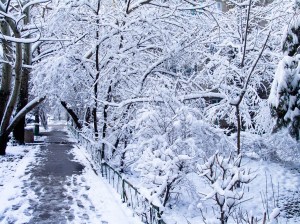
Continuing with last week’s theme of winter, here is Rilke’s take on it.

In the same spirit of starting over, Rilke also left some of his French poems imperfect.  The poem below is such an example.

The last line almost takes me out of the poem.  It is an unfinished thought.  But, read after so many lines of yearning and remembering, the line leaves us lost in as much thought as the speaker.

***

Winter – Rainer Maria Rilke *

I love those former winters that still weren’t meant for sports.

We feared them a little, they were so hard and sharp;

we confronted them with a bit of courage,

to return into our house, white, sparkling wise-men.

And the fire, that great fire consoling us against them,

was a strong and living fire, a real fire.

We wrote badly, our fingers were all stiff,

but what joy to dream and entertain whatever

helps escaping memories delay a while…

They came so close, we saw them better

than in summer…, we proposed colors to them.

Inside, all was painting,

while outside all became engraving.

And the trees, who worked at home, in lamplight…

***

Happy working!

jose

* as translated by A. Poulin in The Complete French Poems of Rainer Maria Rilke.