* some words from Ram Dass & the friday influence

This week on the Influence: some words from world renown American spiritual teacher Ram Dass!

But first, a confession: there isn’t much that I read – be it novels, essays, cereal boxes, texts, etc. – that doesn’t get filtered through my how-does-can-this-relate-to-poetry filter.  I read everything with eyes looking for a symbol, a metaphor, or simply a set of words that captivates.  I end up thinking (and saying) some goofy things but ultimately I am kept engaged and interested.

I say this as preface to today’s post in order to make it clear that I am no expert on the works of Ram Dass or meditation – I have simply read through his book on mediation, Journey of Awakening, and found in it many things that relate to poetry.  Or at least my sense of it.
Dude, c'mon: there'll be chicken wings!

Dude, c’mon: there’ll be chicken wings!

In his book, Ram Dass exhibits a great gift for sampling works from various cultures and beliefs.  W.H. Auden once said that a sign of a writer’s strength as an essayist isn’t what he says but what he quotes.  In this spirit, Ram Dass rocks.  Case in point:

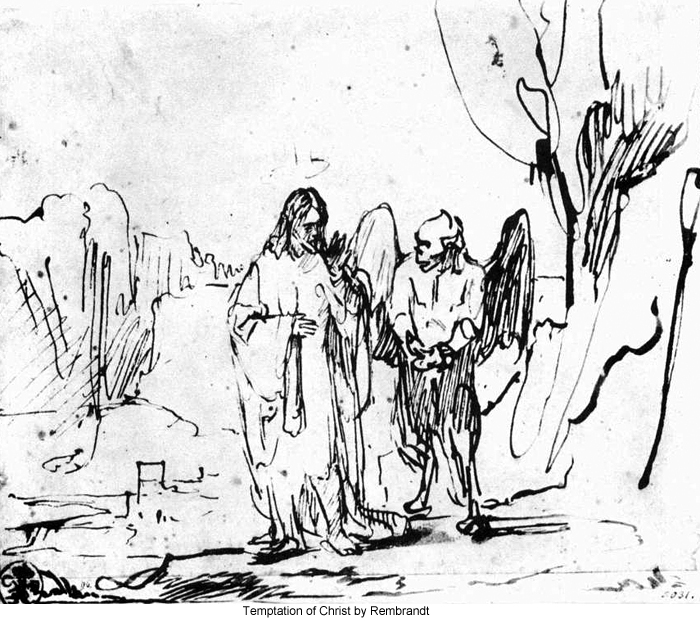
There is a story that as God and Satan were walking down the street one day, the Lord bent down and picked something up.  He gazed at it glowing radiantly in His hand.  Satan, curious, asked: “What’s that?”  “This,” answered the Lord, “is Truth.”  “Here,” replied Satan as he reached for it, “let me have that – I’ll organize it for you.”

I read the above as a parable on poetry workshops as I have experienced them at times.  There are at times two kinds of readers in a group: one willing to be astonished in their consideration of the words before them, and another who feels compelled to say something, to fix, to organize.

Ultimately, both kinds of readers, like the ideas of good and evil, help make the world go ’round.

Here are two more:

If you do not get it from yourself

Where will you go for it?

(Zenrin, The Gospel According to Zen)

*
It is all an open secret
(Ramana Maharshi)

*

I see the last two quotes as having to do with generating work: the first, an idea Philip Levine shared once: It won’t get written if you don’t write it.  The second, how inspiration is seemingly endless while at the same time being impossible at times to get at – but once you tap into it, that thrill, like learning a secret if only for a moment, a few lines.

*

Happy secrets!

Jose

* some origins, manu chao & the friday influence

In regards to the question “When did you start writing?” I give several answers depending on context.

If it’s a professional context, I say seventeen, that being the year that I first typed up, printed, and sent off poems to a real lit mag.  I call it the year I began to take my writing seriously, the act of sending my poems out into the world for consideration an act of considering them worth, uhm, considering.  (Two got published on that first try – bless those forgiving editors!)

If it’s more of the “When did you know you were a writer?” kind of question, then I go a little farther back.  I talk about how as a kid I used to rewrite lyrics to songs I heard on the radio, how I filled up notebooks with various takes on other people’s melodies.

I look back and realize that putting my words into other people’s songs probably taught me something about form, about structure and rhyme.  What exactly I learned, I don’t know.  (I’m a terrible rhymer in poems!)

The core of the experience, though, cultivated an obsession with words – sounds, meaning, phrasing – of saying something and saying it concisely, aptly.  Inevitably.

I threw away those notebooks sometime in middle school – a friend found me scribbling in one of them and asked what I wrote.  I said homework, tucked it away, and later that night tossed them all into the garbage.  Not a scrap remains.

words, yo

words, yo

What has stayed with me through the years is a distinct respect and fascination with song lyrics.

In this spirit, let me share some of the lyrics of French singer Manu Chao!

I have been listening to his first album “Clandestino” non-stop this week.  Manu Chao, after being in a few other bands, took to travelling and picking up different influences from the various street music he encountered to create a hybrid sound that is as much diverse as it is simple.  His songs remind me of Garcia Lorca being influenced by the folk culture of Andalusia.  His travelling manifests itself in his writing songs in French, Spanish,Italian Galician, Arabic, and Portuguese.

Here’s a line that I keep turning over my head:

El hambre viene, el hombre se va –

(Hunger comes, man leaves)

This is a fine line – more than that, you see in the words themselves how one letter changing (hambre = hombre) evokes so much of the meaning of the line.  Now, take the line within its context in the song “El Viento (The Wind)”:

El viento viene
El viento se va
Por la frontera

El viento viene
El viento se va

El hambre viene
El hombre se va
Sin mas razon…

(The wind comes
The wind goes
Across the frontier

The wind comes
The wind goes

Hunger comes
Man leaves
Without a reason…)
***

Suddenly the words take on a whole other meaning.  That change from ‘a’ to ‘o’ in the words (hambre/hombre) seem almost a trick of the wind itself, the same wind that is being sung about.

Part of my general fascination with song lyrics is how you can do certain things in a song that you can’t do in a poem.  I say this not to discredit one side or the other but to show them both as the formidable modes of expression that they are.

In his lyrics, the wordplay of hambre/hombre play out concisely the theme of vagabond that Manu Chao explores throughout his whole first album.  Taken solely as words, the line is simply a proverb.  But put to music, put within the larger context of musing on wind and then the even larger context of an album about transiency and the line becomes downright mythic.

Cool.  You can listen to the song here.

And a fun one can be found here.

Happy bongoing!!!

jose

* photo found here.