This week I’m excited to share two poems by Clara Burghelea. I was taken right away by Burghelea’s work and how it develops lyric momentum through complex imagery. In “Nostalgia,” for example, the idea of being “sick” for a body “before it was a body” immediately kicks off from the title into a meditation how bodies develop both a physical and emotional history. The body that once was, as described in the first stanza, “a prettiness slender / like a smack of wind,” is later in the second stanza the body that has known “heart as a dark vessel” and has grown “thick with other people’s thoughts.” The logic of these lines is visceral; youth is evoked as the body being more feeling than physicality, until, with time, the body grows darker and more weighted. This movement from fleeting to stillness by the second stanza returns us to the title. Nostalgia is often thought of as a light thing, an activity of kitsch and cliche. Here, however, Burghelea presents the concept of nostalgia in a way that shows how much longing and reason for longing lie behind it.
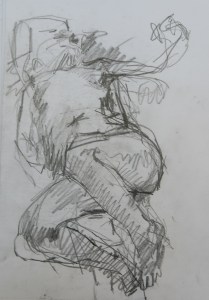
“Sketches 8” by Diana Schulz
In “The Self as Introduction,” too, the body implies movement. The poem begins with the following image: “No wound loathes its scar, / yet craves the radiant absence.” Through this phrasing, the reader is invited to hold two conflicting ideas at once, that of loathing and craving, in a way that implies an erasure of self. Yet, because this loathing and craving is proposed as being enacted by a wound, the erasure seems less dire, merely conceptual. There is space enough here to see the implied message that radiance may involve pain. This implication builds momentum as the poem develops and it becomes clear that the speaker is speaking about what is at stake in human relationships. The line “What fell from your lips / came to nest into my mouth,” for example, presents an image whose logic builds tension. Even in the distance between bodies, there is a momentum at work, the momentum of interpretation and of thought within silence. The poem ends with a frustration of sense (similar to the longing of “Nostalgia”) in its final lines: “The gap on the page, / a muttering under a kiss.” What Burghelea gives us in these poems, ultimately, is a sensibility able to clearly evoke how much and how little of the body we’re able to hold onto.
Nostalgia – Clara Burghelea
I’m sick for my body
before it was a body,
bereft of aching and desires,
unaware of the shortcomings,
a prettiness slender
like a smack of wind,
a breathing silk of youth crowning it,
ready to deliver itself to the world,
without knowing it would be hard
to hold back its lush of innocence.
The body that hadn’t known
heart as a dark vessel,
no push of wind to sail its burden.
That body that had yet to grow
thick with other people’s thoughts,
its taps in disarray,
not a weight erased
but a weight made bearable.
This body I mourn the most.
*
The Self as Introduction – Clara Burghelea
No wound loathes its scar,
yet craves the radiant absence.
God’s laughter punctures
the arch of the sky
every new dawn,
eyes bandaged with light.
What fell from your lips
came to nest into my mouth
the thieving of the heart,
an unpremeditated entry.
The gap on the page,
a muttering under a kiss.
*
 Clara Burghelea is a Romanian-born poet. Recipient of the 2018 Robert Muroff Poetry Award, she got her MFA in Creative Writing from Adelphi University. Her poems, fiction and translations have been published in Full of Crow Press, Ambit Magazine, HeadStuff, Waxwing and elsewhere. Her collectionThe Flavor of The Other is scheduled for publication in 2019 with Dos Madres Press.
 Another recent happening has been my prose poem sequence Gods and Goddesses being published as part of
  The Influence