writer feature: Olivia Dresher

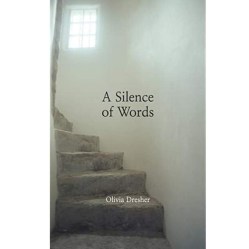
Jumping back into things with the work of Olivia Dresher whose latest collection of fragments and aphorisms, A Silence of Wordscame out recently from Impassio Press.

I actually had the opportunity to get an early read of A Silence of Words and got to share my thoughts via the following blurb:
dresher“In A Silence of Words, Olivia Dresher continues to explore her fascination and deft facility with fragments and aphorisms. Taken from their first public home of Twitter, Dresher’s fragments find their way into a reader’s inner consciousness with the intimacy of poetry and the depth of philosophy, offering “Awe, not answers.” If, as she tells us elsewhere, “The mind likes being alone, the heart doesn’t,” this collection delivers at turns solitude and companionship. In the same way that the mind and heart live within one body, so do the nuance and complexity of these short works live within one’s reading experience, each one a gift of presence and existence.”

To get a sense of what I mean in these words, I have included two small excerpts below.

What I would add to readers new to Dresher’s work is how dually instructive and illuminating these aphorisms and fragments are. Able to carry a range of emotion, from perceptively distant to openly vulnerable, Dresher’s work evokes a person speaking to one’s self in a way that is also speaking to you, the reader. Together in this unique space, human realities are experienced in real time.

I first experienced the unique sensibility of Dresher’s work when I discovered the anthology she edited, In Pieces: An Anthology of Fragmentary Writing (Impassio Press). In this anthology, Dresher outlines a clear idea of the varied scope of fragmentary writing through representative works and authors. I continue to admire her work for how it has shaped me both on the page and in life.

excerpts from A Silence of Words by Olivia Dresher

533
Insects are arrogant

534
Tears go deeper than a smile.
Imagine if a photographer told you to “Cry!” instead of “Smile” before taking your photograph.

535
Tears are perfect

536
Tidal wave moments…

537
Everything to feel,
nothing to be done.

538
If I could love unhappiness,
I’d always be happy.

*

587
Her mind, a kite her heart liked to fly.

588
What are you reading,
the young man on the bus asked me.
Aphorisms, I said.
What do you do for fun, he asked.
Write aphorisms, I said.

589
Longing to feel his longing…

590
As an infant, what did I love?
I loved music and the sky, even then.

591
Stop spilling your silence all over me,
she said silently.

*

Copies of  A Silence of Words can be purchased here.

To keep up with Olivia Dresher’s work, follow her on Twitter: @OliviaDresher

one more from Lynn Otto

PhotoEditor_20190608_141411093In my recent microreview & interview of Lynn Otto’s Real Daughter (Unicorn Press, 2019), I noted some of the ways in which Otto’s poetic sensibility is able to take readers into the liminal space in which words make their meanings as well as gesture toward other imaginative possibilities. Within the traditions of lyric poetry — traditions whose materials are memory, personal insight, and emotional as well as conceptual depth — being able to simultaneously point to what is and what could be/have been is necessary as it is this poetic simultaneity that most aptly reflects human experience.

While a number of poems in Real Daughter deal directly with family narratives to delve into emotional insights, “After the Flood” (below) approaches similar insights in an indirect manner. Taking the flood of the title as narrative context, the poem begins by juxtaposing the images of “mud-bloated cattle” and “fattened crows discussing the landscape” with the following questions:

what will fill our mouths
besides our bitter tongues. Bowls
of foul air? Should we not have
prayed for rain?

Here, the physical reckoning implied in the animal images is led into the speaker’s conceptual reckoning through the word “discussing” which is attached to crows. This projection of human qualities onto animals is a standard move in literature, but the stakes are raised by the emotional charge of the speaker’s questions. Rather than “discuss,” a word that here seems casual and natural in contrast to the tone of the questions, the speaker’s words are strained; “bitter,” “foul,” and “prayed” are words that speak to an inability to adapt as quickly as the crows.

The spiritual meditation born out of this perceived split between human and animal drives the poem. One stand-out moment occurs across the break between stanzas two and three:

Surely we believed our prayers

are sifted, that right requests
would settle on God’s ear like specks of gold
in a miner’s pan, all worthless bits
washed out.

Having the phrase “Surely we believed our prayers” be the end of stanza two lets the speaker’s bewilderment and overwhelm ring through clearly. Note, too, that this line is the second reference to prayer (the first  being in the previous stanza), and both come at the end of their respective stanzas. This parallel invites one to look into the endings of the other two stanzas of the poem. A quick scan shows the word “balance” at the end of stanza three and the image of “all the beetles still clinging to the bark” at the end of the poem. In a way, this four stanza poem can be read as a narrative of spiritual imbalance on the front-end and one of attempting to right that imbalance in the second half.

Now, what I’m terming as “righting” occurs across the break between stanzas two and three, specifically through the continuation of the sentence. The “sifting” of prayers described by the speaker evokes a sifting of sense and doubt. The poem, then, becomes a space where an act like a flood is seen clearly for the physical and spiritual mess it leaves. Yet, this speaker refuses to tie up things too neatly. By ending on the image of “all the beetles still clinging to the bark,” the poem closes not on human argument but on human perception, which is imperfect. The phrasing of “still clinging,” then, is apt and suggestive of the hope and perseverance this speaker wants to believe in.

After the Flood – Lynn Otto

Among the mud-bloated cattle,
among the fattened crows discussing the landscape,
what will fill our mouths
besides our bitter tongues. Bowls
of foul air? Should we not have
prayed for rain?

Warped doors give way to rubbled rooms.
Where windows were,
stained curtains luff lakeward.
Let us kneel to consider the limits of algorithms
and whether God is good.
Surely we believed our prayers

are sifted, that right requests
would settle on God’s ear like specks of gold
in a miner’s pan, all worthless bits
washed out. No doubt
the sun was wanted elsewhere. Maybe
there’s a balance to maintain,

a see-saw system of losses and gains.
Of course a crow
is laughing in the sycamores —
it doesn’t care the foliage droops all sodden and forgetful.
And look at the ants, the competing spiders,
all the beetles still clinging to the bark.

*

To learn more about Lynn Otto’s work, visit her site.