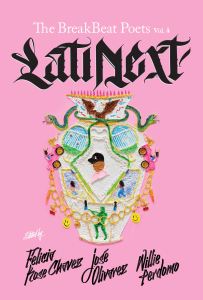
new publication: The BreakBeat Poets Vol. 4: LatiNext!

LatiNEXT Final

Just a quick post to share the release of the latest BreakBeat Poets anthology, The BreakBeat Poets Vol. 4: LatiNext edited by Felicia Chavez, José Olivarez, and Willie Perdomo and published by Haymarket Books. Super-excited to share news of this release – in part because my own poem “La Llorona Watches the Movie Troy” is featured in its pages alongside the work of a phenomenal community of poets including Sara Borjas, Javier Zamora, Denice Frohman, Peggy Robles Alvarado, John Murillo, Janel Pineda, Juan J. Morales, Benjamin Garcia, Jasminne Mendez, Elizabeth Acevedo, and Yesenia Montilla among so many stellar writers.

I’m also excited and grateful to the editors for creating a space representative and celebratory of Latinx poetry in its multitudes. In these pages are the stories and aesthetics of “an array of nationalities, genders, sexualities, races, and writing styles, staking a claim to our cultural and civic space.” I am proud to be a part of this event and look forward to the anthology’s success and impact.

In the spirit of celebration, I am sharing mine own contribution, “La Llorona Watches the Movie Troy” below. I spoke with a friend recently about what this specific poem being included means to me. This poem was one of the last ones revised in time to make it into my second full length collection, Small Fires (FutureCycle Press). So close it was to the then deadline that I never got a chance to send it out. One of four poems about La Llorona in that book, this poem had me exploring what it would be like to have her speak. The first draft was written the summer of 2004 when I lived in a house without electricity in Corpus Christi. Because it was summer in South Texas, I tried to stay out at the dollar movies for as long as I could. I ended up watching a lot movies on repeat, in particular Troy and Spiderman 2 (my book Everything We Think We Hear has the piece born from watching Spidey a bunch).

The first draft was very much heavy-handed and primarily focused as a statement against George W. Bush’s presidency and invasion of Iraq. That draft lived dated and lost for a good number of years. When it came time to work on Small Fires and its tetralogy of Llorona poems, this one came back to mind as being in conversation with that book’s statements of identity and conflicted nationalities. Letting La Llorona speak and harangue America via the actors of the movie still feels right. That the editors of this anthology saw fit to include this poem in an anthology full of similar conversations also feels right.

*

José Angel Araguz

La Llorona Watches the movie ‘Troy’


She watches Brad Pitt leap, then land a stab
like a hammer blow down, spends time taking in
the bronze skin of the actors, the way the say ‘grass’

like ‘toss,’ ¡Todo British! She snags popcorn
by the handful watching the gods
be shrugged off by warriors. During the scene

where the Greeks scurry from the Trojan horse,
their shadows fingers pulling at string
and unraveling the night, her breath is sand

and crackling flame. When they run towards fire
in the desert, towards collapsing roofs
and digitized screaming, the montage

of faces, of bodies pushing against each other
has her whispering to no one in particular:
¡Mira Baghdad, mira Juarez! And no one

in particular hears her over the Dolby
of swords being unsheathed. She begins to hum,
letting her voice hit the same notes

as the opera singer overlaid during the carnage.
Should anyone look over, they’d see
the silhouette of a woman in the third row

treating the forty-foot screen like an altar.
When, after seeing the toppling of statues
and the scavenging through offerings

to Apollo, sun god, the one who sees everything,
the aged and fallen king staggers in defeat
and cries out: Have you no honor!

Have you no honor!, she gasps and nods,
as if watching a telenovela unfold
according to how she would want it. Truth is,

she has seen this all before, has drowned
the brown bodies, has plucked gold coins
from river water before any boatman

could make his way to her. She knows
the blonde and blue-eyed have arrived
to play both hero and love interest again,

that though Helen here is a vagabond Marilyn,
she used to have un poquito de chile
in her blood, y un puñado de lodo

 in her heart. That’s why it’s a woman
who says: If killing is your only talent,
then it is your curse, and says it

like one slapping their hand against the river,
a sting in their hands for a while. Truth is,
there will always be a Brad to leap, and hit hard,

the thud through the speakers like a heartbeat.

*

Copies of The BreakBeat Poets Vol. 4: LatiNext can be purchased from Haymarket Books.


microreview: Word Has It by Ruth Danon

review by José Angel Araguz

word has it

One of the things I admire about Ruth Danon’s Word Has It (Nirala Publications) is how the collection brings together via short lyrics and prose poem sequences a vibe of being a spy of language. I say “spy” and mean specifically a sensibility able to evoke the range of curiosity, intrigue, and vigilance that is associated with the heightened awareness one might associate with a spy. In “Floridian,” for example, we have the following lines:

Unseasonable chill in the palms.
Fronds I mean, and also the cold
fingertips that touch them.

Here, the wordplay that occurs across the punctuation and line break on “palms” of the first line, and the addition and jolt of the second line’s “Fronds” emphasizes both the human and plant double meaning in the words as well as the speaker’s awareness of this connection. It’s a pun of sorts rendered in a tone that is intriguing, as the formulation of “Fronds I mean, and also” have an air of nervousness as the lines continue back to the original human sensory association of “cold / fingertips.” This back and forth of sensory and conceptual perception is engaging for the way it creates an air of heightened awareness which has us in a different place than expected given the title “Floridian.”

This engagement with the unexpected continues throughout the book. In “Domestic,” there are three moments that riff on the concept of a shot of whiskey around which the poem is developed. Here are the opening lines:

“Shot of whiskey,” she thought, from
nowhere, not because she ever drank
the stuff, but because it seemed the kind
of random association one might have at
the end of a long day.

These lines are effective in the way they intellectualize associations around taking a shot, using phrases like “drank / the stuff” and “the end of a long day” to ground the poem in a heightened sense of the familiar. This familiarity is then riffed against in moments like the following:

“Shot through with light,”
was an expression she liked. Radiance or
the idea of glowing from within seemed
a worthy aspiration.

Here, the word “shot” from the start of the poem is repeated but changed from noun to verb. This change evokes the sensibility of the “she” being described who has gone from the poem’s opening “random association” to this aspirational one. It is a moment of hope, in a way, where the interrogative tone is left for a moment. This moment is short-lived, however, as the poem quickly narrates how “Unruly she was,” and then takes us to the ending where “She looked ahead, steady / on her feet, or so she thought.” The charm of this poem is how the established heightened awareness takes the idea of a shot of whiskey at the start and through the poem’s development gestures towards inebriation as a state of being due to overthinking.

There’s a moment in the sequence “Divination” that presents an encapsulated version of this idea of heightened awareness:

Consider now that the birds scrawl their
messages and you are too far from the sky to
read their words.

What then?

It is in asking “What then?” after the logic of birds scrawling messages we can’t read that the heart of the collection pulses. The human spying we do of language, so to speak, is frustrating work. At the end of the day, we don’t know the world through words, we know only words and persist with our vague sense of the world. The act of writing in Word Has It is imbued with a charge of responsibility and need despite this frustration, however. In “Birding” (below), the poem’s play and progression of thought show how much can be seen in light of having our “stupid eyes closed.”

*

Ruth Danon

Birding

So listen, let me confess, I do not live in a world
that lends itself easily to description or evocation
or adoration. In my ordinary life I face one brick
wall on one side and another brick wall on the
other. I do not even have words to distinguish
one brick wall from another and if there are
windows in yet another wall they give over to a
wall on the far side of any small opening. I envy
those who stand quietly on shores and watch
plovers. I do not know what a plover looks like
and I do not know if it makes a sound. The word
contains the word “lover,” and also the word
“over” and that is yet another brick wall. I
believe in the power of birds, but I do not know,
not for a minute, how to describe their quivering
hearts or their flights or the mad plunge of
herons into salty marshes. A little while ago I
washed my face in clear water. I plunged right in,
my stupid eyes closed.

*

To learn more about Ruth Danon’s work, visit her site.
Copies of Word Has It can be purchased via SPD.