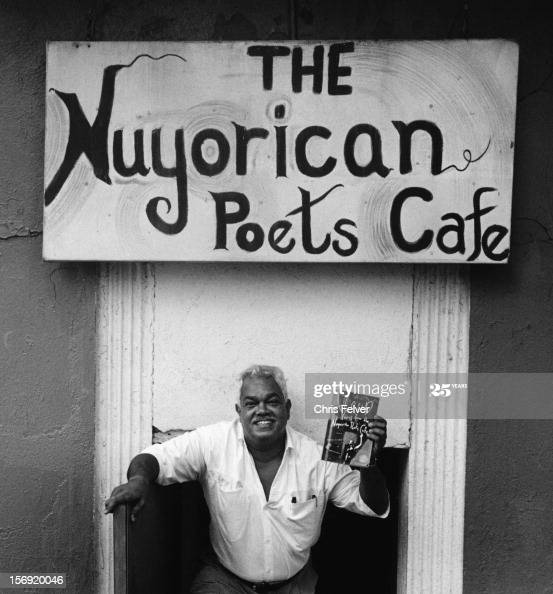
I’d like to dedicate this week’s post to the memory of Miguel Algarín, Puerto Rican poet, writer, and co-founder of the Nuyorican Poets Café who died earlier this week. Algarín was the embodiment of being a poetic presence on and off the page. His poetry set precedents by holding space for political struggles and literary insights that represented the various communities he worked and taught in. His work through the Nuyorican Poets Café as well as in his teaching showed him as a model for holding space for poets from all backgrounds.
The more I teach, the more I feel that the classroom is a space of confluence, a space where the experiences of my students and those of my own all meet, eddy, and converge, a presence. A stage can be a classroom as can the page. Across these three spaces, Algarín touched a great number of lives, influencing directly through community-minded efforts as well as through a singular understanding of languages.
The poet Rich Villar in a recent set of tweets shared the following sentiments:
I think it’s good to celebrate the Nuyorican Poets Cafe. It’s good to celebrate and mourn Miguel Algarín. It’s also good and important to celebrate Miguel’s IDEA of the cafe, the “poetics” of community, which is genius particularly because anyone can replicate it.
So many spaces and places defined what became known as the Nuyorican movement. None of it required official sanction or 501c3 status. It required two things: need, and audience. Even the old squat on 3rd Street wasn’t necessary at first. Any old space would do.
Villar goes on to share the example of Elisabet Velasquez who, among other things, is conducting a series of stories on Instagram highlighting poets who answer questions asked by her followers. I agree with Villar when he compares Velasquez’s use of social media to hold space in the spirit of Algarín. That when one looks outside the capitalist-driven and prejudice-strained world of literary publishing and awards, one sees that giving and honoring each other is easy. That answering a question on social media or mentoring someone through email correspondence is easy, is community. One of the great joys of running this blog is being able to connect with y’all and create community.
It is an understatement to say that Algarín’s example is not just a literary one but a human one, a political one, a socially aware one. It is one I continue to learn from. To return to teaching: it is a platitude for a teacher to say I learn from my students. But what does that really mean? It means I commune with my students. I listen to my students. I build with them. Again, all one needs to commune, to listen, to build and learn is to hold the space for it.
I encourage y’all to hold space with some of Algarín’s work as well as to share it. Share your own work. Share your voice. If you’re reading this, know that I’m glad you’re here.
2 poems
“Not Tonight but Tomorrow (1978)”
“New Year’s Eve December 31, 1975”
A write-up on Algarín’s life at The New York Times.

 The Influence