This past week, I found myself reading the essay “Verbiage for Poems” by Jorge Luis Borges (found in On Writing, Penguin Classics), and coming across a marvelous paragraph – emphasis on the ‘marvel,’ something of strange weather patterns moving across the sky in the middle of an ordinary afternoon about this paragraph.
In my enthusiasm, I found myself reading the words aloud to myself as I would a poem, which naturally led to my writing them out in my notebook. I pushed my fascination further by rewriting the prose into lines (loose iambics).
I present the fruits of my efforts below, calling it a lyrical alignment, something of what chiropractors do to backs – but hopefully less painful 🙂
There is a tradition of this kind of thing, a branch of ‘found’ poetry (Jose Garcia Villa immediately comes to mind as an early ‘aligner’). I enjoy reworking prose in this manner both for the way it keeps my ear sharp as well as for how it allows me to sink into the diction and phrasing of a writer.
I hope to share more of these as they come up in my reading and note-taking. For now, enjoy how Borges redefines the way you look at nouns.
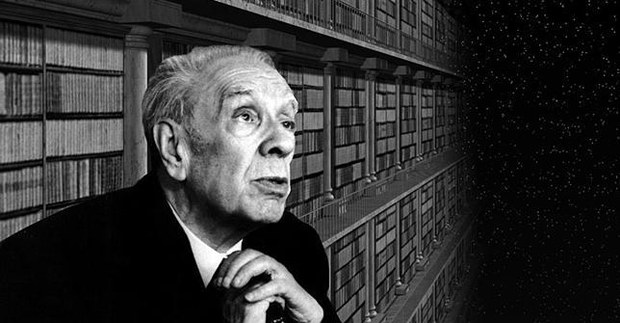
* a rainbowhurricanehailstorm of a writer *
“The world of appearances…” – Jorge Luis Borges
The world of appearances is a jumble
of shifting perceptions. The vision of a rustic
sky, that persistent aroma sweeping the fields,
the bitter taste of tobacco burning one’s
throat, the long wind lashing the road,
the submissive rectitude of the cane
around which we wrap our fingers, all fit together
in our consciousness, almost all at once.
Language is an efficient ordering of the world’s
enigmatic abundance. Or, in other words,
we invent nouns to fit reality.
We touch a sphere, see a small heap
of dawn-colored light, our mouths enjoy
a tingling sensation, and we lie to ourselves
that those three disparate things are only
one thing called an orange. The moon itself
is a fiction. Outside of astronomical
conventions, which should not concern us here,
there is no similarity whatsoever
between the yellow sphere now rising clearly
over the wall of the Recoleta cemetery
and the pink slice I saw in the sky above
the Plaza de Mayo many nights ago.
All nouns are abbreviations. Instead of saying
cold, sharp, burning, unbreakable,
shining, pointy, we utter “dagger”; for
the receding of the sun and oncoming darkness,
we say “twilight.”
***
Happy twilighting!
Jose
p.s. Please check out my poem “De Soto National Memorial Park” in the latest issue of the Rappahannock Review here.
 The Influence