They staunched the wound with a stone.
They drew blue venom from his blood ……….until there was none.
When his veins ran true his face remained
lifeless and all the mothers of the village
wept and pounded their chests until the sky ………..had little choice
but to grant their supplications. God made ………..the boy breathe again.
God breathes life into us, it is said,
only once. But this case was an exception.
God drew back in a giant gust and blew life into the boy
and like a stranded fish, he shuddered, oceanless.
It was true: the boy lived.
He lived for a very long time. The toxins
were an oil slick: contaminated, cleaned.
But just as soon as the women
kissed redness back into his cheeks
the boy began to die again.
He continued to die for the rest of his life.
The dying took place slowly, sweetly.
The dying took a very long time.
Francisco de Quevedo, my bespectacled friend above, was known for having a life philosophy which, at its core, believed that we begin dying the moment we are born. One could argue that this is simply a way of choosing a side in the old “is the glass half full/half empty” query. There’s a subtle, complicated optimism, though, to his statement, that is easy to miss. One gets a better sense of the man’s thoughts in another quote:
Polvo serán, mas polvo enamorado.
Which roughly translates to: Dust be , but dust in love .
2015 was a tough year. About midway through, I found myself in the hospital due to some stomach issues. Having one’s life fall from them, even for a moment, is humbling. On the ground, in the dust, humbling. But then, as this week’s poem describes, there is the “giant gust” that brings us back to life, and returns us to our dying. Ahmed’s poem wins me over each time I read it for the way life is evoked in several actions, and moves from reality and rite to a hopeful, complicated reconciliation.
As the first week of the new year ends, I want to wish all of you who pay me the compliment of visiting this blog and visiting my poems the best in all aspects of your lives. I wish you another year of being dust, but dust in love.
Time once again for my end of year reading – which technically this year is more of a first of year reading – so however you feel fit to see it, please do. See it, that is.
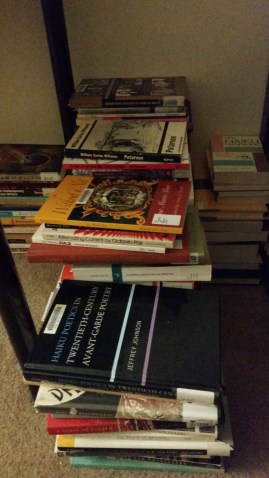
I have been busy the past 3 weeks reading through the last leg of my reading list for my exams later this month. Here be the last stack(s) of books:
If you’re like me and can’t see a photo of books without scanning to see who’s in the “crowd,” here’s a short list of what’s visible:
a book on haiku poetics; Borges’ Dreamtigers; A Sense of Regard (essays); By Word of Mouth (William Carlos Williams’ translations); Pablo Neruda and the U.S. Culture Industry; Without a Net by Ana Maria Shua; two books by Octavio Paz; Rigoberto Gonzalez’s Butterfly Boy (sans-book jacket, esta frio!); La Otra Mirada (microrrelato anthology); William Carlos William’s Paterson; Complete Works and Other Stories by Augosto Monterroso; Takuboku Ishikawa’s Romaji Diary/Sad Toys; Conversations with Mexican American Writers (interviews); Sandra Cisneros’ My Wicked, Wicked Ways; Rosa Alcalá’s Undocumentaries; Pat Mora’s Aunt Carmen’s Book of Practical Saints; & flanking the stacks: William J. Higginson’s The Haiku Handbook; Juan Felipe Herrera’s Half of the World in Light.
***
I took a break last week to record a few readings from Everything We Think We Hearby the Ohio river after eating our annual Christmas Eve Eli’s BBQ. Below is the video and text of “Jalapeños” and “Holiday Policy.”
Looking back, I realize these two poems are a good example of the kind of range I was going for in this collection. “Jalapeños”is a kind of homage not only to the chili pepper but also to Yeats, family, and Corpus Christi, all refracted via nonlinear, lyrical momentum. “Holiday Policy,” on the other hand, is driven by a more linear narrative, but is subverted in its story within a story framework.
Enjoy!
*
Jalapeños – José Angel Araguz
Pickled, you gleam, a smile hiding its teeth. Photo negative from Picture Day, money missing from my pockets, that smile. I can live without money; without food, I’m useless. Hunger is a tide: I walk down when it is low and see more. Over time, you’ve taught me to fashion sensibilities after what I can tolerate. When I am old and gray, and have eaten enough, I will tolerate everyone. When your darkness first cracked, did everyone go silent as you spilled out your many, tiny moons? And did he think himself a sky, the first to place your moons upon his tongue? Or was it only later, after biting into your body, thinking his own body turned water, that the first looked down and found, piled in his hand, the dunes of ellipsis you keep inside? You are commas, keep each bite separate. You are semicolons, a tip of the hat to greet the day. Shape suggestive of the J in my name. Shape suggestive, period. My aunt threatening with you if I ever cussed. Sting of I should’ve known better than to. Without you, I am useless. Corpus Christi Bay begins to glisten with you. You keep riding on the color of the waves, mocking, many and mocking. Family pickled. Family sharp with vinegar. Family broken with bites. Hunger is a tide: when it is high, I remember I cannot swim. Through skin and seed, my filthy existence resumes, after the sting.
Holiday Policy – José Angel Araguz
My friend, who with his white beard and wide chest looks like Santa Claus, tells me of working at a liquor store and having to take polaroids of people paying with a check. He did this when he was my age, but because I am my age, my friend becomes Santa with a camera and nametag, standing as straight as steel bars on windows, watching me buy my liquor. He laughs telling the story, but the Santa whose eyes are hard on me is silent. Under white eyebrows, I see myself already doubled, following the motions of the story: white flash, pen collapsing on the counter, bottles pointing fingers from brown paper bags, fluorescence hum below the words: Holiday policy. The photo hangs like a tongue out of the camera’s mouth, my face slowly appearing from gray-white to a grainy, blurred reflection. It was enough to put cash in their pockets, as if it had been there all along, says my friend in the story, who himself dissolves into the friend in the room, grown quiet, as if he could hear himself speaking in the memory I would later have of him after he died, and disappointed that there isn’t more to him than stories like this one.
*
Happy policying!
Jose
P.S. Check out my Instagram account (joseangelaraguz) for two more shorter readings!

 The Influence