* some words from Basho & the friday influence

This week The Friday Influence introduces the “some words from” feature – on the last Friday of each month expect a quote or two from poets that have and are presently influencing my work or simply blowing my mind.

Our first feature: haiku poet Matsuo Basho!

Sabes sabi?

Here he is talking about the idea of sabi:

“Sabi is in the colour of a poem. It does not necessarily refer to the poem that describes a lonely scene.  If a man goes to war wearing a stout armour or to a party dressed up in gay clothes, and if this man happens to be an old man, there is something lonely about him.  Sabi is something like that.  It is in the poem regardless of the scene it describes – whether it is lonely or gay.  In the following poem, for example, I find a great deal of sabi.” *

                        Under the cherry

                        Flower guards have assembled

                        To chatter –

                        Their hoary heads together. 

In citing this poem (by one of his disciples), Basho illustrates sabi as something to be experienced, a thing to be completed through the engagement of the reader.

This attention to not only what goes in a poem but what it does in each of us is part of the reason is why I return to Basho’s work often.  He gets this poetry thing in a way that expands it, gets it in a way that shows the way for others.

He is one of the great travelers, both on the road and the word.
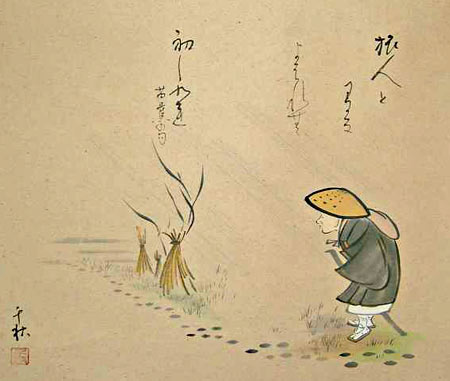
Here’s an excerpt from Basho’s travel journal, The Records of a Travel-worn Satchel:

“In this mortal frame of mine which is made of a hundred bones and nine orifices there is something, and this something is called a wind-swept spirit for lack of a better name, for it is much like a thin drapery that is torn and swept away at the slightest stir of the wind.  This something in me took to writing poetry years ago, merely to amuse itself at first, but finally making it its lifelong business. It must be admitted, however, that there were times when it sank into such dejection that it was almost ready to drop its pursuit, or again times when i was so puffed up with pride that it exulted in vain victories over the others.  Indeed, ever since it began to write poetry, it has never found peace with itself, always wavering between doubts of one kind and another.  At one time it wanted to gain security by entering the service of a court, and at another it wished to measure the depth of its ignorance by trying to be a scholar, but it was prevented from either because of its unquenchable love of poetry.  The fact is, it knows no other art than the art of writing poetry, and therefore, it hangs on to it more or less blindly.”

***

Happy hanging!

jose

* all quotes in this post come from Nobuyuki Yuasa’s translation of Basho’s The Narrow Road to the Deep North and other travel sketches.

** photos snagged from here and here, respectively.

* Akhmatova & some news on the friday influence

Willow – Anna Akhmatova

 “And a worn-out cluster of trees.”

                                  — Pushkin


In the cool nursery of the young century,

I was born to a patterned tranquility,

The voice of man was not sweet to me,

But the wind’s voice I could understand.

I loved burdocks and nettles,

But the silver willow best of all.

And, obligingly, all my life it lived

With me, and its weeping branches

Fanned my insomnia, with dreams.

But – strangely – I’ve outlived it.

There’s a stump, with strange voices,

Other willows are conversing,

Under these, under our skies.

I’m silent…as if a brother had died.

***

This week on The Friday Influence: the great Russian poet Anna Akhmatova.

Akhmatova lived under the reign of Stalin and consequently had her work censored and condemned by the government.  She is known best for her poems of witness during these times, notably the poem cycle “Requiem”.  I first discovered her work while reading Carolyn Forche’s book “The Country Between Us”.

The poem above was the first poem I came across when I laid her collected poems on a table at a bookstore.  I should point out that her collected is 948 pages long and so the book kinda flopped open to this poem.  There were a few weeks that summer where I repeated this exercise over and over again to sheer illumination.

In “Willow”, I am taken in by the power of the direct address.  There are some poets who send the “you” out in a poem and you can dodge it.  Here, the tone of the poem is such that you feel taken into the confidence of the speaker.  While the speaker does not speak to a “you”, it is felt no less distant.  I guess I could call it an indirect direct address.

Whatever it is, the poem pulses with it, and I read the last line for all its implications of loss.  The worlds traveled here, nature, human, dream – all ring in that last line.

This intimate address makes sense seeing as much of her early work is made up of love poems in this vein:

‘He loved three things, alive:’ *

He loved three things, alive:

White peacocks, songs at eve,

And antique maps of America.

Hated when children cried,

And raspberry jam with tea,

And feminine hysteria.

…And he had married me.

It takes not only nerve to say something like this but to write it, and write it well.

***

While thinking about Akhmatova’s intimate tone, I found myself thinking about the tanka poet Izumi Shikibu.  Something of Akhmatova’s connection with the willow and the heart can be found in this:

Sleeplessly

I watch over

the spring night—

but no amount of guarding

is enough to make it stay.

(Izumi Shikibu) **

***

In other news, my chapbook, The Wall, is officially out from Tiger’s Eye Press.  I am working on a page for this blog with excerpts and ordering information but for now please know info on how to order a copy can be found here:

http://www.tigerseyejournal.com/chapbooks.html

Ok, fine.  I’m excited.

***

Happy exciting!

J

* translated by A.S. Kline here:  http://www.poetryintranslation.com/PITBR/Russian/Akhmatova.htm

** translated by Jane Hirshfield, The Ink Dark Moon (read this!!!)