This summer has me putting in office hours on campus, spending the mornings thinking through the syllabi & co. for the courses I’ll be teaching in the fall. I then, to varying success, allow myself time in the afternoon to work on writing projects, including a nonfiction essay collection, a book of poems in Spanish, and new poetry collection.
Could be the range of the projects, how each pushes me to different thresholds of memory, presence, and ability, but I’ve been experiencing pockets of doubt, not of the projects exactly (but maybe), more of my sense of what it means to articulate. If language is a wooden dock leading across water, then this doubt is the appearance of missing wood planks here and there, which make me falter, slow, change my gait. I’m sure it’s all part of another season in my understanding of writing and its place in my life, but damn if it ain’t awkward.
 I feel some of this awkwardness, at least in spirit, is evoked in Rae Armantrout’s poem “With” (below). While the poem doesn’t contemplate some odd metaphor of water and wood planks, its three sections stir up some dust around words and the meaning-making process. The first section brings attention to action, only to end on being “still.” This stillness is furthered in the second section by the mention of the act of writing. Yet, the dichotomy of action and stillness remains in the apt use of “or” and how it splits what the stanza presents into indecision. The third section departs in another direction, focusing on the word “with” and its inexactness. Armantrout’s sensitivity to language creates a moment that leaves the poem open-ended in a way that feels, in itself and the reading experience, like closure.
With – Rae Armantrout
It’s well
that things should stir
inconsequentially
around me
like this
patina of shadow,
flicker, whisper,
so that
I can be still.
*
I write things down
to show others
later
or to show myself
that I am not alone with
my experience.
*
“With”
is the word that
comes to mind,
but it’s not
the right word here.
*
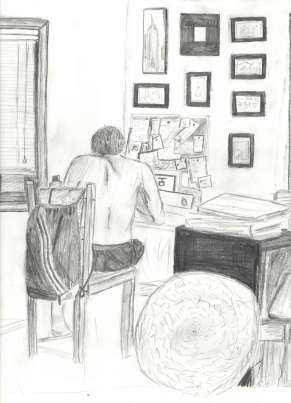 The pencil sketch of me at my desk was done a few years ago by my wife. What is shown in it points to the thread between the various where’s as well as the how and when. There is a particular engrossment that I fall into when I’m writing, and it is the source of a lot calm and excitement at the same time. In the sketch, I am at my present desk, a mess of notes on my corkboard, stacks of papers at my side. These are expected details, in a way, part of the writer-hamster wheel.
 The Influence