This week’s post consists of two parts: First, a blog post I wrote for a journal a few years ago that, for one reason or another, wasn’t used by them. The prompt was to describe your writing space and how you write, and also to include a picture of that space. The pencil sketch that constitutes the “picture” of my writing space was done by Ani Schreiber (@anischrieberart).
The second part of this week’s post is a poem of mine, “Engrossed,” which I thought would be a good complement to my discussion of engrossment and how I write.
Most of what I talk about in this piece still applies to my process now. The cities may change, but the page, the page is always present (presence).
Enjoy!
*
HOW I WRITE – José Angel Araguz
The short answer to where I write is always: Anywhere I can. From subway trains to park benches, as long as my notebook is with me, I’m good to go. The answers to how and when are also short: By hand, and daily. I try to take at least thirty minutes a day to work out a few lines as well as to revise and jot down some notes on daily life. I prefer to write by hand because it keeps me close to words, to the messiness and pressure. I mean literal messiness, as my palms are often blotted with ink after a writing session. I usually find time in the morning; if not, I’ll steal some time between tasks later in the day. I also keep a bullet list going of things to write about later. If I keep at it, the list never lasts too long, and it also helps focus and do some memory work: What was it about the squirrel with half a tail that I wanted to say?
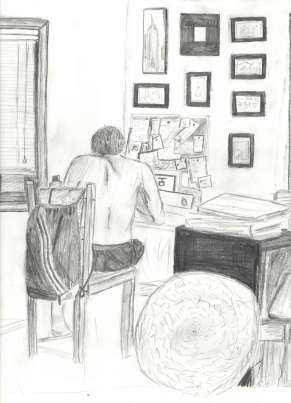 The pencil sketch of me at my desk was done a few years ago by my wife. What is shown in it points to the thread between the various where’s as well as the how and when. There is a particular engrossment that I fall into when I’m writing, and it is the source of a lot calm and excitement at the same time. In the sketch, I am at my present desk, a mess of notes on my corkboard, stacks of papers at my side. These are expected details, in a way, part of the writer-hamster wheel.
What I mean by engrossment, though, can be first seen in terms of what my body is doing. Only one leg is on the ground, barely; the other is up on the chair, tangled under me in what I’m sure is an unhealthy sitting position. Also, though I write with my right hand, my left shoulder is for some reason raised. Sometimes I rock a bit while I write; couldn’t tell you why, except that it is unintentional, and something I only catch after I’ve been doing it for a bit. The other thing to observe in the sketch is that I’m shirtless and in my boxers. This is kind of embarrassing to share, now that I think about it. But that’s just it: When I write, and how and where, all come together to get me to a place where I’m not thinking, where I’m lost in reverie or revelry to the point that I don’t even notice the scratch of my wife’s pencil behind me.
*
Engrossed – José Angel Araguz
Grabbing a raincoat, I find a moth and ask:
What do you do here in my closet,
what of your light –
to which he says: At the end of each night,
my light goes into my soul, what of
yours? The day is then
the weather’s blue colors, mirrors and rain,
that almost white where a thick darkness
blurs with a thick light.
Standing there, I see myself almost a man,
almost a moth, pieces of
a remembered face
brought up, overlapping, as if the changing face
were on old film, and that old film
played across moth wings
holding their position. Almost myself
frame by frame and without sound,
imposed on dust
for an audience. Almost my face holding
still, and face turning away. Face
of wing-wilt and wend.
Grabbing a raincoat, I found a moth and asked
myself about light, and myself answered
light; a moth
throbbed at having been found. When
my words had flickered aloud, the moth,
too, flickered,
an unknown face caught cringing, unfolding
face laughing, face
forgetting its name.
originally published in Qu
 I feel the spirit of Handal’s poem lends itself to this particular exercise because of its logic and progression. Line by line, the poem deploys its images and metaphors, each one a turn down the hallway of the poem, a turn that leads to only more hallway, no doors or rooms. As the reading experience grows and the mind tries to gather a narrative from the lines, a lyrical logic takes over, and, instead of a linear narrative, what is evoked is the feeling of what is present slipping out of sight. This pattern of impression and shift of thought contains a spontaneity and surprise similar to that experienced in the writing of an exquisite corpse.
 The Influence