* layers via michael s. harper & basho


Village Blues – Michael S. Harper

The birds flit
in the blue palms,
the can workers wait,
the man hangs
twenty feet above;
he must come down;
they wait for the priest.
The flies ride on the carcass,
which sways like a cork in a circle.
The easter light pulls hims west.
The priest comes, a man
sunken with rum,
his face sandpapered
into a rough of split
and broken capillaries.
His duty is cutting
down the fruit
of this quiet village
and he staggers slowly, coming.
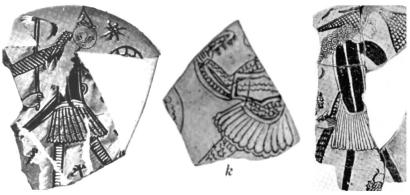
12th_century_Greek_Warrior_Fustanella

Sgraffito, I learned recently, is a technique used in both wall decor and ceramics in which contrasting colors are layered across a surface, only to be then scratched into so as to reveal parts of the underlying layer. The result is an image made of a specific depth and texture.

This week’s poem – “Village Blues” by Michael S. Harper – performs via language in a way similar to sgraffito. Harper writes of a hanged man’s body by choosing to write about the life going on around it. In describing the birds, workers, even the flies at the scene, Harper layers the daily lives of the village over the dead body, and thus makes the presence of the lost life all the more felt. The description of the priest, too, as he “staggers slowly, coming” to the body, becomes imbued with the unspoken. Through indirect association, everything in the village “sways” along to the village’s “blues.”

These thoughts also bring to mind the following haiku by Basho, where the layered images give way to something deeper:

On the white poppy,
a butterfly’s torn wing
is a keepsake

*

Happy winging!

José

* a meditation on brevity with paz, ritsos, & carruth

Writing – Octavio Paz

I draw these letters
as the day draws its images
and blows over them
and does not return


It’s suiting to begin this meditation on brevity with Paz who once said that he admired the short lyric for being the hardest kind of poem to write. Anyone who’s worked out a haiku or tanka in earnestness knows something of this difficulty. With haiku and tanka there are at least parameters, a spirit to leap after. Often, the short poem is a surprise, something arrived at when you intuit the right time to leave a poem alone.


Triplet – Yannis Ritsos

As he writes, without looking at the sea,
he feels his pencil trembling at the very tip –
it is the moment when the lighthouses light up.


I came across this gem from Ritsos in Stephen Dobyn’s illuminating book “Best Words, Best Order.” In it, Dobyns speaks of the nuanced work of the last line as a “metaphysical moment,” one that suggests “sympathetic affinities and a sensitivity to those affinities on the part of the poet.” The power of a short lyric can be felt when one is reading and feels something like “lighthouses light up” inside the mind.


haiku – Hayden Carruth

Hey Basho, you there!
I’m Carruth. Isn’t it great,
so distant like this?


Ultimately, what is at stake in the short lyric is what is at stake in any poem, the translating/transcribing of the human voice. In a longer poem, one can create an argument via imagery and metaphor, what’s being said accumulates like a wave to a crest. The short lyric is the echo of that argument, the sound of foam chisping on the shore. What is compelling about Carruth’s distance is not that Basho feels it, but the reader does.

* wavering *

* wavering *

Happy shoring!

Jose