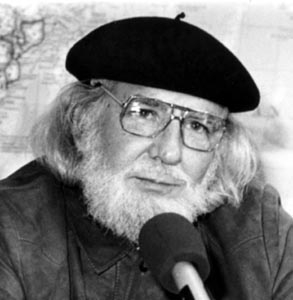
The Parrots – Ernesto Cardenal
My friend Michel is an army officer
in Somoto up near the Honduran border,
and he told me he had found some contraband parrots
waiting to be smuggled to the United States
to learn to speak English there.
There were 186 parrots
with 47 already dead in their cages.
He drove them back where they’d been taken from
and as the lorry approached a place known as The Plains
near the mountains which were these parrots’ home
(behind those plains the mountains stand up huge)
the parrots got excited, started beating their wings
and shoving against their cage-sides.
When the cages were let open
they all shot out like an arrow shower
straight for their mountains.
The Revolution did the same for us I think:
It freed us from the cages
where they trapped us to talk English,
it gave us back the country
from which we were uprooted,
their green mountains restored to the parrots
by parrot-green comrades.
But there were 47 that died.

* cardenal *
For the past two weeks I’ve been doing my best to share with my intermediate composition students what it means to problematize. Last week, one student neatly summed it up as “asking questions to see beyond the surface.” I was so fond of that definition that I’ve adopted it into my day to day thinking.
Poems, in a way, do this kind of questioning, whether explicitly or implicitly. Robert Frost couldn’t just let the two guys build their wall, he had to go and write a poem about it. What else the act of putting words to what we experience but an admission of wanting to understand, to “see beyond the surface?”
This week’s poem, by Nicaraguan poet Ernesto Cardenal, takes us beyond the surface of a story about parrots into what he would understand and have the reader understand with him. The voice remains straightforward to the point that we don’t notice when the “surface” of the story is broken and when the deeper levels of political and personal meaning start to take flight around us.
***
I wanted to take a moment and say thank you to everyone for the good wishes on the release of my new chapbook, Reasons (not) to Dance. The show of support and kindness here and elsewhere has meant the world to me. I am extremely proud of this project. To officially be a “microcuentista” and add what I can to the rich traditions of the prose poem, flash fiction, short-short, microcuento, etc. is an honor. Thank you for being along for the ride!
See you next Friday!
Jose
 The Influence