microreview & interview: Real Daughter by Lynn Otto

review by José Angel Araguz
PhotoEditor_20190608_141411093

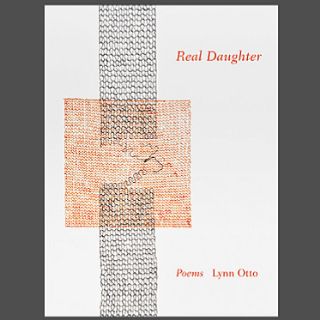
It seems simple to say that what words can point to and hold is a constant source of meditation for me and other poets. Yet, this type of meditation is a high stakes one as it is in contemplating what words can hold that one also necessarily reckons with what cannot be held in words. Reading through Lynn Otto’s Real Daughter (Unicorn Press, 2019), one encounters poems that make use of this meditative space to engage with human conflict.

One can see this in “Marcescence,” which opens the collection with a reckoning salvo:

The beeches’ light brown leaves in horizontal layers
like my mother’s tiered serving trays
artfully placed in the winter forest and here we are,
in another stupid tree poem, this one
about the difficulty of letting go of something already dead.

In these lines, Otto’s speaker braids the direct meaning of the its title — a word meaning “the retention of dead plant organs that normally are shed”* — with family narrative. The first three lines evoke the way memory blurs present moment experience as well as suggests the natural way one understands the world through story. The second line’s simile deftly places nature and family side by side, a juxtaposition further complicated by the return to nature imagery in the third line. The last two lines of this stanza add a further depth to the meditation so far with its metanarrative nod towards the tradition of nature poems. Aware that she finds herself “in another stupid tree poem,” the speaker meets the sentimentality risked in the first three lines with awareness. This awareness furthers the veracity of the poem, allowing the double-meaning of the fifth line’s phrasing “the difficulty of letting go of something already dead” to hit with a compelling lyrical conviction. This conviction is furthered in the second stanza through a listing of words:

Such a fancy word for it when it comes to trees:
marcescence. You could name a daughter that.
Unlike fury. Unlike grief.

Here, the move of braiding nature and family narratives is taken further through the act of naming. There is a telling distinction in the way this speaker considers “marcescence” fit for naming a daughter over the words “fury” and “grief.” Placing these words on separate sides and seeing one as suitable for public use implies a number of things for the other two words. That “fury” and “grief” are human emotions and, therefore, typically kept private due to societal norms; that these two emotions occur in our inner worlds, this versus the public display of marcescence in trees; that, perhaps, these two words in their charged and potent nature eschew the fanciness the speaker sees in marcescence; it is through these copious implications that the speaker’s emotional presence is evoked.

The way these lines evoke this presence is quick and powerful, true to the essence of lyric poetry. This mix of skillful phrasing, hard-earned human voice, and thoughtful imagery render and suggest worlds of meaning througout the poems of Real Daughter. As the poems move through narratives of the roles taken up in one woman’s life (that of mother, daughter, wife), there is always an urgent awareness to see and find enough words for the life lived (and potentially overlooked) outside these roles.

In “Maytag” (below), one can see a good example of Otto’s ability to create a multivalent, compelling speaker. As the poem develops around a narrative about the speaker’s father and mother disputing over a broken appliance, the details begin to color the speaker’s inner world and her handling of a dead bird. The effect of this coloring is evident in the turn in the last stanza as the speaker considers “If my daughter were here.” This speculation creates an emotional depth through its contrast with what actually is done in the poem.

The poems of Real Daughter thrive in this rich space between imaginative speculation and the “real” world of family narratives. As the speaker of “Marcescence” notes in that poem’s ending stanza:

Consider the clean white spaces
between each layer of a family tree.
It isn’t like that at all.

The move to complicate and disrupt accepted narratives implied in this last line underscores the whole of this collection. Through these poems, Otto not only makes clear that it “isn’t like that at all” but also faces what it is like while at the same time providing glimpses of what it could be like.

Maytag – Lynn Otto

It can’t be fixed, says my father
of the dryer, the Maytag of many years—most
of their marriage—and the protest
of my mother, who can’t do laundry anymore anyway,
doesn’t stop him from having it hauled away,
ordering a Kenmore.

What he means is he can’t fix it. He has fallen
and what can a man do with a broken rib?
The third bird in two days hits the window and drops,
a rose-breasted nuthatch I place in a napkin,
but they won’t touch its fine fine feathers for fear of lice.
I’m to throw it in the bay.

If my daughter were here, she would bury it in a small box,
lined with a scrap of soft cloth.
But there’s no time for dead birds.
The crabs creep out sideways to clean up,
and my mother says to call the crematorium the minute she dies.
When the Maytag goes, she cries.

*

Influence Question: How would you say this collection reflects your idea of what poetry is/can be?

Lynn Otto: It seems to me that of all types of writing, poetry leaves the most space for the reader. I like reading and writing poems that give the reader not only sonic pleasure but also the pleasure of discovery–finding connections, layers, ambiguities, and so forth. I think the poems in Real Daughter allow those things to happen. My aim is that they welcome the reader in, and then trust the reader. I think most of the poems can be enjoyed by people who don’t have much experience reading poetry, but readers who want to will enjoy discovering more. The poems don’t over-explain. Neither do they preach or lecture, which brings me to another idea I have about poetry—that is, it’s a genre that generously accommodates uncertainty. A book of poems, even one that’s thematically tied together, can certainly cast about, and Real Daughter does.

Influence Question: What were the challenges in writing these poems and how did you work through them?

Lynn Otto: Ah, well, writing anything at all is a challenge for someone taught that it’s best to keep things to oneself, especially family matters. And the process of putting words on paper—was I writing about what I thought and felt, or were the poems deciding what I thought and felt? The chicken-egg conundrum. Since I was not in the habit of knowing my own mind, it was hard to know what was going on. I’m sure you’ve had the experience of a poem going in an entirely unexpected direction. Of course, although books of poems are classified as nonfiction, they’re certainly not all autobiographical. They are, first of all, made things. Still, at times I wondered whether the poems themselves were putting a spin on things, and were influencing my feelings, even my memories. I worried that family members would be upset. I ended up writing poems that cast doubt on other poems, in effect undermining the reliability of the main speaker of the book. Only then did I feel comfortable sending it out into the world.

It’s funny that the first word of the title is a proclamation of authenticity: “Real.” But the second word is “Daughter,” a word that for me, and I think for many, signals expectations of duty to others, not to oneself. There is a tension in the title that runs throughout the book, and that was also part of my experience of writing it.

*

Special thanks to Lynn Otto for participating! To keep up with Otto’s work, check out her site. Copies of Real Daughter can be purchased from Unicorn Press.

Lynn Otto pic (2)*

Lynn Otto is a freelance academic copy editor and writing mentor, with an MFA in creative writing from Portland State University (Oregon). Her work has appeared in Iron Horse Literary Review, Raleigh Review, Sequestrum, and other journals (see lynnottoinfo.wordpress.com), and her book Real Daughter, winner of Unicorn Press’s First Book Prize in 2017, was published earlier this year.

microreview & interview: Zarzamora by Vincent Cooper

review by José Angel Araguz

zarzamoracover_3_orig

Vincent Cooper’s Zarzamora: Poetry of Survival (Jade Publishing, 2019) is a collection grounded in the great traditions of Chicano poetry. These poems recall the immersive narratives of Jimmy Santiago Baca and Luis J. Rodriguez along with the image-driven lyricism of Gary Soto’s early work. What sets Cooper’s work apart is the distinct perspective of his poetic sensisbility. Whether through dream or memory, Cooper’s visceral lyricism catalogues as well as captures life on and beyond Zarzamora Street.

The collection’s title invites a fitting metaphor. The word zarzamora translates to blackberry which immediately sets one thinking in terms of bramble and tangled overgrowth. Instead of a traditional family tree, these poems deal with family as a similar sprawling entity. Stories of uncles and brothers are engaged in a way that explores a necessary public toughness as well as private depths.

The death of one uncle in particular, Danny, serves as a catalyst for the aforementioned duality, forcing family to open up and reach out to one another. “Five Bullets,” for example, describes a speaker and brother meeeting for “beers and plática,” a ritual public act haunted by personal tragedy. One can feel this haunting in the following stanza:

“I can’t believe Danny is dead,” he blurts.
Surprised, mid-drink, I assent.
The restaurant darkens
and warps into The San Fernando Cememtery.
Bar stools become tombstones.
We dive into Uncle Danny’s uncovered grave.
Stand on his casket
together. Speaking the sacred to the public
worms watching from the niches of the Earth.

This surrealistic blurring and change of scene evokes how sudden memories can come and take over one’s reverie. A similar move occurs in the poem’s ending lines describing a moment as the two men leave the bar: “I leave a tip, as if / a handful of dirt.” Lines like these show how death can color daily life. This imaginative space where memory and feeling blur is where Cooper’s poetic sensibility flourishes.

As much as Danny’s death haunts the speaker of these poems, Danny’s own voice — present in the collection through letters written from prison — serves to further the experience, countering meditations on the life lived with the living presence granted by words. In these letters, the somber, straightforward tone of the poems is checked and challenged by Danny meditating in an imaginative space of his own. Writing from prison, Danny meditates on his own past as well as reaches out and, through his advice to the poet, gestures towards the future.

In one early letter, Danny reflects on family not writing to him:

“Some people have a hard time writing and others like me and you can express ourselves better in writing. Anyway, it doesn’t mean they love us any less because they don’t write. It’s just part of who they are.”

There is a power to this statement that speaks to the heart of the collection. On one level, Danny is working through the complicated feelings of not receiving word from people he cares about; on another level, he is defining the space between him and the poet. In naming “part of who they are” as not being able to express themselves in writing, there’s the implied naming of a part of who Danny and the poet are, a part of them able to honor life through words. As Zarzamora moves through its poems of varied voices and recollections, Cooper’s poetic mission runs parallel to Danny’s epistolary one. Both men are seeking to understand and hold onto lives often overshadowed by death and misunderstanding.

Through unflinching honesty and nuanced lyricism, Zarzamora stands as a testament to the personal lives involved in the poems while also honoring Chicano identity. In this book, Cooper represents narratives and voices often overlooked through poems that evoke their necessary human presence. “Brazos” (below), is a good example of what I mean. Through some riffing with tropes associated with the devil, this poem works out a real sense of the high stakes reckoned with in the world of this book.

Brazos – Vincent Cooper

The devil danced with the most the beautiful
women in the room
before they noticed his feet.
He ran away from the chicanos who chased him
into the bathroom
of the baile where
he vanished,
and Sulphur remained.

He crept behind children playing little league,
hid under the bed of chicano lovers making love,
and laughed in our faces during the depression
of our lives…

And he was present when my Tíos died.
We whispered I love you’s into Mike’s ear
while the devil was massaging Mike’s bare feet.
Saying, “He can’t hear you.”
Told Tony to leave the house
and meet five bullets down the street.
Laughing and swimming in Tony’s pool of blood.
He picked up Danny off the toilet
and threw him onto the living room floor without
air to breathe.
He rode shotgun with Jody.
Infected him with AIDS
watched Jody rot in a prison cell.

He had been present at all our miseries
because the reckless familia
only knows to live on the thinnest edge of life and
death.
Every day with a methadone trip
and heroin and liquor
and worst of all “love.”

They made a fungus of love,
mildew smiles.
Black rotted teeth.
Honey brown chests
with Old English tattoos, on
spore covered stomach muscles.
Their drunken killer smiles dimpled,
telling stories,
our brazos wrapped around their shoulders.
We, the naive, craved their empty promises.
We were naive.

*

Influence Question: How would you say this collection reflects your idea of what poetry is/can be?

Vincent Cooper: I knew, even as a child that I was witnessing something artistic, conversations and other moments resonated. Years ago, a poet said that the first poets you encounter are your tios, tias and primos. This is absolutely correct in my case. My where is South Texas/ Southern California. What I heard were uncles singing and telling jokes. Brown men playing basketball here in the barrio is what I saw. Old schoolers dressed in guayaberas n’ Stacy’s clacking. Smelling like barbecue, tortillas burning on the comal, Old Milwaukee or Schaefer beer and sweat. Some comments or praise I’ve received is “Thank you for sharing personal experiences.” The only thing I can do is write a true and honest account of my experience. I write about being here in the barrio and about missing the barrio. My community. I don’t understand why this wouldn’t be for the literary canon. I write the way I remember it. This is simply the life that we have here in San Antonio.

Influence Question: What were the challenges in writing these poems and how did you work through them?

Vincent Cooper: I am a masochist. The wheels have to be spinning already. There has to be a poem manifesting, prompted by a scene, memory, other writings. It might be an encounter with a relative that will trigger a poem –and it’s typically a negative thing happening that spurs the main idea to the poem. I don’t naturally just go sit at a desk and start typing up a million words. These poems in Zarzamora go back about 10 years. Right around the death of my Uncle Mike, I wrote pages of Westside San Antonio poetry. I debated writing these poems as prose or even as a novel. The narrative style is how I’ve written for at least 20 years. Initial edits by Viktoria made these bits of narrative into poetry. The voice and story was there but she taught me about breath, line breaks –or no line break, etc. She handed me books by Lucille Clifton and Li Young Lee too help build up and process.

Offending relatives was something that crossed my mind and I did remove poems, stories, and letters from Zarzamora. There was one letter where my uncle Danny had written racist comments. He was trying to stick up for me, or cheer me up, regarding an incident that happened in school. I think my relatives who’ve not even purchased the book are probably still offended, but I know this book is my experience not theirs.

*

Special thanks to Vincent Cooper for participating! To keep up with Cooper’s work, follow him on Twitter: @vinnycoop13. Copies of Zarzamora can be purchased from Jade Publishing.

bwvc*

Vincent Cooper is the author of Zarzamora – Poetry of Survival and Where the Reckless Ones Come to Die. His poetry can also be found in Huizache 6, Huizache 8, The Acentos Review and Riversedge Journal. His forthcoming manuscript The Other Side of Semper Fi chronicle’s his tumultuous stint in the Marines pre/post America- 9/11.