microreview & interview: Steven Sanchez’s To My Body

body

review by José Angel Araguz

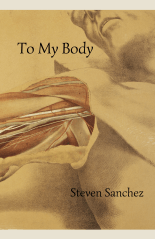
In his chapbook To My Body (Glass Poetry Press), Steven Sanchez brings together a series of poems that explore the ways in which the body learns what it means to be present. In unpacking moments of conflict and joy, To My Body becomes an ode to both the physical body and the body of experiences lived through.

One of the main engines in which this work is done is imagery. Sanchez’s eye for building up to apt and compelling images that speak volumes is evident throughout. In the opening poem, “Homophobia,” for example, a childhood memory of being shamed by a father for being “afraid // to let go” while hanging from monkey bars, ends:

you fall
in the sand and I hear

you sniffle.
You grab sand and squeeze
your hand, each grain

sieving
through your fingers
like water.

This image of moving from “sniffle” to the image of a hand squeezing a fistful of sand works on two levels. First, the grabbing after sand is an act of reaching for and wanting connection; that what is literally close at hand, sand, is something gritty and difficult to keep hold of, however, evokes how distant and unavailable that connection feels. What is being depicted is no less vivid for being a memory; time itself, evoked through the image of falling sand, creates its own grit. Secondly, the speaker interprets this image as moving “like water,” a simile that fruitfully juxtaposes disparate elements. That something rough and solid like sand can move and evoke water places in the reader’s mind a symbol for how fear works. The distance fear creates between people – here, the father and son, but also the son and themselves – often forces people to live parallel lives. The speaker is being asked in this moment to understand the hardness of difference, to let go of the hurt they feel while it is undeniably physically and emotionally present.

Similar image work occurs in the poem “Paleontology” whose opening lines set up the following scene of domestic violence:

My father threw second hand encyclopedias
at my mother’s back and she blanketed me

between her and the mattress…

This image of a mother protecting her child with her body is then unpacked by the speaker through further connections as the speaker recalls:

…the book splayed open

on my bed where a Tyrannosaurus Rex
assumed a fetal position, her spine

and tail arched into a semicircle,
skull tucked between claws

and into what was left of her chest. Her ribs
pierced the eye sockets of her offspring.

When that six-mile asteroid plummeted
from the sky, did the mother devour him whole

protecting him the only way she knew how
or did she fall onto him after impact…

These lines do a great job of unpacking the complicated implications of the opening image. Present day violence and protection is reframed here and placed within the wider context of existence, which is essentially what is at stake. Through the parallel image of an extinct species in a pose of bodily protection, Sanchez makes clear the dire nature of this moment between mother and son without any loss of the risk, danger, or love that existed simultaneously.

Ultimately, the poems of To My Body present a poetic sensibility able to honor and understand what it means to live through physical and emotional circumstances, to render them for both their darkness and light. In the poem below, one sees this sensibility in the service of coming to terms with one’s self. The speaker’s narrative develops through images of bodily knowledge (“skull’s tenor,” “the dense beat of a palm”), and through these images comes to an understanding, not to say peace exactly, with what it means to live with the dual nature of difference. Where the earlier image of sand falling from a child’s hand evoked conflicted and hurt emotions, this poem’s speaker presents its closing image of shark gills with an edge. To be in possession of “two halves of a sonnet / that can turn an ocean into breath” is to be in possession of a whole expression, two parts of an argument that can both overwhelm and sustain life.

The Anatomy Of Your Voice – Steven Sanchez

Only you can hear the rattle of bones
inside your voice, the skull’s tenor

tucked around the alto of your vocal cords
like the drumhead of a tambourine,

the dense beat of a palm striking skin.
At ten years old you hear yourself

on an answering machine and realize
why kids call you fag–your vocal cords

aren’t strings on a cello and aren’t steel
braided cables suspending a bridge,

they’re membranes slit in your throat
like silver zils in a tambourine ringing

whenever you speak.
Remember to inhale

as if through the gills
on either side of a shark —

seven and seven, two halves of a sonnet
that can turn an ocean into breath.

*

sanchezInfluence Question: What were the challenges in writing these poems and how did you work through them?

Steven Sanchez: I’ve never had much patience. When I was little, I’d untie my shoes in a hurry and usually end up with a tight knot I couldn’t get out. Sometimes my parents helped me out, and sometimes I cut it. While I’ve gotten better at untying my shoes, there’s still this knot I feel inside my stomach.

Up until a few years ago, if you’d asked me what I wanted more than anything in the world, I would’ve told you two things: to be straight and white. I didn’t learn the terms for these desires until grad school, and that’s when I realized how much society had made me internalize homophobia and racism. But the knot I have isn’t learned self-hate, it’s the effects of that prolonged self-hate, and it’s also anger. When California passed Prop 8, it was the first time I felt that knot in my stomach—not so much because of the prop itself, but because everybody around me, at best, was nonchalant. And as time goes on, as more headlines point out everyday injustices, people remain calm, and the knot gets tighter.

The knot never leaves and that was the hardest part was about writing To My Body.  I wanted to unravel that knot, to get rid of it so I could move on to something else. I was hopeful that these poems could be something like a spool, winding up my experiences so that somebody else could use them, but more often than not, the poems ended up tightening the knot. I started becoming frustrated.

Part of my frustration was because I definitely wasn’t ready to write these poems; the other part was that I felt like I kept failing because people said my poems were “political,” which people often used as a euphemism for heavy-handed. What really helped me work through that was reading Adrienne Rich and Audre Lorde. They taught me how the personal is political, that simply existing is a political act, that every poem is political. I struggled so much with the negative connotations of “political poetry” that I’d forgotten how empowering it could be.

Changing my perception about the term political wasn’t enough. I knew that my poems still didn’t do what they needed to; they didn’t surprise me and they didn’t feel natural. At a craft talk, Eduardo Corral mentioned that coming to the poem with a pre-set message you want to convey doesn’t work because you’re not allowing yourself to be caught off guard. Also, Adrienne Rich wrote about the two kinds of political poems: good and bad. Bad political poems create an argument. Good political poems create an experience. I started realizing that because I had a pre-set message I wanted to convey, I approached them like an argument—here’s my statement, here’s my image supporting that statement. Instead, I tried re-creating formative moments in my life on the page without worrying about making a statement, without worrying about resolving those moments, and the knot started to loosen.

*

Special thanks to Steven Sanchez for participating! Find out more about his work at his siteTo My Body can be purchased from Glass Poetry Press.

* microreview & interview: jm miller

For this microreview & interview, I present close readings of two poems from JM Miller’s collection Wilderness Lessons (FutureCycle Press, 2016), as well as share some insights from the poet on the work in their own words.

wilderness-lessons-book-cover

Field Notes (The Arcade Poem) – JM Miller

For fifty cents you can sharpen a fang,
sink your claw around the rifle’s trigger.

Take cover behind the bush, resist the rosemary’s
aroma, and sidle the plastic butt firmly to your shoulder.

Programmed sunset drips in the background, breathe
an arrow down the gun’s sight, you’ve been here before.

A deer hops through the pasture, nibbles oat straw,
looks straight up the rifle’s barrel.

Confess you love the composition, the way
it eases your senses into a finely tuned fork

banging against flawless crystal.
Confess you loved that talented seal on TV who gripped

drum sticks, beat Sweet Caroline into trash can lids
in David Letterman’s uptown studio.

The seal’s name was Henrietta and you wanted to accompany her
with your bamboo recorder like the solo performance

in the lunchroom when you were ten. All red-faced,
asphyxiated, and wanting to die. We were all dreams then.

Shoot the deer. You shoot the deer, drop the rifle,
and leave the bar. Who knew she’d come prancing out—first right to left

then so innocently left to right, begging to be seen.
The landscape drew you in, made a promise.

You became the animal you were meant to be.

*

Miller’s speaker here wastes no time in bringing the reader into the details of the scene. Yet, it is the diction and the subsequent character of narration where the scene comes to life. The phrasing of “sharpen a fang” and “sink your claw” frames a casual first person shooter at an arcade into animalistic transformation. In doing so, the poem amplifies the reality being replicated in the arcade game and immediately points to its problematic nature.

This high stakes approach is pursued as the poem goes on describing the “Programmed sunset…in the background.” The vividness of description is echoed in the speaker’s statement, “Confess you love the composition,” making use of the intimacy of narration to highlight the seduction inherent not only in the play of the arcade game but in the images as well. If “fifty cents” allows one to tap into a more animalistic state, then it is a (re)turn to something already inside human nature, something as tied to human experience as a childhood memory. From the pixellated scene of the game to a pixellated scene of a seal drumming on late night TV, the poem shifts into a parallel that further complicates its meditation on play and performance. Here, the line “The seal’s name was Henrietta and you wanted to accompany her” is telling; in one line, the speaker both humanizes the seal-turned-spectacle but also lays bare a feeling of being caught up in the spectacle (much as the speaker is caught up in the game early in the poem).

Thus, the speaker’s narrative is charged with a mix of culpability and innocence which points to an awareness of the stakes behind man-made “games” and “shows,” and what they trigger inside. In this light, the speaker’s admission that “We were all dreams then,” feels both like an explanation and an excuse. When the speaker admits, “You became the animal you were meant to be,” a note of betrayal and conscience is struck that rings out beyond any pixellated screen.

This note of mortal reckoning is picked up at several points throughout the collection. In the poem “Desert Autopsy (2012),” Miller announces that “the poets have arrived…[to] stand here in the hollowed tree, / language unfolding like children.” The phrase “language unfolding like children” speaks to the sense of witness that poets seem capable of, a witnessing that keeps things new and fresh. An example of this “unfolding language” can be seen mid-poem when the speaker states:

What is the effect of drought?
ask the government buildings
drawing blueprints to save the world,

while a pinyon tree simmers in its bark behind a plexi tower.
It shrivels, starves, lets its branches down.

By placing the question in the mouth of the concrete, inorganic presence of “the government buildings,” Miller is able to work a startling juxtaposition into human terms. While the question’s rhetoric places drought in the realm of the abstract and theoretical, the poem’s emphasis on the pinyon tree image brings us back to solid, living material. In these two stanzas, the image of government buildings and trees sound out the physical absence of humans as well as the full presence of human development.

As in the previous poem, the speaker here is aware of their implied role in this scene. Yet, in this poem, the speaker is able to point to the possibility of expanding their role as witness when they answer the question regarding drought with their own: “I can’t climb this picture, but can you imagine it?”

This second question is a compelling and engaging moment in a poem, and collection, that shows the value and power of such imagining.

*

Desert Autopsy (2012) – JM Miller

The harbor pulls in, pulls its sheet tight, pulling
the ground under.

Wintering conifers lean over the banks examining
barnacle-pendant, seaweed-swimsuit.

I, too, bend my body in the lean
for wild. To walk away from the sea
is to be naked at wartime,
a gazing body.

I remember the wrecked season, white bone
of drought, fire opening its giant jaws in the west,
gypsy moths spinning cocoons of sorrow.

On the last day of the year, pinyons and junipers are dying.
Fences in Los Alamos still breathe fire.

What is the effect of drought?
ask the government buildings
drawing blueprints to save the world,

while a pinyon tree simmers in its bark behind a plexi tower.
It shrivels, starves, lets its branches down.

I can’t climb this picture, but can you imagine it?
You’ve seen the pinyon grow, twisting like wet laundry
devoted to the wind sculpting mesa and valley.

I’ve heard the trees roam at night, calling with their voices.
What was it, the solemn whisper,
What calling rubbed the wind, combed the wintering
pencils of grass, laid bare the open spaces. And then I knew

it wasn’t for me, not me on the wind, not for me
were the long shadows, invisible xylem of veins,
not mine the forged silver, fortune of stars.

Army, the poets have arrived, call your horses, call
the cavalry. Lick your feathers, stick them to the dying.

We stand here in the hollowed tree,
language unfolding like children.

*


jm-headshot-2016

Influence Question: How would you say this collection reflects your idea of what poetry is/can be?

Poetry is an invitation to walk into an empty space of being. I wanted Wilderness Lessons to feel like an opportunity for a reader to walk into their own space and find themselves: their purest, most vulnerable self.

As a trans-writer, it is urgent for me to find myself in my work, it is a form of survival. I am looking for the self beyond labels and projections – the one free from attachments. When I started writing Wilderness Lessons several years ago I discovered a liminal space for existence. This would become known as the “Unbetween” – a place without relationality. I had been immersed in Brenda Hillman’s collection, Loose Sugar, and the poem “Unbetween” was a way for me to have a conversation with her work.

My hope is that “Unbetween” – which is not a space between things, but a liminal space, a nothing space, a no space – invites a reader’s pure spirit and phenomenology to the surface.

I remember reading a phrase from Adrienne Rich, that “poetry is not a healing balm,” nor many other things. But it does heal. It heals through a unique listening, an absolute presence. And it is my belief that as we heal ourselves, we gain the power to heal others, to heal the broken systems of our civilizations that enact oppression and violence against marginalized people and the planet and its beings.

Influence Question: What were the challenges in writing these poems and how did you work through them?

I got in my own way a lot throughout the writing of Wilderness Lessons, and most of that had to do with the need to dismantle the restrictions of what a poem can be or do. For instance, I admire ecstatic imagery and rational rhetoric, and I looked for ways to use them together in a lyric poem. Also, it seems like Round 7 of “End of the World” was the background hum to this collection. I was nearing a poetics of urgency, but still trying to have faith in representation and the lyric.

This book also marks a time of profound transformation in my life: getting comfortable with my trans identity, beginning to dismantle my white privilege, getting married, dedicating myself to teaching, living in a city and finding my way toward becoming an environmental activist. It was an urgent time, one of immense uncertainty. These poems were my way through the times in one’s life in which everything shows up and could be lost. These poems held; they found me and held on.

***

Special thanks to JM Miller for participating! Find out more about Miller’s work at their site. Wilderness Lessons can be purchased from FutureCycle Press.

*

Goodreads Book Giveaway

Everything We Think We Hear by Jose Angel Araguz

Everything We Think We Hear

by Jose Angel Araguz

Giveaway ends December 04, 2016.

See the giveaway details
at Goodreads.

Enter Giveaway