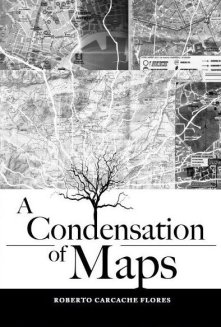
microreview & interview: Roberto Carcache Flores’ A Condensation of Maps

maps coverreview by José Angel Araguz

Treatment – Roberto Carcache Flores

If I could
I’d be your
therapist,
playing
smooth jazz
through
the morning,
one eye
on the clock,
another in
your folder.

I’d browse
through
all those cries
you scribbled
using watercolors
while waiting
for a ring,
to usher
you inside.

My hands
would shake
in yours
like swarms
of moths
around a
lamp shade
until you
grab a seat,
and look me
in the eye.

*

Reading through A Condensation of Maps (Dink Press), I found myself again and again impressed by a poetic sensibility capable of creating images that evoke physical and conceptual movement. In the above poem, this work is set up by the narrative implied in the title, “Treatment.” The speaker develops a brief hypothetical scene, the short lines driving home the intimacy of the address. While the first two stanzas navigate the title’s conceit strictly, speaking in the literacy of the therapist’s office, it is the third stanza’s turn that brings all this metaphor work to a human level. As the speaker’s hands shake in the you’s “like swarms / of moths / around a / lamp shade,” there is a double immediacy evoked, that of hands in hands, but also that of a dire need for direction. This need is implied in the moth imagery, and presents both the speaker and the you as driven by seeking. The empathy here is palpable.

Similar moments of visceral imagery happens throughout the chapbook. The first stanza of “The Fordham Sentinel,” for example, delivers a line by line revelation, one that develops and suggests itself as the six lines move:

Have you checked your bed
for all your fallen pens?
Did the blue stains
on your sheets
leave bite marks
the following morning?

The result is a compelling and unsettling synesthesia: as a reader, I am drawn into the narrative of “fallen pens” and “blue stains,” only to be startled by the implications of “bite marks.” When these elements come together, this stanza does the work of a surrealistic tanka, presenting a personal and immediate meditation.

In “Borders Left Behind,” Flores’ particular brew of imagery and lyric sensibility come to bear on the political. Here, the use of the word “borders” carries special significance. For a poet from El Salvador writing in English, each poem is an act of navigating borders of expression and sensibility. These undertones course through the poem, charging the meditation of the first stanza with an objectivity that is quickly subverted into the intimacy of the second stanza. The political becomes personal in a moment full of human risk and need for understanding.

Borders Left Behind – Roberto Carcache Flores

Imagine
stamping
a black seal
on a feather
every time
an eagle soars
too far from
its nest
or questioning
a vulture’s
motives for its
incessant travel.

The only borders
we should cross
lie across
the eyes
of two
strangers,
even as
we travel
on this bus,
your head
on my shoulder.

*
bookscoffee-2Influence Question: How does this collection reflect your relationship/history with the short lyric?

Roberto Carcache Flores: The collection is ordered somewhat chronologically. The first poems represent my earlier work. Initially I think my approach was much more ambitious. I often tried capturing the essence of places and even bits of history. This is especially true for my “El Salvador” poems, which attempt through longer verses to convey my impressions of different places in my home country.  I still look back at these poems fondly, but with reservation.

Later on, I tried to focus on shorter verses and poems in general. Hence, the collection ends with works that only contain a couple of verses and very little sort of context.  I think my goal now is to merely replicate a specific sensation or thought, trying to say more with less. It can be something like a type of sigh or the meaning of a certain smile.  For better or worse, I now find myself aiming for poetry that is less expressive and more definitive.

IQ: What writers/forms have influenced your sense of sentence, phrasing, and brevity?

RCF: Two specific poems come to mind, since the list of writers who have influenced me is all over the place. The first is a very short poem by Roque Dalton titled “Miedo” or “Fear”, dedicated to Julio Cortázar. The poem says “Un ángel solitario en la punta del alfiler oye que alguien orina.”.  The translated version goes something like: A solitary angel on the needle tip hears that someone is pissing. I believe Dalton wrote this poem while being a political prisoner. Either way, it has haunted me since the first time I read it and completely changed my views on how poetry should work.

I stumbled upon the second poem more recently. It’s an odd sort of poem by Robert Walser titled “Little flowers stand in the field”. The poem involves Walser walking through lovely gardens, drinking coffee, and eating jam and butter. Like most of Walser’s work however, the lightness of these verses foreshadow a precipice, a deeper insight into the fleetingness of these sensations. The final stanza of the poem brings everything back to its essence: “Earth is a house with passageways / and rooms where you abide, / it is the storm and stress in it / that hurry me outside.”

*

Special thanks to Roberto Carcache Flores for participating! To find out more about Flores’ work, check out his siteA Condensation of Maps can be purchased from Dink Press.

microreview & interview: Susan Lewis’ Heisenberg’s Salon

lewis hs

review by José Angel Araguz

Drawing inspiration from German physicist Werner Heisenberg’s uncertainty principle, which “states that the more precisely the position of some particle is determined, the less precisely its momentum can be known, and vice versa,” Susan Lewis’ latest collection, Heisenberg’s Salon (BlazeVOX [books]), presents a prose poem collection that evokes the form’s surrealist traditions while expanding on its logic-making means.

One can see this idea of position and momentum reformulated in poetic terms in these lines from the title poem:

Every time she turned her back, the apartment rearranged itself. Each version created a home for another way of life.

From there, the reader follows the main character adapting to her constantly rearranging apartment, curling up and reading Victorian fiction when she “[discovers] the couch under the picture window,” and setting the next meal when “the dining table was there instead.” In a similar manner, the reader of this collection adapts to each poem’s engagement with and rearrangement of familiar linguistic territory. The aptly named “Indeterminacy” is a good example of adapting to rearrangement:

Indeterminacy

It was time for something, although she could not for the life of her imagine what. So she assumed her post on the stoop & waited for the future to declare itself. A tattered bird of dubious provenance landed on the banister & inspected her with his ancient gaze. She exhaled with emphasis, but otherwise managed to keep her preconceptions to herself. The old fellow cocked his head & screeched. Terrific, she said. How am I supposed to know if you’re the one I’m waiting for? Terrific, he squawked. How am I supposed to know if you’re the one I’m waiting for? I get it, she said, bravely extending her arm. I get it, he echoed, latching on with admirable decision. It was the last conversation they ever had.

Here, the first half of the poem positions two characters in places of waiting. There is a push and pull between interiority and meaning at work; because “she could not for the life of her imagine what” it was time for (keyword here being imagine, an act of interiority), she is forced to look outside herself. Thus positioned, the conversation that takes place in the second half of the poem works as momentum, giving the scene the urgency of question and response. The phrasing of a “tattered bird” also leaves things ambiguous; one can envision a parrot playing out the conversation that follows, merely echoing the other character. And yet, the choice to not be specific about the kind of bird it is leaves room for the fantastical. From this uncertainty, the imagining the other character was incapable of on her own becomes an outer moment of imagination via this “conversation” with the bird.

This transformation via uncertainty plays out for the reader much like the conversation plays out for the characters, strictly in the moment, in the rush as the pieces of the poem come together. There is a thrill in this kind of poetry that speaks of a sensibility awake to the materials at the core a poem, how to get the “tattered bird” of familiar language to say something new. As plot requires conflict, these poems point to lyricism as its pulse.

One of the ambitions of this collection is learning how to be awake to this lyric pulse. The reading act is itself a combination of position and momentum, holding words still in the mind while moving towards the sense implied. In a way, the reader of Heisenberg’s Salon is in the same position as the boy of “One Day” (below) who finds himself literally embodying change, watching the world evolve as the poem develops. Certainty and uncertainty, this collection posits, both happen suddenly and simultaneously. As in the uncertainty principle, one is reckoning with ideas of position and momentum in these poems. Yet, because they are poems – poems whose essence can only be located within the act of reading and being heard, thus, in motion – the interplay leads the reader to a fruitful uncertainty, and, one could say, a lyric certainty.

One Day

grass started growing form the young man’s chest. Everybody changes, said his mother, surreptitiously dabbing at her eyes. But the boy, who was wise beyond his years, felt delicate roots tickling his sternum & knew it was a matter of time before they’d probe his lungs & entwine his heart, crowding the space it needed to expand & contract in its steadfast commitment to preserving his options. As the weeks passed, graceful green strands sprung from his armpits, between his legs, & even, in the finest possible wisps, from his upper lip. One morning he awoke from a luxurious dream of water glossing boulders as smooth & warm as flesh to find a starry sprinkle of tiny yellow blossoms adorning his burgeoning tufts. He had only to be still & tiger swallowtails floated around him, sipping his nectar. Unable to deny the inexorable slowing of his breath, he was content to observe himself contemplate the ramifications of his personal evolution without emitting a watt of excess heat or other sign of agitation.

*

Susan-LewisInfluence Question: How does this collection reflect your relationships/history with the prose poem? What writers have influenced your sense of sentence and story?

Susan Lewis: I love the prose poem! Brevity and density are its challenge and its promise. To paraphrase Whitman, it contains multitudes — like the power to embrace or eschew narrative, meter, syntax, and even the sentence itself.

I began working with the more narratively driven poems in Heisenberg’s Salon as a kind of emotional and intellectual R & R after being immersed in another collection of prose poems (currently called Zoom) which are far more abstract, fragmented, and entangled on the lexical meta-level. This was not my first time exploring this sub-genre: my book, How to be Another, gathered a group of tale-like creatures in the section called e.g. (reflecting my notion that narrative proffers examples, rather than, say, arguments, restatements, or prescriptions — like the other poems assembled under the headings vis, i.e., and Rx).

The rhythms, architecture, and verbal texture of these poems, however, are quite different than those earlier pieces. And my critique of categories, boundaries, and borders has intensified (in the geopolitical context as well). A fish confined to a small container stays a small fish. The same can be said for a psyche. Any insistence on us vs them deprives ‘us’ of the (sometimes challenging) benefit of ‘their’ company and perspective. For this book, I found a kind of metaphorical support for this principle of inclusivity in quantum indeterminacy.

My love of the prose poem dates back to my introduction (thanks to my friend and mentor Chuck Wachtel) to Julio Cortázar’s seminal The Lines of the Hand, and Russell Edson’s Dinner Time, both of which can be relied upon, in a pinch, as complete guides to writing of any kind — be it short story, novel, or poem. (Which is to inveigh, once again, against the unhelpful constraints of such categories).

Cortázar’s other very short works, like many in Cronopios and Famas, and all of Edson’s oeuvre, have wormed their way into my sense of timing and ‘turn.’ Their compressed journeys draw an arc from premise, to ramification and extrapolation, to conclusion — which in different pieces might be more or less conclusive, and more or less shocking, or absurd. They model a kind of imaginative and investigatory digging — deeper, absolutely, but also laterally, towards new terrain — which ends up yielding a skewed and oddly clearer view of their starting positions.

The poems in Heisenberg are also deeply indebted to the work of Lydia Davis and James Tate, both of whom transform the ordinary into the extraordinary by penetrating, judicious, and genuinely inspired elisions, containments, and departures. And Kafka looms over all of us who touch on the surreal in the hope of exposing the tragic absurdity of the real.

*

Special thanks to Susan Lewis for participating! Find out more about her work at her siteHeisenberg’s Salon can be purchased from BlazeVOX [books].