microreview & interview: Michael J. Wilson’s A Child of Storm

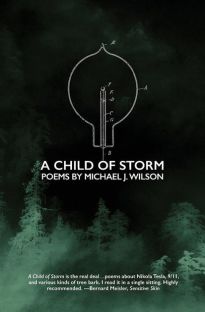
wilson cover

review by José Angel Araguz

Tesla Writes An Obituary – Michael J. Wilson

I left you New York —

Walked the mountain paths of Colorado — found
a field to plant my bulbs

I’m the tired circus sidekick — arms spread — tied to a wheel
waiting for daggers

The clear dark night steamed with Milky Way and nothing

Here is some patent for a ray gun on a receipt for a hat
now — let me spill anonymous electrons in peace

You have your direct currents to the ears of America

I am not inclined to be king
Quietly — I will build a city of light
capture the sun
drive my fists into the ground until I split the earth in two

I will walk into the sky —

Edison, +++++++ you have no hobby —
care for no amusement —
disregard the rules of hygiene —
you have

immense +++ blind +++ contempt +++++ for learning
knowledge
decency

trusting only good +++ American +++ sense —

Leave me in my empty with Clemens

Forget you ever knew a Nikola Tesla

*

Mirroring the image above of “the tired circus sidekick — arms spread — tied to a wheel / waiting for daggers,” the poems in Michael J. Wilson’s A Child of Storm (Stalking Horse Press) approach their materials from various angles. Whether assuming the persona and mythology of Tesla, providing a sequence of history lessons, or delving into the implications of selfhood juxtaposed against nature and city, these poems take aim at exploring variations. Each turn in a poem is another dagger thrown, not to hit the subject directly, but to create a charged air and impact around it.

In the poem above, the Tesla persona is taken on with a directness capable of epic address (“I left you New York”) as well as pathos (“let me spill anonymous electrons in peace”). The effect of this directness is a commanding lyricism. There is command in the way the voice in this and other Tesla poems feels human; yet the lyricism arises not out of the voice but out of the ambition visible behind each poem, line by line.

This poetic sensibility leads to lines that cascade in meaning and image. In “Faraday Cage,” for example, a sequence ends: “May the echo that is my ghost skip on your page like a frame / of film melting.” The travel here is compelling: from the resonance of “echo” and “ghost,” words that imply sound first then mortality, to the moves of logic within the image of a melting film frame, the ambition here is to both evoke and hold, all the while aware of the transient nature of memory. Another moment of lyrical ambition occurs in “Study (Sand Dune and Tree)” and its image of “These flagellant trees / arms raised mid-cat o’ nine prayer.” These two lines work like a Venn diagram, evoking simultaneously the action of flagellation and the stillness of trees and prayer.

This vision runs through the collection, allowing for moments rich in revelation like the following excerpt from “History Lessons: The Rock Dove”:

The pigeon originates in Europe, northern Africa and southern Asia but is found in nearly every city in the world. One of the first animals to be domesticated, pigeons seen today are feral ancestors of birds raised for food, work, or as pets.

While ostensibly part of the history lesson of the poem, these lines read as possibly being about Tesla as well as the speaker in other poems, these various voices aware of a history that both created and estranged them.

Ultimately, a fruitful estrangement results from the ambition behind these poems. In the poem below, the reader follows a scene between the speaker and another person where the unravelling of a sweater at the end of the poem mirrors the unravelling that can occur between two people. The poem moves, however, with an intimacy that grows with each turn of conversation, sense, and memory.

*

Eastern Red Cedar – Michael J. Wilson

You
smell
like
cedar berries +++ and sawdust
mixed with plastic

You say: The radiator is full of steam

It’s closed system
probably full of some black death
we wouldn’t want to know about :

Remember when we had a stove in the kitchen
the grass comes yellow squared where the woodpile is
remembered

How
did
this sweater get a hole in it

How does a moth get passed all that smell

You mumble
Something about an old dog you used to know
a cold snowy day
a fall by the woods
when you were ten
The radiator punches the air and you look
at the discolored circle on the floor where the stove was

You say these things only comfort on the first cold day

That slipped stitches in sweaters only get bigger

*

unspecifiedInfluence Question: How would you say this collection reflects your idea of what poetry is/can be?

Michael J. Wilson: At its core, poetry should be revelation, it should sear. This could be personal, but it needs to be like a shot of light through the subject. It should clear space around itself. I reference St. Teresa a lot in my work. I’m not remotely religious, but the idea of being penetrated by revelation is one I identify with. I equate revelation with the body and mind.

Nikola Tesla felt science the way Teresa felt God. His vision of science – a great light that infused his being – is as close to actual religious ecstasy that I believe one can get in reality. Tesla saw his creations wholesale in his visions, then he made them to match what he perceived. That’s a description of writing. Poetry can, and should, be complete visions laid bare.

Speaking more broadly about books as objects – I am interested in arcs. Narrative and emotional. I wanted this book to feel like it added up to something. Even if that something is ephemeral and indescribable. I find books that feel like random poems collected to be tiring. There are great examples of this kind of book, but I want more. I want them to feel like the best albums do. An experience to be had. They should cohere. I like to think I did a small bit of that with my book.

IQ: How did you navigate the use of persona/research during the making of this collection and what did you learn from this process?

MJW: Research is ingrained in my process. I will spend months reading, obsessively, on a topic. I’ll buy books. Watch documentaries. I will talk about it to anyone in earshot and get my findings tattooed across my eyeballs.

I’ve always been attracted to the weird details in the “truth” of things. The fact that Tesla’s brother died from a fall off a horse. That the idea that maybe Tesla caused the accident somehow. Those things interest me way more than the particulars of his plans for alternating current. That level of research is where I go. The personal, the tiny. So, in a lot of ways they are inseparable.

When writing in Tesla’s voice I tried to just think about how one would behave if this was how the world was seen. And then I blended in my own world view. I found that this created a Tesla that could also talk about my beliefs and issues.

I found that this helped me work through the deaths of several family members. It was almost like Tesla was doing the thinking. It created a persona for myself to navigate the world in this project. And perhaps beyond it.

*

Special thanks to Michael J. Wilson for participating! To find out more about his work, check out his siteA Child of Storm can be purchased from Stalking Horse Press.

author photo credit: Cameron Gay
microreview & interview: Robin Carstensen’s In the Temple of Shining Mercy

carstensen chap
review by José Angel Araguz

Stray – Robin Carstensen

She came howling for food
on the porch in June — tufts
of gray-white hair sprung from her
birdlike strut — huffing a claim
for herself, as if she could
conjure the rain in this brown
drought-struck town, boarded up
houses marked Foreclosed.
On this small plot of land
I’d come back to save, books
in my heart with my name on them,
on these sun-baked planks
on this yellow-scabbed yard,
I’d watched her streak across
the street, tomcat tearing up
her dust. Her screech had stiffened
the humid night. She’d come
for three seasons, gulp my leftovers
beneath the red hibiscus, swish
her smoky plume of tail, brush
by me like a petal, be gone.
In early April, I found her
under the moonlight, her right eye
gouged and black-encrusted,
draining green as if the moon
had wept. Hard news struck
morning: the vet showed a pellet
lodged in her thin neck,
the entrance wound — her blown
eye. As I buried her that night,
children played in the yard
next door. Her milk had been dry.
The litter likely starved to death.
I couldn’t hear myself think
about them. Just the children’s
voices scratching the hot air,
loud and bored, my turn, my turn,
bouncing on the trampoline,
their big, thin skulls bobbing
on their string-bean bodies
soon to be loose on the planet,
roaming beneath the faint
moon bearing earthshine.

*

One of the things that immediately struck me about the poems in Robin Carstensen’s chapbook In the Temple of Shining Mercy, is the way poetic language is placed at the service of empathy. In “Stray,” for example, the speaker meditates on the final days of a stray cat whose life is cut short due to an act of violence. The speaker’s tone throughout conveys a sober wistfulness, able to lay out the details in a direct manner. The phrasing of “as if she could / conjure the rain in this brown / drought-struck town” both paints a picture of the speaker’s surroundings but also implies a certain hope.

This dual turn of imagery and phrasing occurs again at the end of the poem in the imagery of children on a trampoline. As a pellet was found to be the cause of the stray’s death, there’s a slight implication the cat was shot by neighborhood kids. This implication is furthered by the phrasing of “their big, thin skulls bobbing / on their string-bean bodies / soon to be loose on the planet.” The use of the word “loose” is crucial here: there is the loosing of the possible threat the children could grow up to be, but also the loosing from the safety of home and childhood, of children growing up and becoming strays themselves “roaming beneath the faint / moon bearing earthshine.” The poem ultimately empathizes with the speaker’s understanding of mortality, that all — stray cat, children, and self — are loosed awaiting their mortal “turn.”

Throughout the chapbook, Carstensen shows herself as able to lift everyday experience and evoke a bit of the mystery beyond it. From a magazine advertisement imploring the would-be consumer to “Explore This,” to a game of poker, the range of material Carstensen writes about is given the same multivalent empathy and consideration, each subject seen for what they are and what they mean and might mean. In this work, the poet is less mystic and more like the envisioned gardener of “The Master” (below). In this poem, the speaker describes growing a “garden in my next life” where:

My next-door neighbor will be a woman
who will not ask me to confess
my failures, nor by tongue, eye, sleight-
of-hand, ask whom I’ve betrayed or who
betrays me and themselves.

Instead of this human interrogation, the speaker’s imagined neighbor will:

offer cuttings, give easy
watering tips: aim for the roots
on lamb’s ears, not the leaves, or they wilt.
The fire witch like their drink in the morning;
Astoria soak the live-long day in sun. 

This exchange of one kind of wisdom is rich with meaning, namely that of moving through the world in a way that helps others become themselves. Part of that work seems to be learning how to approach things (aim for the roots) or seeing them for how they work. The purpose of this work and consideration is evident in a final scene between the neighbor and the speaker:

Behind her rosebush, beneath her straw hat,
she will wave to me, no small occasion
tender things, our radiance, and our laugh.

The phrasing of this “no small occasion” reflects the lessons learned from this “master.” Being able to show consideration and empathy for other beings can teach one how to be considerate to one’s self. Yet, the poem is masterful in its own right in that it avoids speaking in the high terms I speak of it; that is to say, in handling the narrative through direct details, the poem develops such meanings subtly, so that both reader and speaker simultaneously experience the revelation of seeing the “tender things” before them in a clear light.

The Master – Robin Carstensen

I want to grow a garden in my next life
and watch a spotted toad beneath the rain.
My next-door neighbor will be a woman
who will not ask me to confess
my failures, nor by tongue, eye, sleight-
of-hand, ask whom I’ve betrayed or who
betrays me and themselves. Nor will she
insinuate how on Earth do I not know
how to trim a rosebush. She’ll know
I’ve learned perfectly well how to ask
such questions of myself. Behind her
fence, she’ll offer cuttings, give easy
watering tips: aim for the roots
on lamb’s ears, not the leaves, or they wilt.
The fire witch like their drink in the morning;
Astoria soak the live-long day in sun.
My neighbor won’t ask me over for tea,
so I will never be late or anxious
about presentation. She won’t press
her weight over the fence or plant
herself in my yard inch by inch, tell me
wistful stories of sons who never call
or of poor souls besodden, stricken down.
I won’t tell her how I blew it again at work,
let someone get my goat. All that meditation,
awareness of ego, and for what? I won’t
tell her how I try to wean it, though it keeps
me up at night, how I’ve been too kind
or not kind enough, how much I know
about a womb and the way it can embody
hollowness, the way it echoes fears, mothers’
and daughters’ fears and envies and more fears.
My neighbor will observe these shadows
and leave them wordlessly to ebb and flow.
We’ll revel in the lizard, the red-tailed
hawk, the pink-fleshed mice they both devour,
and my face lit up upon the green shoot
in my garden, my first seed come to light.
Behind her rosebush, beneath her straw hat,
she will wave to me, no small occasion
tender things, our radiance, and our laugh.

*

Robin.Nov.2016.Influence Question: What were the challenges in writing these poems and how did you work through them? What do you feel poetry can do/be?

Robin Carstensen: Restraint  is one of my biggest challenges. It took many years reading, studying, and practicing poetry’s craft to learn this fine art of suspension and release. For this, I’m grateful for my graduate experience with such teachers as Lisa Lewis and the late Ai. While I needed encouragement and validation, I also needed someone willing to tell me to hold back, to work harder at precision and clarity as I ventured with the reader into uncharted territory. My early drafts are often journal entries over-steeped in the sensory, emotional world. I work to chisel the poem down to the sharpest, most resounding images and sounds. I want to cut but not drown the reader or myself. I’m thinking of my poem, “Stray,” for example, my outrage at the violence perpetrated against a neighborhood cat. The challenge in this and so many poems was to express the outrage, to question unnecessary violence, to discover its connection to all of human violence, without the overbearing polemics or the sermonizing that surely makes the reader run for the hills.

I enjoy the long adventure, the slow promenade. Perhaps this mirrors how I move my body in my daily life—I hate to rush. The challenge for me in life as in the poem is to bring the reader along with me, to hold steady at my pace and length, to trust we’ll arrive somewhere, if not spectacular and breathless, perhaps intriguing or quietly special. I discovered help and pleasure in received forms and the innovation of form in containing and shaping ambling, cumbersome drafts.  In particular, the incantatory ghazal and villanelle as well as the sonnet’s iambic beats help me hold the reader in a mutual descent or ascent into terror, ecstasy, meditation and all the valleys and rivers between. The question remains: How can I keep the reader with me—my companion, my lover, and my friend—as we reach into human violence, loneliness, or the depths of eros and love? The first reader, friend, lover is myself, and if I can be very still and honest with myself, the poem might expand to invite others to hold the tension with me. In the stillness, the imagery, sound, and form radiate and bubble forth.

Like James Baldwin in his writing habits, I found the stillness for writing most of these poems long after everyone else had gone to bed. Whether living alone or with someone, I mean a kind of quiet when the world and all our clamoring subsides. In her dialogue with Jane Hirschfeld and Juan Filipe Herrera on the “Poet’s Civic Responsibility,” Naomi Shihab Nye refers to this “muchness” we are all experiencing. We’re living among heightened, intersecting tensions locally and globally, as well as increased demands personally and professionally. While technology and social media offer more avenues to connect, imagine, and share, we are inundated with stimuli, information, private lives overshared and overexposed. Writing and reading a poem is an opportunity to bring us into stillness and the depths of feeling, thought, connection we hunger for. It’s one of my greatest challenges and pleasures to write poetry that reaches for this depth and for the impossible beauty between mystery and revelation.

*

Special thanks to Robin Carstensen for participating! To find out more about Carstensen check out this announcement by Iron Horse Literary Review. In the Temple of Shining Mercy can be purchased from IHLR here.