microreview & interview: Jennifer Met’s Gallery Withheld

review by José Angel Araguz

gallery

Met Object

At the end of “Coming of Age in Idaho,” the second poem in Jennifer Met’s chapbook Gallery Withheld (Glass Poetry Press, 2017), the reader is presented with the phrase “an immovable feast” which hearkens back to Ernest Hemingway’s memoir A Moveable Feast. This reference is key on a number of levels beyond wordplay. For one, much of the poems in Met’s book challenge and subvert the very stereotypes and gendered double standards that make possible the aura of a writer like Hemingway. Rather than rail against said aura directly, these poems imply it through sharp insights. As Idaho is “Hemingway country” and the site of his final days, the speaker’s “coming of age” is akin to rising from the ashes of a certain kind of writing tradition and taking flight into another.

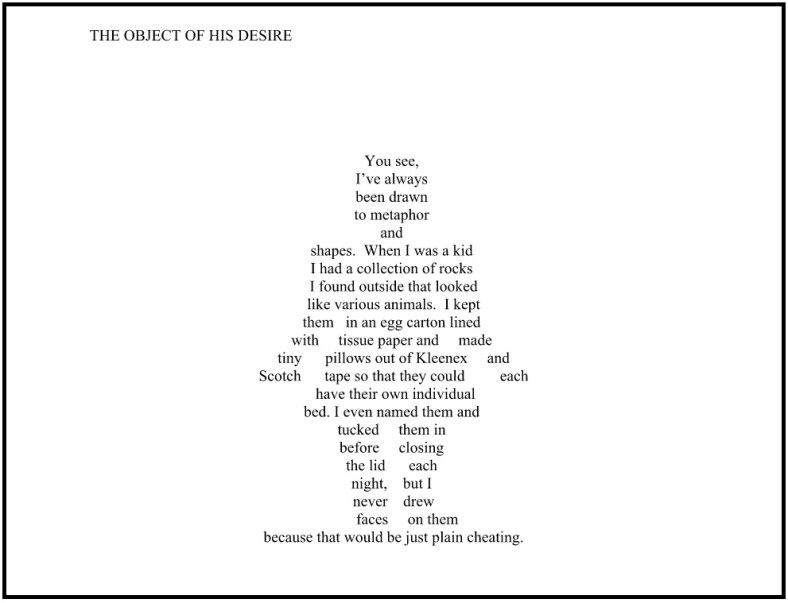
Which is where another level of meaning can be found: this collection brings together lyric poems that trouble traditional poetics through engaging, experimenting, and expanding upon the visual poetry and projective verse traditions. Each poem can be seen as “an immovable feast,” either fixed on the page through intuitive choice or fixed into shape through a formal choice. In “The Object of His Desire,” for example, the narrative of a young boy collecting rocks is troubled when presented in the poetic shape of a woman. This confluence of content and form is purposeful and distinct; if the words were flushed left, they’d still be the same words, but they wouldn’t say the same thing they say in this shape. It is the gift of a visual poem to engage with a language’s plasticity and provide opportunities for multivalent, complex readings. For example, as the poem ends on the idea of facelessness, one can’t help but return to the shape of the poem, and note that where a woman’s face would be are the words: “You see / I’ve always / been drawn / to metaphor.” This implies another facelessness, a societal one. The casual tone of these words further point to the learned narratives of childhood and their insidiousness.

This critique of stereotypes continues in “Old Made: Self-Portrait in a Negative Space,” (below) which lives across from “The Object of His Desire” on the facing page. Where the shape of a woman is the shape of the poem in “Object,” in “Old Made” a woman’s shape is everywhere the poem is not. Even in describing this difference due to formal choice carries with it some of the charged critique that is everywhere in the poem. The assumptions behind the phrase “old maid” are challenged in the title; the rephrasing to “old made” implies how ideas of “old” are “made” in lack of knowledge and lack of connection. It is telling, then, to consider the way this poem ends and begins with the word “Us.” Stereotypes like the one challenged here can make a person feel that they are nothing in the face of others. This feeling is further implied in the form; where the woman’s face would be in this shape, there is instead a list of conjunctions, “if….and….but.” Which is to say that where a face, one’s most personal, recognizable feature, would be, there is instead a brief scatter of words standing alone. Read alone as they are, this list could be read as a half-started, unfinished, and unlistened to protest.

The poems of Gallery Withheld again and again make space to listen and engage with the half-started and unfinished. Reading these poems, one is left like the speaker in “Lefty Loosey” who contemplates Robert S. Neuman’s painting “Monument to No One In Particular” along with another woman who

contemplates
the structure with a frown
and when she leaves I take
her angle hoping
for direction

Each of these immoveable feasts invites the reader to come closer to the text in their reading. And like the speaker above, we must reflect that “its chaos is just / not meant for me or her / or my father in particular / but us all.”

Met Old Made

Influence Question: How would you say this collection reflects your idea of what poetry is/can be?

Jennifer Met: I don’t have an MFA and my undergrad degree is in Molecular Biology, so I have a very open opinion of what poetry can be—I am not limited by an idea of what a perfect “workshop” poem should sound like in order to be accepted as real, good poetry. In fact, I am often drawn to forms (like haiku/haibun, speculative, ekphrastic, and concrete poetry) that seem to have more of an outmoded or niche status in the contemporary poetry scene. In a time when poetry has such a limited readership I think it is silly of us to narrow the definition of what poetry can be. I love to read and write widely, and without labels!

In this vein, Gallery Withheld contains poems that have abandoned frames and formal spaces of presentation. They run the gamut from experimental to lyrical to narrative and contain variations of haibun, ekphrastic poems, persona poems, and more. While they share thematic elements exploring definitions of gender, objectification, and the intersection of word, art, and identity, the main binding thread of the collection is that the form of each poem contains some sort of shape/concrete element. More than just a gimmick or a literal, visual shorthand of the content, I think a good shape, like a good title, can lend an extra layer of meaning and engagement to a written piece. It is particularly important in these identity poems as we are so often judged and defined by our visual elements.

For example, take the poem “Object of His Desire” from the collection (originally appearing in experimental poetry journal The Bombay Gin). On the surface it is a charming anecdote about a child keeping pet rocks in an egg carton, but add the shape—an icon—a perfect, bathroom-door skirted woman—and the words become much more sinister. You notice how the rocks are being objectified and their plight becomes symbolic. Sure, they are treated nicely, but are “animals” (implying a hierarchy), and taken care of (again, implying power), named (implying possession and external definition/validity). Then, when the rocks, just like the woman-icon shape, are left without faces, we see how their feelings, even their individuality, ceases to matter. How without eyes, nose and mouth, they are unable to sense stimuli. Static—unable to interact with their environment, process or ever change. Trapped unable to speak and respond. But without any sensory input, they are unaware that this is even an issue—the system feels perpetual, grand, safe, even desirable. Hence the poem becomes the definition of “woman” as seen not just by a man, but by us all—a blank, yet somehow identifiable, object. However, this meaning only exists when the text is paired with the shape.

Influence Question: What were the challenges in writing these poems and how did you work through them?

Jennifer Met: One of the challenges in writing these poems was wrestling with their literally “concrete” nature. Generally I started with an anecdote (narrative or image-based), then formed the polished prose into a meaningful form while trying to be mindful of good line breaks. However, poetry is such a fluid and organic process that this proved limited—the content would inform the shape, which would then re-inform the content, which would then re-inform the shape, in an endless cycle. However, it is not easy to cut or change even a single word without seriously disturbing a set, concrete, typographic shape, so I found myself constantly constructing a shape only to take the writing back out and revise it before reworking it back into a form. Because of this I actually felt the freedom to do a lot more straight-out rewriting than my revisions would usually entail.

Rewriting seems like a lot of work, and even a betrayal of our charged first-words, but it benefitted this collection so much that I have continued the practice in my current poems to great success. While changing single words or just reworking stanza breaks has never been my idea of revision, I have started to really scrap and rebuild poems—often saving only a few phrases, a single image, or even an idea that had unexpectedly developed during its initial writing—a process I highly recommend.

*

Special thanks to Jennifer Met for participating! To find out more about her work, check out her site. Gallery Withheld can be purchased from Glass Poetry Press.
met_biopic_gJennifer Met lives in a small town in North Idaho with her husband and children. She is a Pushcart Prize nominee, a finalist for Nimrod’s Pablo Neruda Prize for Poetry, and winner of the Jovanovich Award. Recent work is published or forthcoming in Gravel, Gulf Stream, Harpur Palate, Juked, Kestrel, Moon City Review, Nimrod, Sleet Magazine, Tinderbox, and Zone 3, among other journals.  She is the author of the chapbook Gallery Withheld(Glass Poetry Press, 2017). 

microreview & interview: Jennifer Maritza McCauley’s Scar On/Scar Off

scar on scar off

review by José Angel Araguz

Loriella is Dead – Jennifer Maritza McCauley

Yesterday Loriella choke-cried into my phone,
saying we black gals got to stick together, hip to hip
since the world is a leech sucking at our night
necks, and I said girlIhearyou and I could hear
her voice cleaving clean down the center and
I remembered this was the girl who kicked a blackboy
down the stairs of Litchfield Towers, and burned my books
in the dorm yard when I told her I couldn’t love her like that–
With all-the-time love, with only-her love

and she said give me sweet words then and I said what sort
and she burned my books again, the next night, on the dormhall yard
and told me my skin was the wrong kind of tawny,
that I was too soft-voiced to be a real black girl, that
everything I said was too long for listening.

Yesterday, she was talking and her voice got soaked with
ghosts, of men who sexed her bad and women who
gave her lies of love, and I remembered the other nights
she called me, when we were young and tighter-skinned, and
she talked about firearms and gun barrels and her
Auntie’s arm- burns and she said she’d never
do what her Auntie did though she thinks about
what it’d be like to go away, with no man or woman draining her
dead, to go away by her own hands like Auntie did that
night when we were playing Scrabble on the dormhall
floor and she got the call that said Auntie is dead
Auntie left the room.

Yesterday, Loriella thanked me for love, said I was okay and
she knows her head is cut-up and we agreed that every
head is cut-up and every little black girl head is a little
tired and today her Mama calls me and says

Loriella is dead, and asks me what I said to her and
I said nothing, just that we black girls got to stick together
hip to hip, heart to heart, and her Mama says
how come you didn’t try any kind of talk to make
My Girl live and I listen to fat air on the phone and her Mama’s
cold cries, and I imagine Loriella’s neck, life-broken, on the floor.
I think of its fleshy folds and clavicle, her pink mouth,
how it pursed and pouted and spoke fear and I think of what

I said every day when we were young: What do you want
me to tell you? and how I wondered what
words could do. I tell her Mama that, as
I choke-cry, “What could words have done?”

*

Reading through Jennifer Maritza McCauley’s Scar On / Scar Off (Stalking Horse Press), I kept coming back to the final question in the poem above: “What could words have done?” This question lives at the core of this collection whose poems embody spaces of agency and contemplation. Whether reckoning with danger and gendered double standards while listing “40 Ways to Avoid Sexual Assault,” or invoking Celia Cruz’s bittersweet refrain “la vida es un carnival” in an underground mall, McCauley’s poems answer the question of “What could words have done?” with witness and presence.

In the poem above, the question originates from a moment of grief. The narrative of Loriella is one of misunderstandings and fractures. Even the phrasing of “girlIhearyou,” whose collision of words evoke urgency and a desire for connection, stands out as a one-sided gesture. The speaker goes on to detail the ways in which that sought-after connection kept slipping. And yet, the poem stands as an answer to the question itself, a testament to a life that cannot be summed up neatly, and the life of the speaker who must move forward despite this knowledge, questioning and holding close to words.

This question returns implicitly in the lyric essay “An End,” in which a speaker meditates on her experience working with and caring for an elderly man. The speaker relates: “I am afraid to die, my oldman client tells me,” at the start of the piece, and follows up a little later with “My oldman says don’trepeatwhatIsaid again, and I nod.” Through this back and forth, the text becomes a space where this secret can be held; it resides here for the speaker in a way that allows her to empathize as well as contemplate the fear itself. The speaker later learns of his death via a phone call answered while driving. The news shocks her and results in a car accident:

I pull over and wait for the driver to get out. She climbs out of her Jeep carefully. I walk up to her, give her my information. I watch this woman scribble the superficial facts of my life on the back of a Burger King receipt. She is writing what I tell her: my car’s make and model, my Daddy-given name, my address and phone number. All evidence of my short and stupid life. Underneath the red of Target storeface, I watch this woman record everything I tell her about me. She finishes quickly; I don’t have much to say. She looks up, wondering if my body is shaken. It is not. I was young then, nauseatingly alive.

Here, again, we have misunderstandings and fractures, albeit of a more literal kind than before. In the act of exchanging information after a car crash, the speaker becomes aware of her mortality, but also of what little might remain afterward. This piece which is an act of the speaker recording the final days of her “oldman client,” suddenly finds a parallel in this scene after an accident. The insights offered here are nuanced. What can words do in the face of “the superficial facts” of our lives? What could words have done for her oldman client? Again, witness and presence return as an answer.

Not every answer to the question “What could words have done?” is elegiac. “The Summer of Screens,” for example, presents a speaker awake to what words can do and are doing. In the excerpt below, there is a lyric elasticity able to hold the varied layers of experience that the speaker lives through while watching a Beyonce video in a particular time and place in American history. What plays out as juxtaposition within the literary and aesthetic act of a poem, reflects the complicated nature of life for this speaker of color. Here, again, the speaker seeks connection, but finds instead a troubled reflection; the same medium that offers up these also offers up the cultural rejection embodied by Donald Trump. It is hard not to feel left out in a world where our pop stars and our politicians have a major presence in our consciousness while remaining, ultimately, inaccessible on several levels.

The poems of Scar On /  Scar Off live in this duality. How do we make peace with the scars we have? We live despite them, with them, but not ignoring them. We remain present with them. We use words to engage what the scars mean. And after understanding what we can through the witness and presence of books like McCauley’s, we persevere, like the speaker below, to “still, desperately, / want to getinformation.”

*

III.

On YouTube, Beyonce has tied up that
blonde weave we’ve been seeing for years
into tight braids that look like shadowed cornfields,
shining against her expensive scalp. She
is twitch-dancing, her soft-hard legs jerking
to the sound of pop and power, a beat
rehearsed to make us shout “yeah, girl, please!”

Beyonce isn’t wearing white and she’s not
having fun anymore she wants you to know she won’t
have as much white fun. On YouTube, she glowers
at me and descends into Katrina-water, while sitting
on top of a copcar she bought for this video.

In another video, Donald Trump calls my graduate school
by name and says it is full of little black people with little
white leaders, and he looks me in my eye and reminds me
I am one of the little black people he hates.
I click on Beyonce’s video again because I know this dark
rich woman, in a game of theoreticals, loves me
far more than Donald Trump.

When I realize this, Beyonce is no longer glowering at me,
she’s saying, “girl, we got this, I’m with you,” and she is
glistening fine and smooth. Her royal black skin could be mine
but it isn’t.
Her skin: as shiny as a money-coin.

When she sings ladiesgetinformation I start crying
and don’t know why, because I know this is
a video and she has purchased all of our culture’s
chilling symbols and will go back to a queen-home
I will never see. But when I see her skin like this: suddenly black
and toughly smooth on my small computer, she reminds me of who
I am. This summer I could be one of those Bey-lovin’ blackfolks
worshipping my be-weaved goddess from the backrow of
a concert that costs half my rent. Maybe, before I go back to
my busted Ford, me and other blackgirls and boys might get lucky
enough to pass her security guards, to walk around the concert
copcars she owns, that we could never buy
for protection. I still, desperately,
want to getinformation.

I click off the video,
when she sings:
SLAY SLAY SLAY
SLAY SLAY SLAY

*

Influence Question: How would you say this collection reflects your idea of what poetry is/can be?

Jennifer Maritza McCauley: Audre Lorde has this terrific quote: “There’s always someone asking you to underline one piece of yourself…because they want to dismiss everything else…” Poetry is my way of underlining, striking out, and rewriting all of these pieces. With poetry, I can interrogate the many definitions and intersections in one person, community, language, and genre. As a half-African-American and half-Puerto Rican woman, I’ve often been told who I am, what I’m not, how to fit in and how to talk. As a result, I’ve never been a fan of simple definitions. I don’t like leaving “pieces of myself” dismissed. I also enjoy many poetic forms, and think the identity of a poem can be just as complicated as the identity of a person.

For me, the beauty of poetry is that it can tell a story, sing love, compel readers to act, lay loss bare and bloody. Ideally, I wanted this collection to reflect some of the issues posed and dissected by poets I admire like Claudia Rankine, Sonia Sanchez, Tato Laviera, and Gloria Anzaldua. How do my experiences and those of folks I know push against stereotypes? What are the conversations and conflicts in my communities? How do I complicate what folks already think about race and gender? These were questions I was consciously and unconsciously wrestling with as I wrote this collection. Ultimately, I wanted this work to be many-voiced, hybridic, messy, searching, and full of love.

Influence Question: What were the challenges in writing these poems and how did you work through them?

Jennifer Maritza McCauley: I started writing this collection while I was bouncing around the South and Caribbean, editing my novel with my wonderful agent Amanda Jain and preparing to move to the Midwest from Florida. During this time, I’d be in prickly situations or meet folks that unearthed my complicated feelings about blackness, Latinidad, the body, love, and loss. Poetry and short prose were my go-to genres for exploring these concerns.

Some poems were more challenging to write than others. Sometimes I had to be in the right mindset to get the words on the page. Often, I’d say, “I really need to write a poem about this,” and the piece would take forever to come together. I’d give up, return later. Other times, the words came naturally. Sometimes a poem would tell me it needed to be prose, or vice versa. After a year or so, when I realized I had enough poems to start thinking about a collection I tried to find themes and through-lines. The hard, fun work was determining which pieces belonged and didn’t belong in the book. I cut a lot of darlings and played around with the structure of the book  quite a bit. The awesome folks at Stalking Horse helped with this process further after they picked up the collection. Writing this thing overall, was a challenging and liberating process.

*

Special thanks to Jennifer Maritza McCauley for participating! To find out more about her work, check out her site. Scar On/Scar Off can be pre-ordered from Stalking Horse Press.

jenniferpictureJennifer Maritza McCauley is a teacher, writer, and editor living in Columbia, Missouri. She holds or has previously held editorial positions at The Missouri Review, Origins Journal, and The Florida Book Review, amongst other outlets, and has received fellowships from Kimbilio, CantoMundo, the Knight Foundation, and Sundress Academy of the Arts. She is the recipient of an Academy of American Poets University Award and has appeared in Passages North, Puerto del Sol, Split this Rock: Poem of the Week, The Los Angeles Review, Jabberwock Review, and elsewhere. Her collection SCAR ON/SCAR OFF will be published by Stalking Horse Press in fall 2017.