microreview & interview: House of McQueen by Valerie Wallace

review by José Angel Araguz

wallace

In the note for “Let’s make a dress from these,” from Valerie Wallace’s  House of McQueen (Four Way Books), we learn that the poem’s title is a quote from Alexander McQueen himself, spoken “as he walked into his workroom with a handful of red medical slides.” In the same spirit of ingenuity and repurposing, Wallace’s collection presents poems that inhabit similar liminal spaces. Ranging from ekphrasis and collage to engaging with docupoetics with singular purpose, the poems of House of McQueen brings McQueen’s aesthetic vision and humanity to life through its engagement with the observable and imaginative.

The aforementioned poem, “Let’s make a dress from these,” which centers on the dress made from medical slides mentioned in the note above, starts with an objective description: “Stained red medical slides layer vertically on sleeveless sheath, / high-necked and cut away from right shoulder to right hipbone.” The reader is presented strictly with what the eye can see in these lines. The poem then moves from the physically observable, to the suggestive and poetic:

Heavy overskirts of crimson ostrich feathers swish & switch,
thick & deliberate into underskirt of plum-black ostrich feathers.
These skirts obey the law of push. From the slightest pressure they bloom.

In these lines that round out the first stanza, the observable is engaged on two levels. First, there is the evocation of the image through phrasing with the repetition of “ostrich feathers” across two lines; but there’s also a structural echo of the image in the enjambment of “swish & switch, / thick & deliberate.” Here, the repeated use of the ampersand works like typographical stitching joining two descriptions of ostrich feathers. The last line of this stanza furthers this evocation, taking it to an imaginative space through its mention of “the law of push” and “bloom,” language that makes the observable fact of the dress into an active, engaging image.

Another kind of engagement between the observable and imaginative occurs in the poem “Shears,” only this time it is one on the level of craft. Composed out of text found and “occasionally corrupted” by the author from Basil Bunting’s Complete Poems (New Directions), what makes this poem remarkable is how Wallace is able to find and repurpose language outside of the McQueen-centered project and bring it into conversation:

Silk tweed gray felt sable damask flannel
Glory of sharp tool be the lasting part of me

Plip scut slew slew all sounds fall still
Have you seen the fox? Which way did he go, he go?

These opening lines begin with fabric language and quickly go into intimate revelry. The repetition and wordplay here are to different purposes than in the poem discussed above; yet the move on the poet’s part to evoke image and feeling from recovered language remains the equally compelling.

Similarly, the poem “Autobiography of Alexander McQueen,” which is composed of quotes from print and video interviews with McQueen himself, takes the found language approach and creates from it a sense of human voice and presence:

I’m a romantic, really—
I try to protect people.
People say I do it for the shock value
I just like exploring the sinister side of life.

Drawn from McQueen’s lips, these opening lines are haunting in the way they represent isolated moments of self-awareness and aesthetic vision. Despite their repurposing into poetic form, in this case a pantoum, the designer’s unique sense of self-possession and character ring out. When the poem closes and the form repeats the first and third line above, the argument performed through the act of the poem lands for the reader as an argument of being:

Solitude is the blank canvas I work from.
Life is transformation.
People will say I did it for the shock value—
But I’m just a romantic really.

House of McQueen can, in fact, be read as a romantic’s transformation of language materials into aesthetic revelation. The very spirit of high fashion is implied throughout the conceptual and structural narratives explored. Wallace’s deft eye and ear create poems that keep pace with and come close to matching McQueen’s original sartorial creations. What stands out as the book’s highest accomplishment is how Wallace is able to bring readers again and again to the liminal, imaginative space of inspiration.

The poem below, “Council House, 1972,” opens the collection with exactly this note of dwelling on the possibilities inherent between the observable and imaginative. From the feeling of having “never seen anything like it” to “wondering, how to draw that color — sea coast changing to dawn,” the reader is presented with two artists: the artist McQueen was on the verge of becoming, and Wallace now, able to find the words to house them both.

Council House, 1972 – Valerie Wallace

When I was about 3 years old, I drew a dress on the wall. And what dress was it? Cinderella.

When she turned, I’d never seen anything like it.
Dress made for charming prince and fairy.
I could manage the little sleeves, tiny waist rising
out of skirts which laughed as they traveled with her across the ballroom floor.
And they had stars woven in them.
I got caught wondering, how to draw that color — sea coast changing to dawn.
There was trouble, but I didn’t care. I knew it was the dress
that saved her. All the rest was just a story.

*

Influence Question: How would you say this collection reflects your idea of what poetry is/can be?

Valerie Wallace: Thank you so much for this question. I think poetry is a space for great permission, so for me this collection invigorates that idea, because it takes on many challenges at once – persona, ekphrastic, formal, free, a bit of narrative – all in an attempt to make a cohesive  emotional . . .  welling forth about a singular life.

Influence Question: What were the challenges in writing these poems and how did you work through them?

Valerie Wallace: This is probably obvious, but my primary challenge – which animated all the other challenges – was to stay true to McQueen’s aesthetic and vision. Ultimately I used form and craft in service to his tailoring foundation, and a wide range of source material, as he had, for his collections. I researched Scottish and English history and the history of fashion, learned bespoke terminology, read McQueen biographies, and made use of interviews with McQueen, as well as his close friends and family. I felt my own imagination had permission to be wild. If I thought, Why not? I tried it. If I thought, What if…, I did it.

I’ll just add that at first I thought I was writing a kind of elegy. Then I thought I was writing language poems. At times, I was forcing poems into these categories. Of course, those poems were not very good. I learned that I had to strengthen my listening muscles. I had to listen to what the poems needed to say, wanted to say, find the little soul for each. As that began to happen, the poems and I began to trust each other, and then a collection began to hum.

*

Special thanks to Valerie Wallace for participating! To learn more about Wallace’s work, check out her site! Copies of House of McQueen can be purchased from Four Way Books.

*

wallace 2Valerie Wallace’s debut poetry collection House of McQueen (March 2018) was chosen by Vievee Francis for the Four Way Books Intro Prize in Poetry. In their starred review Publishers Weekly said that Wallace created “…a literary seance…serving as a scholar of and medium for the late iconic fashion designer Alexander McQueen….” Her work was chosen by Margaret Atwood for the Atty Award, and she has received an Illinois Arts Council Literary Award and the San Miguel de Allende Writers Conference Award in Poetry, as well as many grants to support her work, for which she is extremely grateful.
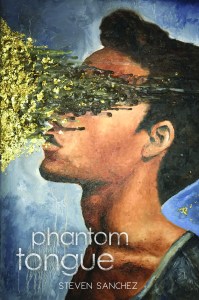

microreview & interview: Phantom Tongue by Steven Sanchez

review by José Angel Araguz

phantomtongue7

Phantom Tongue (Sundress Publications) by Steven Sanchez begins with “On the Seventh Day,” a poem depicting the speaker poring over images of male models in the Sunday ads—”glossy men” that “look like my G.I. Joe / if his clothes weren’t painted on”—then cutting and pasting body parts, fashioning ideal versions of attractiveness. This act is narrated in a compelling and telling manner; as the speaker notes that “These paper men / are caught inside words / they don’t even know exist,” it is hard not to notice the parallel with the speaker himself, a youth whose burgeoning sexuality is manifesting outside of words through this play with images. The poem ends with a similarly telling image:

I’ve learned to hide these men inside
the pages of my dictionary,
where words always cling
to their wet curves
like the newspaper ink
on my hands, headlines
and stories staining my skin.

This final image is charged with guilt and self-consciousness. Unlike the title’s reference to God resting after the creation of the world, this speaker is far from being able to rest or feel settled. In fact, his act of creation leaves him scared and with an impulse to hide his fascination.

This tension between fascination and self-consciousness lies at the center of Phantom Tongue. Starting with this poem about bodies, the collection begins to explore ideas of breaking—how bodies break, and what breaks with them—balanced by meditations on what is not broken. One can see this balance in the sequence “Passing.” In the section One of the Guys, the speaker is asked on the playground “Are you white or a wetback?” and responds with “I’m just like you.” The speaker is then told to grab a rock and join in the taunting and assault of another child. Unable to find a rock, or unwilling to, the speaker picks up a “large dirt clod” and is commanded to throw it at the head of the other boy. When he moves to do so, however, the speaker ends up only feeling how the dirt clod “explodes in my raised hand.” This closing image implies not only the futility of violence, but also the speaker’s discomfort in participating. It is almost as if the dirt clod breaks apart in empathy with the speaker.

This scene of coerced action resulting in futility skillfully leads to the second section of this sequence, Boy Scout. In this poem, the speaker is out fishing and reels in a brown trout, the experience bringing him closer to a growing sense of mortality:

I feel the rest of his life in this wire, taut
like string between two plastic cups.

Does he hear my heart tightening its pace,
a fist that will not let go?

The feeling of life on the wire compared to a childhood makeshift telephone drives home what is being communicated through this experience to the speaker. Viewed within the context of a conversation, the speaker is aware that he is at fault for the breaking from life that is going on at the other side. This awareness becomes a new knowledge in the form of the final couplet where the speaker’s heart becomes “a fist that will not let go.” Even the breaking life of a fish holds its fascination and lesson.

Sanchez’s attention to and facility with empathy is also present in the poems about his complicated relationship with his father. In “La Llorona,” for example, we are given an imagined origin story that is braided with the Mexican folktale. As the speaker tells us “My father’s forgotten / who brought him / to America,” the poem sets its license for this braiding as being grounded in the father’s absence of details. We further learn:

Somebody found him
when he was a boy
walking in the streets

of Tijuana, his mother
absent. The jagged
remains of his living

room window
cut his hands
when he reached

one more time
toward his own father,
dead for three days.

From here, the poem enters the speaker’s dreams where he tries to comfort the father. Where in reality the speaker’s father reached to the dead father, in dream he reaches toward the speaker. In this parallel, death and dream frame the speaker’s father with absence. This absence then becomes a space where the poem can explore the story of La Llorona and braid it to the father’s via imagery:

I can never touch him,
always my reflection
in water. A woman

emerges and slides
her finger across
his navel

where kelp grows
like an umbilical chord
inching toward his neck

Comfort exists in these stanzas edged with threat, as it does in life. The uncertainty of water—a realm of intangible reflections and unperceivable depths—makes a suitable parallel to the life of the father, who, through his own absences, lives an uncertain life. As the poem’s dreamscape baptism comes to a close, La Llorona holds the father and prays. In this way, braiding the narrative of La Llorona with that of the father redeems both troubled figures.

In “Approaching El Arco / Reloj Monumental,” redemption is explored in a way that allows for complication and doubt. As the poem moves through its crushing depiction of the speaker being questioned by border patrol while walking near the entrance of Tijuana, there comes this moment:

A gull walks

in circles a few feet away, his left wing
broken, upside down; his white

remex makes a path in wet sand
that three offspring follow. I could

hold the gull, stroke his sleek back,
and make a purple sling from my shirt.

But I wouldn’t know what I’m doing,
how to reset or mend his bones.

I would just break another one
I try to convince myself, even though

I know what happens if I do nothing.

This act of pausing, of acknowledging what’s in front of the speaker and each possible course of action, of lingering over meaning, speaks of the great empathy at the heart of this collection. By considering the broken wing of the bird, the speaker goes through the motions of feeling something (not quite innocence, but like it) break inside himself. Moments like this one showcase Sanchez’s gift for dwelling in complexity.

While the collection begins with a fascination with the body, this fascination quickly becomes an unflinching awareness of what is at stake within a body. Along with the physical breaking possible, there is the body as the house of what is broken and what continues to break. In the final poem, “What I Didn’t Tell You” (below), an address to a younger brother begins as advice and quickly shifts into regret and apology. Sanchez’s ability to look deeply within his own breaking—the physical and emotional, as well as the breaking that makes up memory—is illuminating. Throughout this collection, worlds that have gone neglected and unseen are made visible and granted the rich and transformative acknowledgment of poetry.

What I Didn’t Tell You – Steven Sanchez

for my brother

You can ask me anything,
Even about my first kiss,
which was at your age
and tasted like stale beer.
I used to feel guilty swallowing
the pulse of another man,
but now I know there are many
ways to pray. There’s a name for
that most intimate prayer:
la petite mort—the little death.
If, when your lover rakes
your back, you recall
the flock of worshippers
surrounding you like raptors
when they learned you’re gay,
clawing at your shoulders,
squawking for salvation,
remind yourself you have to die
before you can be resurrected.
Never forget what the Bible says:
when two people worship together,
they create a church
no matter where they are—
which must include
the backseat of a car
or the darkest corner
of Woodward Park.
These are some of the things
I wanted to tell you
that night in April
you called me for help
with your history report
about the gay rights movement.
Neither of us admitted
what he knew about the other.
Instead I started
with the ancient Greeks,
told you it was normal for them,
that for one brief moment
they were allowed to shape
their own history and religion,
organizing the stars, forming
Orion, for example,
flexing in the sky, arms
open in victory, belt
hanging below his waist.
But he was punished
for his confidence,
a scorpion’s hooked tail
piercing his body
like a poison moon.
When I see Orion,
I think of you and remember
what it felt like
for my knuckles to sink
into your stomach,
for my fist to collide
with your face. Your voice,
your walk, your gestures
reminded me of myself,
your figure bright and fluid,
creating a reflection
I wanted to break.
And now I see
your body spill open—
Big Dipper hooked
to your ribs, North Star
nestled in the middle.
I reach for that ladle
and drink.

*

Influence Question: How does this full length relate/grow out of your chapbooks?

Steven Sanchez: The earliest draft of Phantom Tongue came first, followed by my chapbooks: To My Body (Glass Poetry Press) and Photographs of Our Shadows (Agape Editions). While my two chapbooks have a lot of thematic overlap (in terms of Queerness, internalized oppression, and Pocho-ness, among others), the image systems and tones between each chapbook felt different. Despite these differences, or probably because of them, I was able to figure out how to meet Phantom Tongue on its own terms.

Originally, Phantom Tongue had three sections, and the differences between the first two sections reflected the differences between the two chapbooks. The third section tried to reconcile those differences, but, like a bad sewing job, the thread was visible and didn’t match. I expressed my concerns to Sara Henning (my wonderful editor at Sundress) and she encouraged me to remove the sections and see what happened.

Reading through it without sections, I still saw significant shifts that reminded me “oh, we’re switching between chapbooks now,” so I tried out an organization strategy I used in my first chapbook—begin the book with a poem centering the body and end the book with a poem centering the body. If I could begin and end with a body, Phantom Tongue could tell the story of that body.

However, the final poems in Phantom Tongue had tones that clashed with each other. The title poem itself comes relatively late in the book and is a poem of witness (sort of) where the speaker lacks agency. But I wanted the end of the book to acknowledge and challenge what happens in the title poem. I turned to the poems from my second chapbook for help and found the poem I wanted to close on—What I Didn’t Tell You. When I found that poem, I realized a few of the poems in that chapbook had a similar tone and pacing; I realized that Phantom Tongue needed those poems near the end.

Ultimately, I found that my first chapbook seemed to privilege the physical, lived experiences of a body, while the second chapbook seemed to privilege the ways bodies get read as texts and assigned meaning. While those chapbooks can be their own entities, I realized Phantom Tongue felt clunky because the physical body and metaphysical body inform each other and cannot be so easily separated (if at all). My chapbooks were so helpful in my revision process, sort of like a phoropter in an optometrist’s office—sometimes one chapbook made an aspect of Phantom Tongue super clear, sometimes that same chapbook made me lose focus; toggling between the two helped me hone in on the smaller details I couldn’t see on my own.

*

Special thanks to Steven Sanchez for participating! To learn more about Sanchez’s work, check out his site! Copies of Phantom Tongue can be purchased from Sundress Publications.

*

1888_sanchezSteven Sanchez is the author of Phantom Tongue (Sundress Publications, 2018), selected by Mark Doty as the winner of Marsh Hawk Press’ Rochelle Ratner Memorial Award and a finalist for the Andrés Montoya Poetry Prize & the Four Way Books Intro Prize. He is also the author of two chapbooks: To My Body (Glass Poetry Press, 2016) and Photographs of Our Shadows (Agape Editions, 2017). A recipient of fellowships from CantoMundo and the Lambda Literary Foundation, his poems have appeared or are forthcoming in Poet LoreNimrodNorth American ReviewMuzzleCrab Creek Review, and other publications. He holds a B.A. in Philosophy and an M.F.A. in Creative Writing from California State University, Fresno.