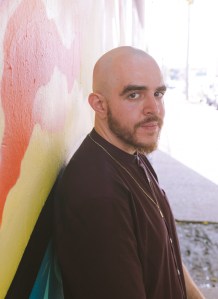
microreview & interview: Love Me, Anyway by Minadora Macheret

review by José Angel Araguz

lovemeanyway

The First Time PCOS Spoke – Minadora Macheret

The doctor didn’t believe my periods had disappeared.

Most months were painless
as I watched all the other girls clutch cramps and bloating—
I wanted that too. I was different enough
and every 28 days I begged my uterus.

Medicine wrestles pubescent girls into journal articles
amenorrhea is due to over activity (at this age).

Please gentle the body—
thicken it with sleep.
When you slow down,
you will be
a woman,
again.

*

Reading through the poems of Love Me, Anyway (Porkbelly Press) by Minadora Macheret, one encounters a poetic sensibility capable of exploring the intersection of disability and being a woman in ways that interrogate the misguided narratives around both. The first line of the poem above (“The doctor didn’t believe my periods had disappeared”) begins this work within the context of disbelief. Here, it is disbelief not only of what is stated, but also an implied doubt due to youth and gender. The poem then builds from this initial disbelief by adding to it the speaker’s own disbelief in the workings of her body. The difference between these two disbeliefs is stark: the doctor’s disbelief is authoritative, while the speaker’s is grounded in vulnerability and fear. This starkness is furthered by the third stanza, where the medically-informed disbelief is seen as “[wrestling] pubescent girls into journal articles,” phrasing that evokes what it feels like to have a personal experience reduced to objective terms and analysis.

By the final stanza, the turn to the language of prayer (“Please gentle the body— / thicken it with sleep”) is a surprise on several levels. First, authority is subverted and, while still distant, it works now in a different tone, a tone that reads first as “gentle” but proves itself controlling by the end. Secondly, this subversion exposes the condescension and harm of the doctor’s disbelief; their authoritative advice is prescriptive in both a medical sense but also in a sense charged by gender bias. In a way, this last stanza could be read as a command to the speaker, a woman, to “slow down.” Lastly, returning to the title, these last lines can also be read as PCOS (Polycystic Ovary Syndrome) itself addressing the speaker. Because it echoes the medical authority in tone and advice, this address becomes a betrayal charged with vulnerability.

This engagement with disbelief through lyric (re)imagination is at the heart of Love Me, Anyway. The PCOS experience is shown as a human experience that affects both a woman’s body and identity. Throughout the poems, Macheret evokes the struggle of identity through poetic acts of (re)definition. In “Remembering Girlhood,” the speaker reckons with the identity-shaping effects of the schoolyard:

…I am other Watch the girls point inside themselves to understand the outside of me Listen to their words mouth traitor…She can’t be a woman there is no moon inside of her to wax and wane Follow the porcupine quills on her face and breasts She is of men not of women Turn away turn away turn away

What is compelling here is how the context of the schoolyard is subverted by, first, being informed by the disbelief of other children, and, second, by how this disbelief is channeled through a formal, high diction. Phrasing like “there is no moon inside of her to wax and wane” and “She is of men not of women” is charged with a severity that drives home the damning effect childhood bullying has.

In “To the Bearded Lady I Am (Age 26),” the speaker begins by sharing:

I spend my days mirror-bound. Farm the angles of my face with tweezers. Lately, I can afford laser treatment. Each pulse of light burns hair follicle clusters.

Here, we have the clarity and directness found in other poems, metaphor being used to set the scene. The poem develops to these ending lines:

The anxiety of hair growth strangles my days to slip into nights. I’m like a teacup left out, dust covered, a chip in my side.

The clarity of the opening lines grounds the poem in the speaker’s reality; coming to these closing lines, metaphor works in a different, richer way by showing a further depth to the speaker’s reality. Not only is anxiety acknowledged as part of the self-conscious act depicted, but there is the effect on identity. In seeing herself as a “teacup left out, dust covered, a chip in my side,” the speaker evokes ideas of beauty and purpose as well as neglect. A disease’s ability to make one feel “other” (as noted above) is presented here in literal object-ification. These lines are another example of how working past otherness and imposed narratives comes at the cost of a shifting sense of self.

In this last poem, the idea of disbelief—both that of others and one’s own—is answered by a clear reckoning and acknowledgment. Disbelief, by being present, implies the possibility of belief. The poems of Love Me, Anyway argue, ultimately, that sometimes all one has to believe in is one’s own experiences, one’s pain and survival. These poems embody one of the gifts of lyric poetry, specifically the ability to evoke struggle and the life found through it.

In the title poem (below), this idea is worked out as a hard-earned belief. (Re)definition appears again in the opening lines—“Settle into my skin, / show of nature gone awry,”—but is accompanied by conscious (re)action “make-believe the parts are working.” The poem continues through admission, creating from honest acknowledgment a lyric space where the speaker is able to fully voice and feel, and, thus, fully exist.

Love Me, Anyway – Minadora Macheret

Settle into my skin,
show of nature gone awry,
make-believe the parts are working.

There will be days
anger currents keep me upright
as anxiety locks me to the bed
and the safari of my skin
full of brush
stains the covers fluorescent-red

the Nile is deep and endless
as the mechanism syncs
to the monthly flood-watch.

And on the mornings
I am barren
for a day more than I can handle,
please love me, anyway.

*

Influence Question: How would you say this collection reflects your idea of what poetry is/can be? 

Minadora Macheret: This collection reflects what I see poetry can do and/or can be because it is giving voice to invisibility, to disability, to the liminal spaces that make us more human than we care to admit. Through the manipulation of white space and use of lyric images to guide a narrative that is searching to understand itself, this collection allows for the reader to gain an emotional glimpse into a body haunted by grief, by disease, by an inability to function “normally.” Also, there is the blending of language/translation, of culture, of folklore/myth (Baba Yaga & Demeter make appearances), and how those elements of identity also play a foundational role into understanding the body and how to recreate the self and the stories told on the page. Most importantly, this collection is another avenue for political poetry and social justice because it is asking the reader to see how the patient is gazing back at the doctor, the clinic, the world they inhabit, especially as it considers the disabled body, the diseased body, the female body. Poetry also has the capacity to breathe new meaning and understanding into the undefinable and this collection is pushing against the ways in which doctors engage the female body and struggle to offer support and/or treatment for diseases they think they understand.

Influence Question: What were the challenges in writing these poems and how did you work through them?

Minadora Macheret: Some of the challenges in writing these poems came through translation. What I mean by that is not just the translation of disease from scientific literature to something accessible, but in the actual act of thinking in Russian (my first language) to writing it in English. Because I think multilingually (and grew up in a household of polyglots) I struggle with translation at times and though poetry has the capacity to hold a multiplicity of languages and their conversions/inversions, I would need to have trusted friends look at the syntax and/or grammar at times of what I was saying for clarification. Another challenge was how to talk about a disease that is terrifying, that disintegrates the body from the inside out without just glamorizing it or making the disease beautiful. I worked very intentionally with balancing between the horrific/grotesque with lyrical images or use of musicality/sound to show the duality of disease and its affect on the body. In particular, I am thinking of my “Self-Portrait as Mythos” poem that is using beautiful language and imagery to show the realities of a disease that causes infertility among a host of other issues. Lastly, something I struggled with is how to balance the grief in the collection without ending on something inspirational. I tend to turn away from the inspirational because I wanted to show the lived every day experiences that many people go through as grief/disease/disabiltiy becomes a facet of their lives. One way that I dealt with this is to not shy away from (my) truth of the experience and to let myself sit in those images/experiences as they were.

*

Special thanks to Minadora Macheret for participating! To learn more about Macheret’s work, check out this interview with her at Rogue Agent Journal! Copies of Love Me, Anyway can be purchased from Porkbelly Press.

m macheret*

Minadora Macheret is a Ph.D. student and Teaching Fellow at the University of North Texas. She is a Poetry Editor for Devilfish Review. Her work has appeared in Tinderbox Poetry Journal, Red Paint Hill, Rogue Agent, Connotation Press, and elsewhere. She is the author of the chapbook, Love Me Anyway, from Porkbelly Press, 2018. She likes to travel across the country with her beagle, Aki.

microreview & interview: Citizen Illegal by José Olivarez

review by José Angel Araguz

olivarez

The Latinx experience is often reduced to ideas of duality. There’s the phrase “ni de aqui, ni de allá” (neither from here nor from there). There’s Gustavo Peréz Firmat’s idea of “living on the hyphen,” which acknowledges the duality of having a hyphpenated identity, in his case Cuban-American. Even one of the more popular textbooks in Spanish classes across the nation is titled Dos Mundos, a nod to the narrative idea of living in two worlds.

This kind of phrasing and thinking is reductive when only one duality is considered. What I have found in my own experiences is that it is not only one duality that defines my own Mexican-American life, but a multitude of dualities. This thinking feels truer to the Latinx experience because while one duality implies a clean split into halves, multiple dualities implies a series of splits in one’s identity. One of the driving forces of José Olivarez’s Citizen Illegal (Haymarket Books) is an exploration of the complexity inherent in these kinds of multiple dualities and splits.

The opening poem “(citizen) (illegal)” begins this exploration in the subverted phrasing of its title, which takes the phrase “illegal citizen” and turns it via parentheses into two separate adjectives. The poem goes on to develop its narrative using the rhetoric of word problems:

Mexican woman (illegal) and Mexican man (illegal) have
a Mexican (illegal)-American (citizen).
Is the baby more Mexican or American?
Place the baby in the arms of the mother (illegal).
If the mother holds the baby (citizen)
too long, does the baby become illegal?

Here, the logic of words is placed against the logic of human laws. Having isolated (citizen) and (illegal) in the title, the two words begin to develop a life of their own as they move in their narrative placement. In the first line, (illegal) is strictly in the language of immigration law. Yet, the word is something different—and marked as such by the absence of parentheses—by the end of the stanza. This change occurs via the question asked in the last three lines of this stanza. This question’s narrative places the mother and child, one marked as (illegal) and the other as (citizen), in a familiar embrace between mother and child. Through context, the question parallels the proximity of this embrace with the proximity of words on a page, both the physical closeness but also the way the closeness of two words changes the meaning of both.

In bringing together word logic and law logic through this parallel, Olivarez evokes the fear immigrant parents live with, even in such innocent moments as holding a baby. By taking charge of these two words in an objective, logical way, the poem makes the humanity that is affected by them more evident and real.

One of Olivarez’s accomplishments in this collection is this ability to make present the humanity behind dualities in poem after heart-wrenching poem. In the aptly titled “Mexican American Disambiguation,” Olivarez works the duality of presence and influence through contemplation of American cultural staples:

everything in me
is diverse even when i eat American foods
like hamburgers, which to clarify, are American
when a white person eats them & diverse
when my family eats them. so much of America
can be understood like this.

Here, we have another moment of closeness, of something being embraced out of need. While the stakes are albeit different than the closeness between a mother and her baby, the meaning remains the same: words and ideas are affected by the human presence behind them. Even a hamburger, which here is at first taken as an American symbol, can become politically fraught when put in contact with the narratives of the Latinx experience. This poem quickly shifts to higher stakes as the speaker takes note of his family’s effect on the idea of the American Dream:

my parents were
undocumented when they came to this country
& by undocumented, i mean sin papeles, &
by sin papeles, i mean royally fucked which
should not be confused with the American Dream
though the two are cousins.

Within the complexity of the wordplay here, which moves between English and Spanish as well as between the metaphor of the American Dream and ideas of family, lies the conscience of this speaker. It is identity, ultimately, that the speaker is seeking to make clear by working through the ambiguity of symbols and ideas of America. Yet, clarifying one’s identity isn’t as simple as noting the right words; one must work through what the words mean. From “sin papeles” to “royally fucked” to “American Dream,” the poem seeks to understand each word through correlation, ending at “cousins,” a word that means family, but not immediate family. In Citizen Illegal, readers are invited to slow down and dwell on such distinctions for what they say about connection as well as for what is missed.

This navigation through distinctions of duality is consistently reckoned with in this collection on a personal scale. In “my therapist says make friends with your monsters,” the speaker delves into the context of therapy, where “monsters” are self-created; yet, within the greater context of the collection’s Mexican-American narrative, the speaker’s monsters are as double and duplicitous as the two countries themselves. The lyric sequence “Mexican Heaven,” braided throughout the collection, reimagines heaven as a source of respite but, as the following excerpt shows, tinged with familiar mistrust:

all of the Mexicans sneak into heaven.
St. Peter has their name on the list,
but the Mexicans haven’t trusted a list
since Ronald Reagan was president.

Movement is the common thread of this meditation on multiple dualities. In the most compelling moments of this collection, Olivarez presents to us poetic spaces where one dwells alongside the speaker on the elements in motion around him. The poem below, “I Walk Into Every Room & Yell Where The Mexicans At,” is a good example of what I mean. Within the context of a problematic conversation at a party, the speaker navigates beyond the good intentions of the conversation and unravels the meanings and memories at play in his mind. In this space, one sees not only what it feels like to be seen in a distorted manner, but also what it is like to survive it.

*

I Walk Into Every Room & Yell Where the Mexicans At – José Olivarez

i know we exist because of what we make. my dad works at a steel mill. he worked at a steel mill my whole life. at the party, the liberal white woman tells me she voted for hillary & wishes bernie won the nomination. i stare in the mirror if i get too lonely. thirsty to see myself i once walked into the lake until i almost drowned. the white woman at the party who might be liberal but might have voted for trump smiles when she tells me how lucky i am. how many automotive components do you think my dad has made. you might drive a car that goes and stops because of something my dad makes. when i watch the news i hear my name, but never see my face. every other commercial is for taco bell. all my people fold into a $2 crunchwrap supreme. the white woman means lucky to be here and not Mexico. my dad sings Por Tu Maldito Amor & i’m sure he sings to America. y yo caí en tu trampa ilusionado. the white woman at the party who may or may not have voted for trump tells me she doesn’t meet too many Mexicans in this part of New York City. my mouth makes an oh, but i don’t make a sound. a waiter pushes his brown self through the kitchen door carrying hors d’oeuvres. a song escapes through the swinging door. selena sings pero ay como me duele & the good white woman waits for me to thank her.

*

Influence Question: How would you say this collection reflects your idea of what poetry is/can be?

José Olivarez: For me, poetry has been most powerful in shared experiences. The moment that made me want to write poems was seeing my peers, teenagers at the time, perform poems that spoke truthfully about their own experiences to an audience full of rapt teenagers and adults. My favorite past time is getting drinks with friends and then reading them my favorite poems (Ada Limón’s Glow, all of Lucille Clifton’s poems, Aracelis Girmay’s On Kindness, Patrick Rosal’s BrokeHeart: Just Like That). I believe that poetry is communal. I wanted to write a book that people would want to share with each other. I wanted to write a book that people could laugh to and cry to and feel all the feelings to. I wanted to write a book that young poets would want to read and rewrite and challenge and remix. I wanted to write a book that could belong at the library and on public transportation and in the park. I wanted to write a loud poetry. An impolite poetry. A poetry that asks you to reimagine the world.

Influence Question: What were the challenges in writing these poems and how did you work through them?

José Olivarez: One of the challenges in writing these poems early on was that the poems were fitting too neatly into already established narratives about Latinx people and immigration, things like the sense of belonging neither here nor there, the arc of the American Dream, the othering gaze of whiteness. Where did these ideas come from? How could I complicate and destabilize them? I tried to rewrite the poems with an eye towards mischief and subverting those tropes. When I finished a poem, I tried to rewrite it to see what other possibilities existed. That’s how poems like “Poem to Take The Belt Out of My Dad’s Hands” were made. I didn’t want to write poems that fit too neatly into what was already expected of me.

*

Special thanks to José Olivarez for participating! To learn more about Olivarez’s work, check out his site! Copies of Citizen Illegal can be purchased from Haymarket Books.

*

JoséphotobyMarcosVasquezJosé Olivarez is the son of Mexican immigrants and the author of the book of poems, Citizen Illegal. Along with Felicia Chavez and Willie Perdomo, he is co-editing the forthcoming anthology, The BreakBeat Poets Vol. 4: LatiNEXT. He is the co-host of the poetry podcast, The Poetry Gods and a recipient of fellowships from CantoMundo, Poets House, the Bronx Council on the Arts, the Poetry Foundation, & the Conversation Literary Festival. His work has been featured in The New York Times, The Paris Review, and elsewhere.  In 2018, he was awarded the first annual Author and Artist in Justice Award from the Phillips Brooks House Association. He lives in Chicago.