Happy to be sharing a collaborative poem this week by two poet friends: Yahia Lababidi and Laura Kaminski. Collaborative poems create such singular reading experiences, the meeting of two sensibilities creating another sensibility performed through the poem. Because of the idiosyncratic nature of this creative undertaking, I asked Yahia and Laura to share some thoughts on their process, the results of which are featured below after the poem.
 I was excited when I first read the poem, intrigued by its pacing and lyric turns right away. What I most enjoy about this poem is how its meditation on sin and the body is approached in references and images that redefine both as they accumulate. The first stanza, for example, sets up a logic around guilt that is quickly subverted in the second. Then at the end of the second stanza there is a reference to Franz Kafka’s The Trial, “Guilt is never to be doubted.” This line on its own is one of those faux truisms that denies itself the moment after it’s read or uttered. The silence after the line break makes you immediately doubt this statement on doubt. These moves early in the poem have the effect of a bottle rocking unsteadily on its base and then settling into stillness via the Kafka line. This stillness is the perfect lead into the following stanza’s “Walk softly then” direction.
Similarly, the body is described in house terms and images, all of which create a different conversation about interiority and the self than usually encountered in poems. An image like the water pitcher one in stanza six, for example, is effective for what it evokes through the directive tone and leaves unsaid. By the poem’s end, gratitude for the “holy mess” of who we are works as a physical and active thing through the refrain of breathing.
Holy Mess
by Yahia Lababidi & Laura Kaminski
Overnight, your once blessed existence
might reverse course
become an alien thing
and you stand accused
of unspeakable crimes
Never mind, you are innocent
of these base horrors—
as Kafka says, in his Trial,
‘Guilt is never to be doubted’
Walk softly then, in sock-feet
across the floor that’s in your mind
until you reach the alcove
between the two open windows
that serve as sockets for your eyes
inhale through the nose
exhale through the nose
Be grateful, then
there are still dreadful sins
in our fallen world
of which you are blameless
Then move to the left window
lift the pitcher full of water
just beneath it to the sill
and pour it out
inhale through the nose
exhale through the mouth
Cross over to the other window
and look out, cross your arms over
your chest and clasp your shoulders
Now, tell me, how will this crucible
change you? Then show how this
unasked-for crisis is
blessing, allow it to assist
the birth of your longed-for self
inhale through the mouth
exhale through the nose
Slowly, return to descend
the spiral staircase of your spine
until you reach the landing
level with the Heart —
Thank God, for this Holy Mess —
Open the window, air it out
inhale through the mouth
exhale through the mouth
*
Yahia: Poetry is an expression of the intolerable. Through it, one can confess in code and attempt to articulate what is unutterable. Recently, undergoing a particularly difficult spiritual trial, I turned to poetry for solace, as a form of prayer, to overhear my higher self.
But, in this trying instance, I found that my voice and vision were not enough; I needed another poetic soul to unburden myself to, who could talk back to the intimacies that I shared and walk me through them.
So, I submitted the partial poem that I had composed to a poet and friend I admire, Laura Kaminski, and the result is this fuller work of (he)art — a steadying call and response and a kind of breathing meditation.
Laura: I carried the partial poem with me through the remainder of that day and into the night, and what came was this: when a part of our body is in pain, it screams out along the nerves, and it becomes difficult not to slip into that pain as an identity: *I am the torn ligaments in my foot* and such, where the injury and pain of it supersede any other perceptions of the body, become defining. When I hurt, pain hijacks my identity. I cannot see my self beyond the injury.
How much the same is true when what is injured is one of our inner selves, part of our psyche rather than physical body, but superseding identity in the same way: our “I am” is lost beneath the “I am the falsely accused.” How to return to the wider, more comprehensive perspective, to gently invite the injured voice inside to subside, to return to being part of a larger, uninjured whole? Then came the words of walking across the floor within the mind, and it struck me how once those words are thought, the imaginative-identity, like Alice, resizes its self to fit, and opens us to wonderland again.
*
Yahia Lababidi, Egyptian-American, is the author of seven books of poetry and prose, most recently the collection of aphorisms, Signposts to Elsewhere.
Laura M Kaminski (Halima Ayuba) is the author of several poetry collections and chapbooks. She serves on the editorial teams at Praxis Magazine Online and Right Hand Pointing. For more information on her work, check out her site.
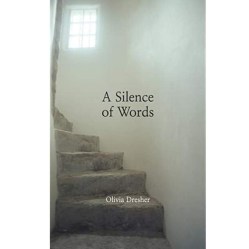 “In A Silence of Words, Olivia Dresher continues to explore her fascination and deft facility with fragments and aphorisms. Taken from their first public home of Twitter, Dresher’s fragments find their way into a reader’s inner consciousness with the intimacy of poetry and the depth of philosophy, offering “Awe, not answers.” If, as she tells us elsewhere, “The mind likes being alone, the heart doesn’t,” this collection delivers at turns solitude and companionship. In the same way that the mind and heart live within one body, so do the nuance and complexity of these short works live within one’s reading experience, each one a gift of presence and existence.”
 The Influence