review by José Angel Araguz

Often I find myself discussing poetry as awkward human utterance, that what we are after as poets is being able to say things in a way only we can say them. In Griselda J Castillo’s chapbook, Blood & Piloncillo (Poxo Publication), this work is done distinctly at the level of word choice and line break. In the poem “Taking Inventory,” for example, we have these opening stanzas:
the garden has two fig trees
a stuttering blackberry bush
i stole from
surprised by the moody jolt
that dripped down my fingers
there’s a short peach tree
a pear with a few years yet
to fruit
lettuces and chard
3 honey bees enthralled
in a yellow squash blossom
What is great about these lines are the way the navigate through the inventory of the title, listing what is in the garden, but also keeping the reader close to what each detailed thing evokes. Narrative and meaning flow out of each line. The speaker’s inventory in the rest of the poem develops naturally into a meditation on trespass; the speaker contemplates not only the abundance of what she finds but also what her human presence means, asking “can i really have it all” at one point, only to end by asking:
or does it come
at the cost
of red ants clamping
their jaws into my feet
a reminder that nothing
in this life is free
On the page these lines move in a way that makes me think of William Carlos Williams – the clarity of image and emphatic, clean phrasing – as well as Gary Soto and Francisco X. Alarcón. These three poets are known for their respective minimalist approaches, working out big ideas via short, intense, concentrated lines. What makes Castillo’s work with the line stand out is her movement from attention to reckoning. In this poem’s ending, the speaker’s question leads not to an answer but to an image of pain. In doing so, the poem remains grounded in human experience and imbues even this last image with the feel of praise.
This rich and complicated relationship with praise can be found in other poems. In “Sardines,” the reader is given a profile of the speaker’s father via a contemplation of food. The poem begins:
headless in oval
tin cans
bobbing in tomato sauce
sardines
remind me
of my dad
five packed blue backs
silver belly to silver belly
tiny collars curved
like his back at the table
or the ends of his
mustache starting to grey
Here, there is a back and forth going on between stanzas, alternating between images of the sardines and memories of the father. What this alternating movement does is compel the reader to enter a space where the two subjects of the poem are blurred in a similar way as they are for the speaker. This blurred feeling is made purposeful and direct in the way the imagery of the third stanza suggests the imagery in the fourth. The poem continues in this way, navigating between memory and description. The result is memory uttered on the page in a way that feels present and immediate.
The poems of Blood & Piloncillo present the attention and reckoning Castillo has paid to her life as a Mexican-American, the intersections of culture and family, womanhood and youth. How this attention and reckoning play out on the page speaks to the nuanced navigating required by survival. The poem “Laundry” (below), is a good example of what I mean. The narrative elegizes someone who has taken their life, but in the complex spirit of praise of this collection, this elegy looks at the life around this loss clearly, uttering the human meaning of what is left, and doing so without flinching.
Laundry – Griselda J Castillo
there is small talk
about the warranty
about the years they’ve
gotten out of them
the expected laundering of words
swirl nervous in our tin mouths
we kept the machines
in the garage until
one broke and we
cut it down
then you hung
yourself up
a wet blanket
on Mother’s Day
someone else
had to cut down
waiting for the load
my sister sits
on the cooler
used as a step
cracks a beer
the same beer
you two drank
to kill time
when you’d be here
washing clothes
*
Influence Question: How would you say this collection reflects your idea of what poetry is/can be?
Griselda J Castillo: We are blessed to live at a time where we can arrive at poetry or create it in many different ways. I am not too preoccupied with what poetry is or can be, but I am definitely enamoured with the fact that it exists. The best poems are the ones that move you and, at a high level, that reflects what poetry is to me and what I think it can do.
Poetry can at once be challenging and complicated and still also beautiful and engaging. It encourages me to dig, to learn by feeling, to get to the root. When I finally started to do the internal work of figuring out where I write from, poetry allowed me the freedom to tackle difficult experiences with reverence. Poetry offered me several opportunities for grace. This collection helped me to examine my life not carefully for answers but with tenderness for meaning. I think poetry help us find meaning.
This chapbook captures moments from the last decade that were impactful to me for many different reasons.
The poems are summaries of lessons in life that either took or gave me lifeblood and morsels of sugar. Separately, the poems work through boundaries I have traversed or let confine me. I’m a first-generation Mexican-American who grew up on the border of Texas and Mexico, so this isn’t surprising. The poems use Spanish words for which I offer no translation and mixed imagery. They contain undercurrents of values I may not immediately relate to but carry within me just by sheer luck of having Mexican heritage. All this to say, they can be difficult to get into. I hope they inspire readers to get to know my culture (and others!) more in order to reach understanding.
They are also imperfect. There’s a bit of an inevitable contained mess in all of them which is another reflection of what poetry is or can be to me. I’m in my 30’s and still learning about myself and life so some clumsiness is bound to comes through. Poetry allows room for that too.
Influence Question: What were the challenges in writing these poems and how did you work through them?
Griselda J Castillo: The biggest challenge was writing about my family. They are all still alive and some of the topics are still raw. My brother-in-law’s suicide was never really talked about. We don’t talk about our support for immigrants freely. Subjects of infidelity, love, and homesickness are treated coolly. In a way, building this collection of poems helped me to understand the intensity of these moments and how they shaped me. I had to deal with them somewhere.
The poem “Sardines” is about my dad who, after having heard it, will never attend one of my readings! There’s no bad blood between us, but I know I crossed a boundary. My sister won’t attend a reading because of the poem “Laundry.” And she LIKES the poem! They don’t enjoy being exposed. Who would?! So, that was a new and interesting thing poetry taught me. I saw how it affected my immediate family and the poems showed them how they affected me. I hope despite all that they are still proud.
The only way I knew how to overcome this challenge was to do the work. To actually do the physical, mental, and emotional labor and make the poems. But, getting to the desk was also the hardest thing for me to do. It took so long to refine these and get them out into the world. I write for a living and sometimes there was just no more energy in me. I wish I had the stamina, concentration, and resources to have a higher output and write more.
*
Special thanks to Griselda J Castillo for participating! To purchase a copy of Blood & Piloncillo, please contact the author directly at: griseldajcastillo@gmail.com
 Griselda J Castillo is a bilingual poet and creative nonfiction writer from Laredo, Texas. She is the daughter of Mexican immigrants, a first-generation American, and explores her bicultural identity through poems and stories. Her work is featured in Ocotillo Review, Chachalaca Review, and Sparkle + Blink. She also performs her poetry as part of a improvisational art and jazz collective. She received the 2018 Premio for Best Poetry Book from the National Alliance for Chicana and Chicano Studies Tejas Foco for her first poetry collection, Blood & Pilloncillo.
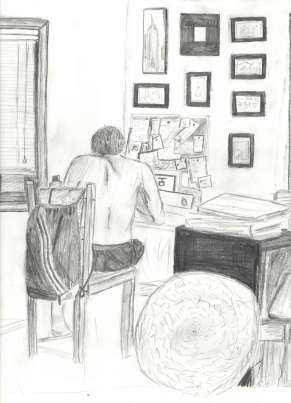 The pencil sketch of me at my desk was done a few years ago by my wife. What is shown in it points to the thread between the various where’s as well as the how and when. There is a particular engrossment that I fall into when I’m writing, and it is the source of a lot calm and excitement at the same time. In the sketch, I am at my present desk, a mess of notes on my corkboard, stacks of papers at my side. These are expected details, in a way, part of the writer-hamster wheel.
 The Influence